

Yen strengthens after Japan intervenes to support currency for first time since 1998
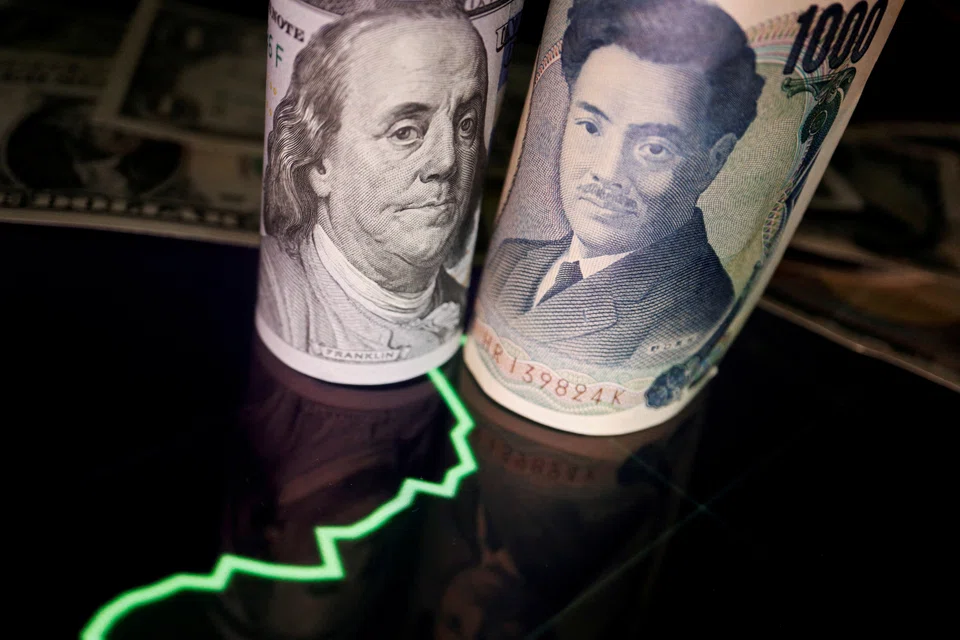
THE Japanese yen strengthened on Thursday (Sep 22) after authorities intervened in the foreign exchange market to shore up the battered currency for the first time since 1998, although trading was choppy.
The US dollar was last down 1.17 per cent at 142.42 yen. It hit a low of 140.31 after the intervention, having earlier reached a fresh 24-year peak of 145.9 yen.
The spread between the day’s high and low for the pair was the widest since June 2016.
The euro, Australian dollar and pound also plunged against the Japanese currency, before regaining a little ground.
“We have taken decisive action,” Vice Finance Minister for International Affairs Masato Kanda told reporters, responding in the affirmative when asked if that meant intervention.
Confirmation of the intervention came hours after Bank of Japan (BOJ) decided to maintain low interest rates to support the country’s fragile economic recovery.
BOJ governor Haruhiko Kuroda told reporters the central bank could hold off on hiking rates or changing its dovish policy guidance for years.
In contrast, central banks around the world, most notably the US Federal Reserve (Fed), are raising rates aggressively and the policy divergence has weighed on the yen.
“Unless there is a clear shift in the fundamental backdrop driving Japanese yen weaker, the ability to turn the trend is limited,” said Derek Halpenny, head of global markets research at MUFG.
“The Ministry of Finance may see this as buying some time and hope that the Fed completes its tightening cycle by year-end, which may help to bring some degree of turn in the trend.”
Even after Thursday’s moves, the US dollar is still up 23.4 per cent against the yen this year.
In what is proving a very busy day for markets, the US dollar earlier hit multi-year highs after the Federal Reserve surprised markets with hawkish interest-rate projections.
The US dollar index - which measures the greenback against a basket of 6 other major currencies - rose as high as 111.81 for the first time since mid-2002.
The euro weakened to a new 20-year trough of US$0.9807 and sterling fell to a fresh 37-year low of US$1.1213.
Both made up a little ground in London trading, and with the stronger yen, the US dollar index was last down 0.3 per cent at 110.95.
The Bank of England is due to announce its latest rate decision and the market currently sees around an 85 per cent chance of a 75 bps rate hike, and 15 per cent of a half point increase.
On Wednesday, the Fed issued new projections showing rates peaking at 4.6 per cent next year with no cuts until 2024. It raised its target interest rate range by another 75 basis points (bps) overnight to 3 per cent-3.25 per cent, as was widely expected.
The US dollar was already supported by demand for safe-haven assets after Russian President Vladimir Putin announced he would call up reservists to fight in Ukraine and said Moscow would respond with the might of all its vast arsenal if the West pursued what he called its “nuclear blackmail” over the conflict there.
Separately the Swiss franc tumbled after the central bank raised rates by 75 basis points.
The US dollar and euro both climbed more than 1 per cent against the franc, with the US dollar last at 0.9798 and the euro at 0.974.
The Swiss National Bank raised its policy interest rate to 0.5 per cent from the minus 0.25 per cent level it set in June - only the second increase in 15 years.
“I think the outsized reaction in EUR/CHF was down to the view that SNB could do 100 basis points, following (Sweden’s) Riksbank earlier this week. I think the market reaction, the EUR/CHF rally, is a bit overdone,” said Chris Turner, global head of markets at ING. REUTERS
Decoding Asia newsletter: your guide to navigating Asia in a new global order. Sign up here to get Decoding Asia newsletter. Delivered to your inbox. Free.
Share with us your feedback on BT's products and services
TRENDING NOW

World’s largest offshore wind platform by Seatrium consortium on track to be completed by 2028

Is stamp collecting enjoying an analogue revival or are its best days over?

GovTech retrenches another 38 staff in second round of layoffs

MBS adjusted property Ebitda falls 20.6% in Q3 with fewer high-roller visits, weaker hold

