

Banks power Singapore stocks higher on Tuesday; STI up 1.4%
The iEdge Singapore Next 50 Index advances 0.6% to 1,445.35

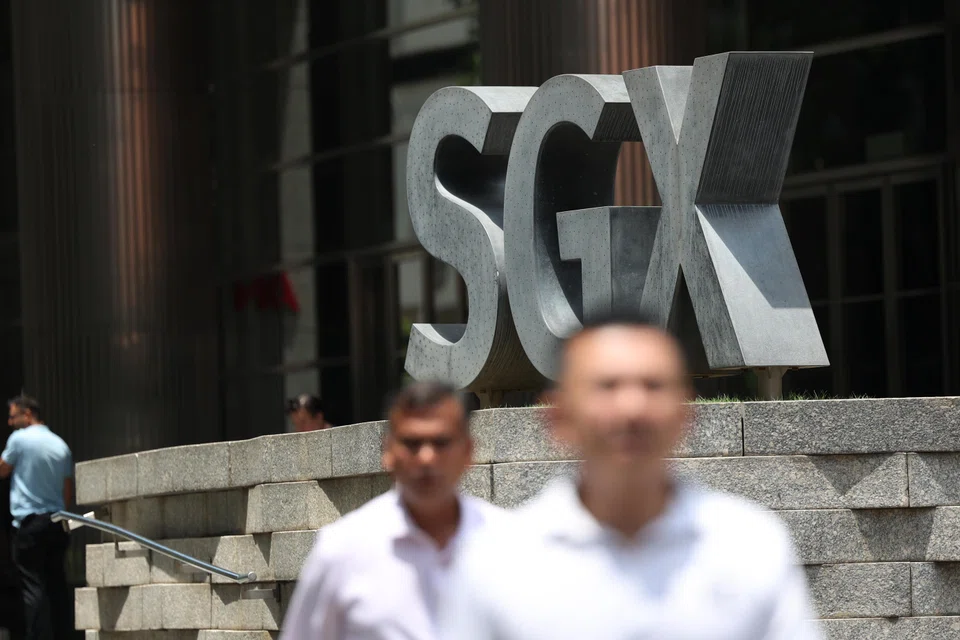
[SINGAPORE] Singapore stocks ended higher on Tuesday (Mar 17), lifted by gains in all three local banks.
The benchmark Straits Times Index (STI) rose 1.4 per cent or 67.28 points to close at 4,935.97. The iEdge Singapore Next 50 Index advanced as well, by 0.6 per cent or 9.3 points to 1,445.35.
Across the broader market, gainers outnumbered losers 400 to 212, with 1.5 billion securities worth S$2 billion having changed hands.
Regional markets were mostly higher. Hong Kong’s Hang Seng Index edged up 0.1 per cent, South Korea’s Kospi rose 1.6 per cent, and Malaysia’s FTSE Bursa Malaysia KLCI gained 0.9 per cent. Japan’s Nikkei 225 slipped 0.1 per cent.
On the STI, Singtel led the gainers, rising 2.6 per cent or S$0.13 to S$5.17. Thai Beverage was the worst performer, easing 1.1 per cent or S$0.005 to S$0.44.
All three local banks ended the session higher. DBS gained 2 per cent or S$1.10 to S$57.08; OCBC rose 1.7 per cent or S$0.35 to S$21.10, and UOB advanced 1.5 per cent or S$0.53 to S$36.88.
Among components of the iEdge Singapore Next 50 Index, Hong Leong Asia was the top gainer, climbing 6.2 per cent or S$0.17 to S$2.92. Geo Energy Resources was the biggest loser, falling 6.5 per cent or S$0.035 to S$0.50.
Separately on Tuesday, Singapore reported that non-oil domestic exports grew 4 per cent year on year, slowing from the previous month’s 9.2 per cent expansion.
Overall, the Republic’s key exports rose 6.7 per cent year on year in January and February combined, up from 2.3 per cent in the same period the year before.
“We turn cautious on Singapore’s trade performance in the coming months, given ongoing geopolitical noise and tariff-related external risk,” wrote RHB group chief economist and head of market research Barnabas Gan in a Tuesday note.
“We view that Singapore’s growth and trade will be negatively impacted should the Middle East tensions exacerbate in the first half of 2026; separately, we are also cognisant of tariff-related risks,” he added.
Decoding Asia newsletter: your guide to navigating Asia in a new global order. Sign up here to get Decoding Asia newsletter. Delivered to your inbox. Free.
Copyright SPH Media. All rights reserved.
TRENDING NOW
Malaysian king buys stake in Singapore-listed mining firm expanding into rare earths

Grab CEO’s wife Chloe Tong on life with Anthony Tan and finding her purpose

Once staunchly pro-China, Malaysian Chinese businesses are now distancing themselves from Beijing
Longer wait times expected as S’pore healthcare institutions report system disruptions

