Barramundi Asia mulls IPO amid scale-up plans
Singapore-based company hungry for capital as it strives to realise its vision of becoming the leading player in barramundi farming.

Claudia Chong
BARRAMUNDI Asia started off in 2008 with the aim of making a splash in the fish-farming industry, even as the infrastructure and support available in Singapore were still in their nascent stages of development at the time.
Today, it operates one of the largest barramundi farms in Singapore and Australia and has set its sights on growing further. The Singapore-based company is mulling over an initial public offering (IPO) as it looks to scale production to 50,000 tonnes by 2030.
Barramundi Asia, which last week announced it is acquiring fish genetics startup Allegro Aqua for an undisclosed amount, said that discussions are still "exploratory" but that the Singapore Exchange (SGX) and a Nordic exchange are potential listing avenues.
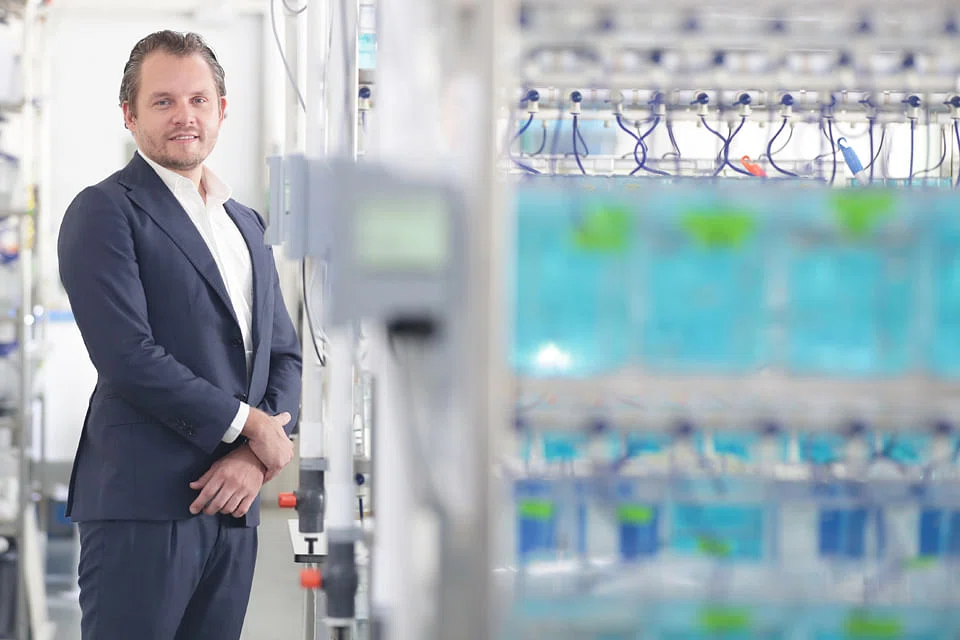
CEO Andreas von Scholten tells The Business Times: "To realise the vision (of Barramundi Asia becoming the leading player in barramundi farming), we're going to need capital. Whether that's from an IPO, industry partners or investors, I think it's too early to say . . . We do have ideas for an IPO, but I wouldn't say it's confirmed."
Barramundi Asia operates a 1,343-hectare farm site - about the size of 1,881 football fields - along the Northern Australian coastlines of the Kimberley (Buccaneer Archipelago). In Singapore, it operates a 30-hectare farm site off the Southern Isles.
The group, which says it is on track to produce over 11,000 tonnes of fish by 2023, is in the midst of developing its largest site yet - in Brunei's Nankivell Offshore Aquaculture Site. Spanning 6,600 hectares in total, the site is expected to produce 36,000 tonnes of fish a year at its peak by 2032, valued at S$324 million. About S$300 million will be invested into developing the site.
Mr von Scholten says global aquaculture players have favoured bourses that are familiar with aquaculture, as well as marine food and packaged goods. The company recently had talks with a Nordic exchange.
"However, the overwhelming growth in aquaculture for the future is still here in Asia. Singapore, as an international financial hub, and with proximity to our key business activities in Brunei, Australia and our local R&D and grow-out sites, also makes the SGX a strong contender," he says.
Barramundi Asia recorded revenue of more than S$20 million in 2019. It is not yet profitable, which Mr von Scholten says is due to the group being in "a very capital-intensive phase of (its) growth plan".
In general, a company seeking to list on SGX's mainboard must be profitable (before taxes) and have an operating track record of at least three years. Alternatively, a company could also show that it has generated operating revenue, and is seeking an estimated market capitalisation of S$300 million and above.
SGX does not impose any minimum quantitative criteria for Catalist listings - sponsors will use their own house deal selection criteria.
"Secret sauce"
Mr von Scholten reckons that a laser focus on science and technology, coupled with sustainable farming practices and a strong brand, will be the firm's "secret sauce" to making barramundi the "salmon of the tropics". (For comparison, salmon-farming is currently a 2.4 million tonne-a-year industry, while barramundi-farming is a 80,000 tonne one.)
Besides the development of the site in Brunei, the company last year announced a S$2 million extension to its Recirculating Aquaculture System nursery in Singapore. The system allows water from the fish tanks to be treated and re-circulated, leading to more efficient use of resources and better water quality control.
Upgrading of plant and equipment at Barramundi Asia's grow-out sites - including for automation and feed-monitoring technology - is also heavily in the works. The firm has also invested in solar panels at its Singapore farms to keep energy costs in check.
The company has also explored inorganic growth. It is acquiring Allegro Aqua, a startup set up in 2018 to commercialise an elite strain of the Asian sea bass called the St John's Sea Bass.
The sea bass represents over 15 years of research in genetic selection and mass cross-breeding, and can be bred in 30 per cent less time, is less susceptible to diseases, and is meant to be more nutritious and tasty.
Allegro Aqua's majority shareholder Temasek Life Sciences Group will become a "significant shareholder" of Barramundi Asia post-acquisition. Singapore-based F&B investment firm Commonwealth Capital, whose portfolio includes PastaMania and The Soup Spoon, is a "significant minority" shareholder of Barramundi Asia, while other investors include funds, family offices, institutional investors, European investors and private individuals.
Allegro Aqua will work closely with the Temasek Life Sciences Laboratory and Barramundi Asia's subsidiary UVAXX to develop vaccinated barramundi fingerlings.
"You need to set your fish up for success from a very early stage, with giving them the best genes, and then the best TLC (tender loving care)," says Mr von Scholten. "That's why it's about water control, temperature control, about constant nurturing and caring for the fish, especially when they are quite small. And that's when both genetics and vaccines come in."
UVAXX was founded by Barramundi Asia in 2012 to provide custom autogenous vaccines and fish health monitoring support for the company. To date, it has six autogenous vaccines approved by the Agri-Food and Veterinary Authority for the protection of Barramundi Asia's fish, and another two undergoing the approval process. It has also begun to develop vaccines for two large international aquaculture firms.
Once Barramundi Asia begins supplying vaccinated and improved barramundi fingerlings to farmers, it can potentially couple it with a buyback programme for when the fish are ready to harvest, says Mr von Scholten. Farmers would have to adhere to certain farming standards.
With this, production can potentially increase by up to 25 per cent, though there are many factors that can affect this estimated figure, such as the specifications of the farming sites, water flow and stocking densities.
Barramundi Asia is also looking to give a boost to its end-to-end value chain. It is set to announce another acquisition in the coming weeks, this time of a company "further downstream" in the value chain instead of one in the farming business.
Fish produced by the company is marketed under its Kühlbarra brand. Australia is its largest market to date, and almost all the fish produced at the site in the Kimberley is sold to the Australian market. The group is also supplying fish to Hong Kong, China, South Korea, Thailand and the US.
As it prepares for further growth, Barramundi Asia appears to have gone through a restructuring of its management team. Mr von Scholten has been in his newly-minted role of CEO since November 2019. Prior to joining the company, he was general manager (Asia-Pacific) of PHARMAQ, a group that creates vaccines and health products for aquaculture.
Barramundi Asia was previously headed by its managing director and co-founder Joep Staarman, who is now director of sustainability. Mr Staarman was previously with Norwegian company Marine Harvest, a global heavyweight in the seafood industry.
Other recent appointments include chief financial officer (CFO) Helen Chow, who was CFO of fish farming operation Marine Produce Australia (MPA). MPA was acquired by Barramundi Asia in 2018. Chief marketing officer James Kwan joined the firm in Dec 2019, moving over from Commonwealth Capital, where he was also involved in the inception of the Kühlbarra brand.
Barramundi Asia now counts 180 staff across all its business units and countries. Mr von Scholten says that as the firm looks to grow rapidly, it will have its years of experience in fish farming as a competitive edge.
He says: "Whenever we have somebody coming out and visiting our farm, they're amazed with the level of expertise, know-how and technology that goes into farming of fish.
"When we're presenting our four to five kilogram fish to a consumer or partner, it's not only been two years in the making. This is the result of decades of hard work and research to bring that beautiful fish to the table."
TRENDING NOW
MAS allocates S$1.45 billion to five asset managers in third EQDP batch: Chee Hong Tat
‘My grandfather’s legacy’: Sherman Kwek lays out three-year plan for CDL to drive returns
He built the Vingroup empire. Now South-east Asia’s richest man is handing some key roles to his sons
‘How many will survive?’: Bubble fears arise as China’s humanoid robotics face reality check