Bearish outlook on H-Shares Index Futures contract amid renewed Fed hawkishness
 Add BT as a preferred source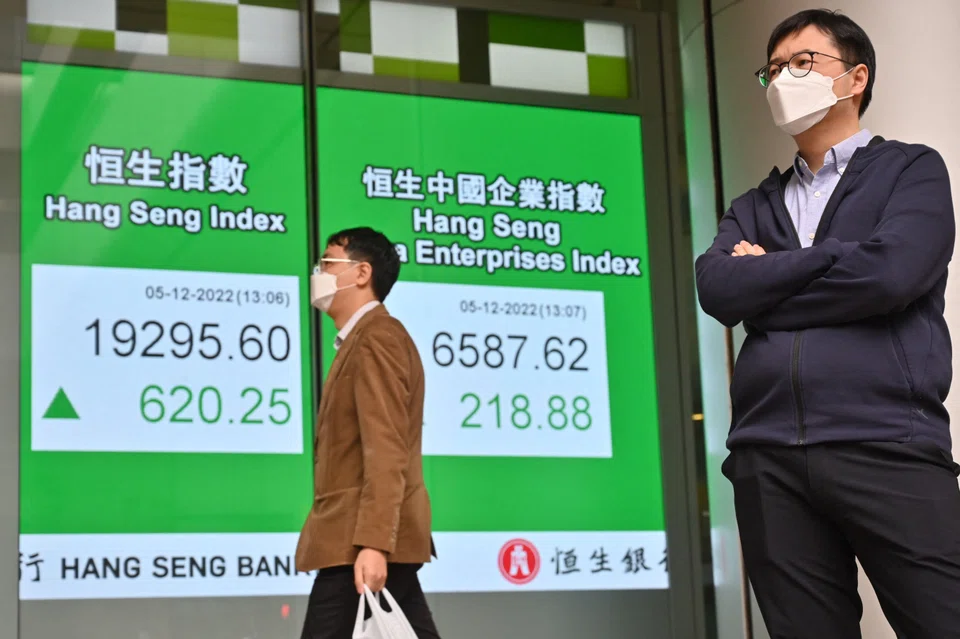
DeeperDive is a beta AI feature. Refer to full articles for the facts.
THE H-Shares Index, also known as the Hang Seng China Enterprises Index, serves as a benchmark that reflects the performance of Hong Kong dollar-denominated mainland Chinese stocks traded in Hong Kong. After an uptrend sustained since November 2022, the H-shares Index Futures contract fell by around -15 per cent from its Jan 30 peak at the end of February, as uncertainty over China’s reopening and rising US-China tensions caused by an alleged spy balloon sent by the Chinese further dampened investor sentiment.
The contract jumped by 5.02 per cent on Mar 1 after economic data showed China’s manufacturing sector activity expanded at its fastest pace in over a decade, with the February manufacturing PMI unexpectedly coming in at 52.6, up from 50.1 in January. The service sector activity also jumped as the non-manufacturing PMI accelerated from 54.4 to 56.3 in February.
However, gains have been muted since as investor optimism dipped on growth concerns, a more hawkish Fed, and persistent US-China tensions, culminating in a decline of 3 per cent on Mar 8. The contract was last at 6,656 as at market close on Mar 9, having broken below the 200-day moving average trend line of around 6,700.
Weighing on the index was China’s surprisingly conservative GDP growth target of around 5 per cent at the annual “Two Sessions” meeting of its National People’s Congress on Mar 5. This was below market expectations, suggesting that additional stimulus is unlikely. Market sentiment was also impacted by a lack of major catalysts from the twin sessions.
US Fed chair Jerome Powell’s recent hawkish rhetoric also increased the risk of a larger 50bps hike at this month’s policy meeting. The Fed chair said that the central bank is likely to lift interest rates higher and faster than previously anticipated. Higher rates will impact the Hong Kong dollar, which is pegged to the US dollar, increasing the risk of capital outflows, leading to slower growth.
On a macro level, we analyse China’s “Dual Circulation” economic strategy, which involves the domestic market (or internal circulation), as well as the export-oriented market (external circulation).
Navigate Asia in
a new global order
Get the insights delivered to your inbox.
The external environment remains difficult as recent data releases show that external circulation contracted, with exports down by 6.8 per cent year on year in February 2023, while imports shrank by 10.2 per cent year on year.
Tensions between US and China are also unlikely to subside anytime soon, with the Biden administration implementing export controls and sanctions, potentially worsening the outlook for the Chinese tech sector. Other nations could also join in the fray as the Netherlands reportedly plans to restrict the exports of DUV (deep ultraviolet) lithography machines, vital for producing advanced chips. A potential ban on US investments in the Chinese tech sector that is being considered by the Biden administration could also dampen China’s economic recovery further.
Regulatory risks have also resurfaced due to the sudden disappearance of high-profile dealmaker Bao Fan, which could signal further regulatory crackdowns on China’s finance industry.
On the domestic front, we believe consumption (domestic) will take time to recover. Data from the National Bureau of Statistics of China showed that the Consumer Confidence Index remained historically low at 91.2 in January 2023. Compared to a reading of 123.7 in January 2019, this signals that it could take some time for consumer sentiment and spending to return to pre-pandemic peak levels. Consumers are also hesitant to invest in the property market amid a housing slump.
In conclusion, China’s recovery will be slower than expected. We hold a bearish outlook on the H-Shares Index Futures contract in Q2 2023 amid renewed Fed hawkishness and a difficult external environment.
From a technical perspective, we maintain a bearish view on the H-Shares Index Futures contract in Q2. An emerging head and shoulders pattern can be seen since Dec 5, 2022. It is a bearish reversal chart pattern that occurs after an uptrend as bullish momentum weakens. Once prices break below the neckline level of 6,590, a technical target as high as the depth of the “head” should be set. Pattern confirmation would involve a close below the neckline. We are bearish for two main reasons:
1. The Relative Strength Index (RSI) supports the bearish outlook. It is a momentum indicator which suggests overbought conditions when it is above 70, and oversold when it is below 30. A reading below the neutral line of 50 hints at a bearish momentum. As at market close on Mar 9, the RSI is hovering at 38, pointing to bearish momentum.
2. The Moving Average Convergence Divergence indicator (MACD) also validates our bearish view by showing a bearish crossover signal as the MACD line is currently below the signal line. The MACD histogram is also in negative territory, signalling bearish momentum.
We expect the H-Shares Index Futures contract to head further downwards in Q2 and test the head and shoulders neckline support level at around 6,590 (S1) which, if broken through, could see the contract head further downwards towards the technical target of 5,420 (S3).
Nevertheless, we believe there could be a more sustainable recovery in H2 2023. With the February Consumer Price Index for China coming in lower than expected at one per cent, down from 2.1 per cent in January, a combination of low inflation and excessive savings build-up in households should fuel domestic consumption.
We expect the H-Shares Index Futures contract to face downward pressure and test our technical target at 5,420 (S3) in Q2 before recovering in H2 2023. Recovery will take time to materialise as consumer confidence remains low, and potential Fed tightening limits upside potential.
The writer is strategist at Phillip Nova
Decoding Asia newsletter: your guide to navigating Asia in a new global order. Sign up here to get Decoding Asia newsletter. Delivered to your inbox. Free.
Copyright SPH Media. All rights reserved.