Best, but not necessarily the biggest: Piyush Gupta on DBS’ transformation 

Outgoing CEO talks about working across teams, being data-driven and having a purpose 

Summarise
Lee Su Shyan
Published Wed, Mar 26, 2025 · 08:50 PM
    • Gupta says: "DBS now has a culture where individuals are more accountable and willing to take decisions."
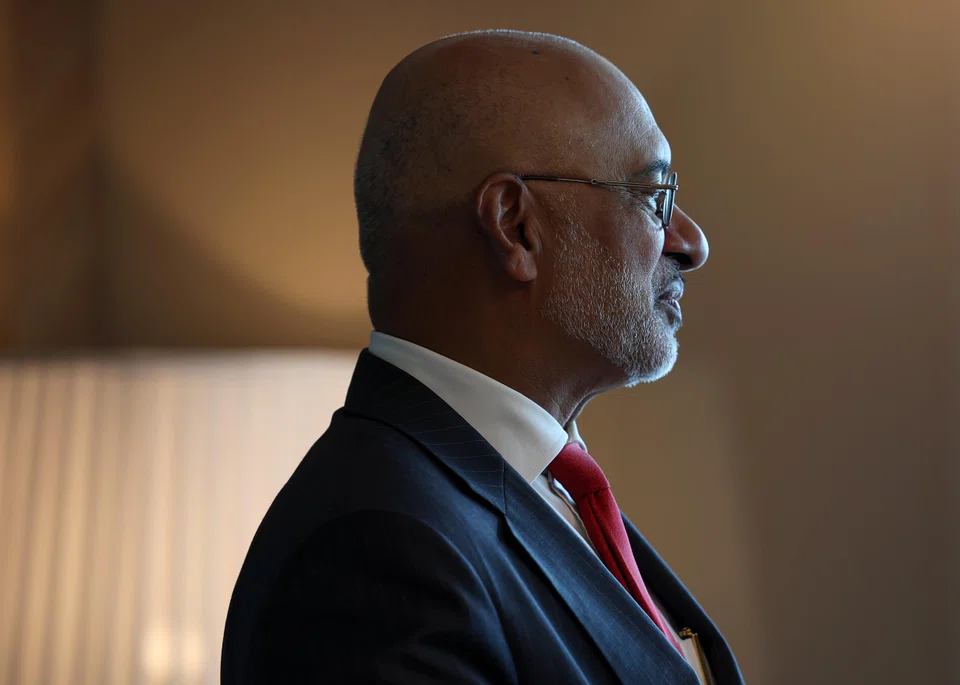
    • Gupta says: "DBS now has a culture where individuals are more accountable and willing to take decisions." PHOTO: YEN MENG JIIN, BT

    [SINGAPORE] When DBS in 2015 set its sights on being recognised as the world’s best bank, there was scepticism within the management ranks. In terms of the size of assets, DBS was not within spitting distance of the world’s top 10 banks and still is not. It is the largest in South-east Asia though.

    Interactive: DBS’ key milestones under CEO Piyush Gupta

    But as its chief executive Piyush Gupta pointed out: “Changi has been named the best airport in the world. Singapore Airlines is not the biggest airline, but is the best airline in the world. Big doesn’t necessarily mean best.” 

    Gupta started at DBS when he was 50. As he ends his 15-year run at the helm, he can look back at a long list of the bank’s accolades and achievements and a success story that has been profiled in various case studies by the likes of Harvard Business School and consulting firm McKinsey. 

    There have been awards galore including “World’s Best Bank” by Global Finance in 2018, “World’s Best Bank” by Euromoney and “Global Bank of the Year” by The Banker, just to name a few. 

    The numbers speak for themselves. In 2009, DBS’ market capitalisation stood at S$35 billion. It is now a staggering S$132 billion. Return on equity (ROE), a measure of how efficiently it is using shareholders’ funds, has gone from 8.4 per cent, when it lagged its peers, to outpacing them at 18 per cent. Net profit has grown five times, from S$2.1 billion to S$11.4 billion. And the list goes on. 

    Perhaps it starts off with having a clear vision. Gupta told The Business Times that he presented a PowerPoint deck with “eight, nine” slides to the board as he was trying to land the job.  

    In 2009, it was an inauspicious time to join though. Five CEOs had come and gone in the past decade. 

    As he began work at DBS, he realised: “We were trying to run a multi-country multinational bank with the infrastructure which was suited to a single-country organisation.” There were disparate policies across markets and across businesses such that an identical credit application could get approved in Hong Kong but rejected at home.  

    Successful strategies with a touch of luck  

    Long-term vision is all very well, Gupta noted, but it was important to deliver results in the short term too. “We got lucky, and we started seeing results very quickly.”

    One success story was expanding its China franchise just as the market started to open up. “How do you bank 1,000 companies in China? That was our strategy.”

    DBS’ trade finance book went from S$6 billion to S$60 billion between 2010 and 2012, a whopping 10 times growth as the renminbi internationalised. 

    Another area was turning around the underperformance of the Singapore home market. Management improved the loan-deposit ratio, regained market share in mortgage and unsecured lending. It also became a leader in the bancassurance market.

    Yet another key priority was to grow the wealth management business, which brought in a handsome 23 per cent of DBS’ income at the last count. 

    Back in 2009, DBS’ private bank was a low-key business that few knew about. Gupta joked that it resembled Fort Knox in that it mostly took in fixed deposits.

    Wealth management was a small contributor to the group’s bottom line. But for the CEO, the idea of a wealth continuum – serving wealthy clients from the affluent category to the ultra-high-net-worth segment seamlessly – posed an exciting opportunity for DBS. He said: “We figured that these segments had very high growth potential in Asia.” 

    With the idea that this was a chance for DBS to stake its claim to the wealth management business, he persuaded Tan Su Shan from Citi to join DBS and develop the business.

    Doing banking like a tech firm  

    Breakdowns and outages notwithstanding, DBS remains at the forefront of digital banking with its various apps, including DBS digibank, PayLah! and iWealth. Over the years, it has revamped its tech architecture, become more data-driven and transformed its culture to be more startup-like.

    It is no surprise that with Gupta’s background in technology and operations, he turned to technology to scale up and reinvent DBS. But this was also against a backdrop where mega merger and acquisition deals were unlikely to happen, given the various political sensitivities and regulatory environment. 

    There was huge growth potential in the big markets of India and Indonesia, but costs were also high to expand there physically. Meanwhile, fintechs were springing up everywhere.   

    But there was an “aha” moment when he met Alibaba’s Jack Ma, who was developing Alipay and seeing banking in a completely different light. 

    Gupta said: “We told ourselves that this was only the shackles in our own mind. We could do banking like a tech company does banking.” 

    In 2014, DBS announced plans to invest S$200 million over three years to better harness digital technologies. This was on top of the S$1 billion the bank had invested in strategic technology initiatives at the time. 

    According to Gupta, the board said: “Okay, S$200 million, to accelerate our digital transformation. But your financial metrics like cost-income ratio – that will deteriorate.” It added: “Don’t worry about it. We will give you air cover, because you need to invest if you’re going to get there.”

    With the new technology coming in at a fraction of the price of the existing technology, DBS started seeing payback from its efforts earlier than expected. 

    Long-term stability 

    A strong and supportive board and a stable, large shareholder are one theme that underlines the DBS success story. 

    Director Peter Seah became chairman in 2010, not long after Gupta joined. Both had cut their banking teeth at Citi. “Both of us have the same banking instincts (on taking) the appropriate amount of risk and reward. Our styles of banking resonated with each other,” said Gupta. 

    DBS also benefited from having a strong anchor shareholder in state investment firm Temasek with its 30 per cent stake. 

    Agile and data-driven culture 

    CEOs often cite the importance of people, but nowhere has the transformation been more apparent than at DBS with its 41,000 strong workforce.

    “Internally focused and policy-driven, that was the DBS of old, with decisions that went up to committees,” recalled Gupta. 

    The biggest change since then? He said: “We’ve tried to move away from vertical management and silos to horizontal management. We’ve got 60 ‘journeys’, where people from different teams, including business, operations, (and) technology, participate and work together.”

    DBS is also massively data-driven now. “People are looking at live data, live transactions the entire time. We plug in artificial intelligence and experimentation too.” That gives the bank nimbleness, Gupta noted. 

    “DBS now has a culture where individuals are more accountable and willing to take decisions,” he added.

    He pointed to the appointment of Tan as the bank’s next CEO as a sign of the strength of the management bench. The vacancies that have opened up as a result of her promotion have also been filled by internal people. 

    Teams are continuously innovating, within bounds, of course. Gupta calls it “a hundred flowers blooming”.

    “In the last few years, I’ve been focused on making sure that we’ve not only emedded a way of working which outlasts me, but also built a team which outlasts me.”

    Companies with a sense of purpose 

    People who have met Gupta know that he is not only an erudite CEO, but also a thinker, equally comfortable with giving his view on geopolitics as with speaking about technology and banking challenges. 

    Another area he is passionate about is companies giving back to society. He takes issue with comments that businesses support social causes only for their self-interest.

    Gupta said: “A company inherits rights and responsibilities. As a people’s bank and heartland bank, if we had only focused on money, we wouldn’t have served certain segments, such as the migrant worker, and we could have raised our ROE by one to two percentage points.”

    In 2014, DBS set aside S$50 million to establish the DBS Foundation. Last year, DBS committed up to S$1 billion – S$100 million each year – over the next decade and pledged 1.5 million employee volunteer hours to support vulnerable communities.

    He added: “If we want DBS and POSB to be successful and thriving in 2030, 2040, and we do not have the support of the people nor strong brand resonance, we would face a much more difficult time in the future. To be around for the long term, people must believe that you have a right to exist.”

    Interactive: DBS’ key milestones under CEO Piyush Gupta