Boustead Singapore looks ahead following re-merger with Boustead Projects

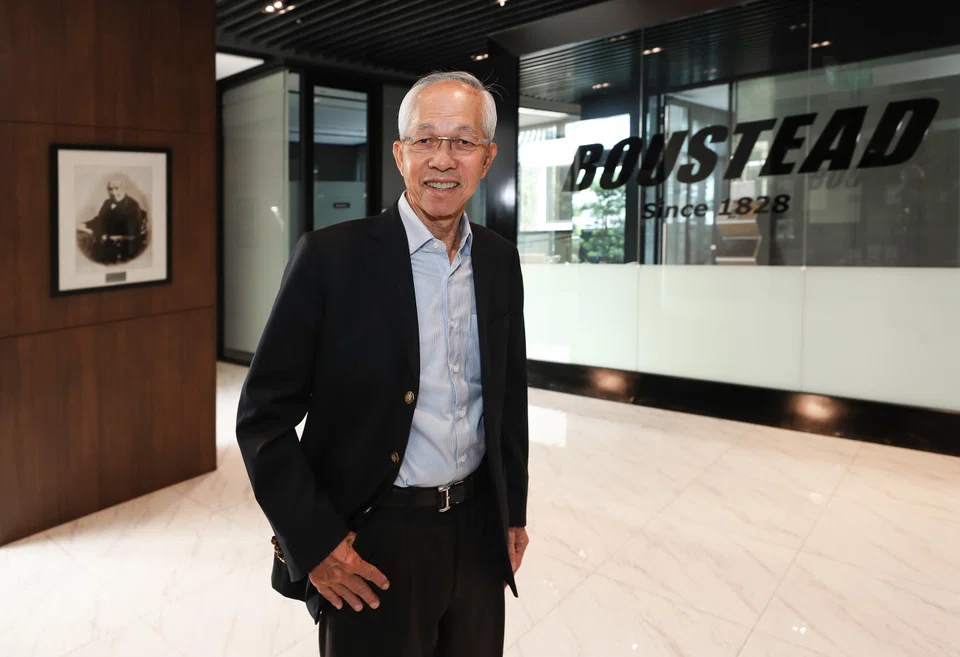
BOUSTEAD Singapore’s group chief executive officer Wong Fong Fui is known for being able to turn around businesses and actively make deals for the conglomerate.
But the company’s bid last year to privatise its subsidiary Boustead Projects was met with pushback from segments of the market amid views that the original offer price undervalued the property player.
“I think it was pretty misunderstood,” Wong told The Business Times in an interview.
He noted that the conglomerate had been acting in accordance with the majority’s interest in the deal, given that both companies had a significant overlap in their shareholder base of around 90 per cent.
Difficult deal
Wong highlighted that Boustead Projects was listed in 2015 through a distribution in specie from Boustead Singapore, with no capital raised from shareholders.
The rationale for listing a separate entity was to allow Boustead Projects to raise capital without having to obtain monies from shareholders of Boustead Singapore.
But the company later found out that it did not need such a mechanism.
“We found out that we… managed to attract other big funds to come in,” Wong said, noting that there were investors in the Boustead Industrial Fund, which functioned like a private real estate investment trust.
“That helped us to raise capital for us to embark on a bigger project.”
With the funds available from private investors, the purpose of listing Boustead Projects as a separate company came into question.
“We’re thinking, then, what’s the point of having two listed companies?” Wong said, adding that this also brought about liquidity concerns, as institutional investors were less likely to invest in small-cap stocks.
“True enough, liquidity was a big problem for both (entities), so we felt... a re-merger” was for the best, he said.
Last year, Boustead Singapore launched a voluntary unconditional offer to acquire all the shares in Boustead Projects – with the exception of those it or its concert parties already owned – at an initial offer price of S$0.90 apiece.
At the time, Boustead Singapore and Wong already held more than 70 per cent of the shares in Boustead Projects.
The price was later bumped up to a final offer of S$0.95 per share, but market watchers – including the Securities Investors Association (Singapore) – said the discount to asset value was too large to ignore.
The independent financial adviser, PrimePartners Corporate Finance, ruled that the offer was “not fair but reasonable”, as it was not within its final estimated valuation range of between S$1.17 and S$1.38 per share.
Boustead Projects lost its free float after the offer closed, leading to a trading suspension. This was followed by a period of limbo as the counter was caught between two sets of rules.
On the one hand, it was required to restore its free float under the Singapore Exchange Listing Rules. On the other hand, it was not allowed to make another offer that was better than the first within a period of six months, under the Singapore Code on Takeovers and Mergers.
Wong noted that the company was law-abiding and played by the rules.
After six months, an exit offer was made, with a price of S$1.18 per share. The offer was also extended to interested parties, including Wong, his son Yu Wei and daughter Patricia Huang. This was subject to shareholder approval.
Wong acknowledged that some shareholders who surrendered their shares at the offer price of S$0.95 apiece may have been unhappy, but vote results showed that this dissatisfaction was not widespread.
The “test case” was when the issue came before shareholders for their approval, he said. “If that many shareholders disagreed, then the percentage would reflect it.”
However, more than 91 per cent of votes had been in favour of acquiring the shares from related parties.
Wong noted he had to serve the interest of the majority, and that getting the higher price himself was not something he had anticipated.
“How could I (have known) that, actually, I would end up getting S$1.18? I didn’t. I feel that it is ridiculous, actually, to be honest,” he said.
He noted that in the market, investors would have been able to buy Boustead Project shares at S$0.80 apiece, but he “paid a premium at S$0.90, S$0.95 maximum”. “I refused to go further – I did put my foot down.”
Despite what the majority of shareholders felt towards the exit offer, Wong believes the market price of S$0.80 would have made more sense. He would have accepted it as well, he said, if everyone else could have also done so.
Looking ahead
With the privatisation completed, Wong is looking ahead. Boustead Singapore’s key businesses include energy engineering, geospatial technology, real estate and healthcare.
Wong noted that the oil industry has been facing changes due to the focus on cleaner sources, but the industry will not go away.
“It might be downsized, it would certainly need a lot of improvements in terms of efficiency, in terms of emissions.” But, he added, there was still money to be made even in a shrinking market.
“We will continue to do well in this area, but we are not going to expand it for the sake of expanding, because the market is shrinking,” he said.
Its geospatial business, on the other hand, is growing for Boustead Singapore.
The company is the exclusive distributor of Esri’s ArcGIS technology – a leading geographic information system smart mapping and location analytics platform – in major Asia-Pacific markets such as Australia, Singapore, Malaysia and Indonesia.
Users of the system are mainly governments, but Wong noted that the technology has also been used for other purposes such as insurance and logistics in other markets.
“In Indonesia, (we’re beginning) to see some applications into the private sector, such as mining and utilities.”
He added: “There’s no question that it will continue to grow for many more years. There is no replacement in the foreseeable future.”
Boustead Singapore also has a healthcare arm, where Wong is acting CEO.
“I feel that healthcare is a sunrise industry,” he said, noting the ageing population trend. “As people age, they would need help to still be able to be productive both physically and mentally.”
Legacy
Even as he turns 80, Wong remains active on the golf course and still takes long walks regularly.
But succession planning for Boustead Singapore is also something he has considered.
“I’ve been asked this question for the longest time, at least 15 years already,” he said.
He noted that his son Yu Wei had already assumed leadership of Boustead Projects as executive deputy chairman.
Meanwhile, his older son, Yu Loon, has experience running Boustead Singapore’s other businesses, such as Esri as well as energy engineering, and is deputy group CEO.
“Literally, I can say if I were to kick the bucket today, the business will continue to run,” Wong said.
Over the years, some have also questioned the rationale for keeping Boustead Singapore listed, considering that it has never raised additional capital. However, Wong believes that there are merits to remaining listed.
“When we bought this company, (it) had nothing, with most of its businesses close to the end,” he said, noting that he had effectively paid a premium of around S$50 million for the Boustead name.
“The name itself – Boustead – worked for me,” he said. “If I de-list it, the name, the public awareness... will be gone.”
TRENDING NOW
32 companies, 6 individuals bag accolades at Singapore Corporate Awards 2026
He built the Vingroup empire. Now South-east Asia’s richest man is handing some key roles to his sons
URA to review guidelines on floor space to give developers more design flexibility: Chee Hong Tat
Chagee, Mixue and Luckin won the market. Sustaining their edge is the harder part