

Building lifestyle developments in China
Asia-Pacific Strategic Investments is focusing on third- and fourth-tier cities, and projects along the Grand Canal.
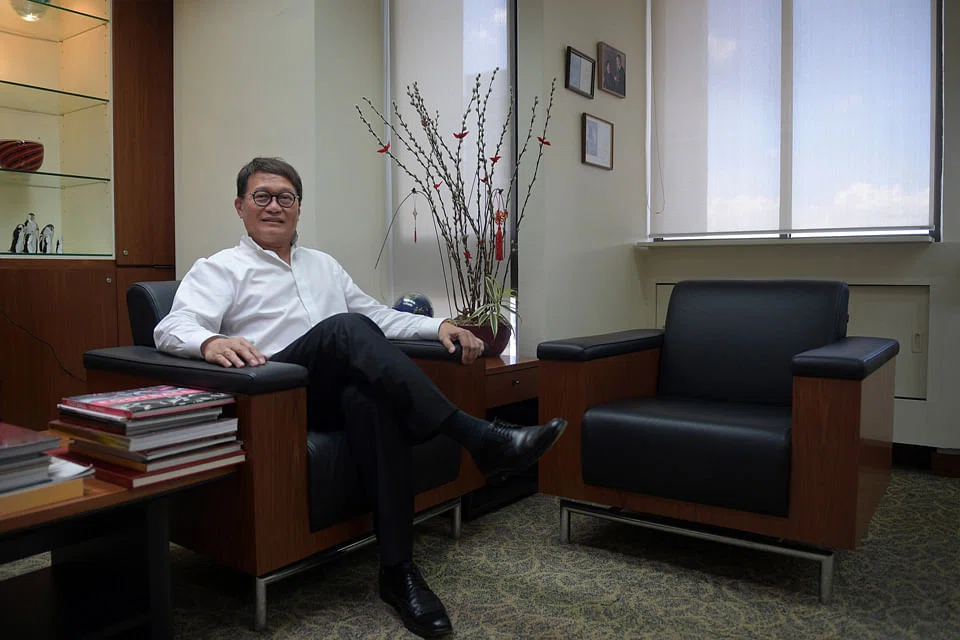
ASIA-PACIFIC Strategic Investments Ltd (APSIL), a Catalist-listed small-cap company backed by Singapore tycoon Oei Hong Leong, may be an unlikely candidate to pioneer new real estate offerings in China. But it is doing just that.
Determined to carve a niche for itself in the vast country where most blue-chip Singapore players are entrenched in first- and second-tier cities, the group is banking on lifestyle property development in third- and fourth-tier cities.
It is of no surprise that such an innovative idea should come from Mr Oei himself, an old hand in China who owns a controlling 35.2 per cent stake in the group.
To better reflect its new strategic thrust, the group is seeking shareholders' approval for a name change to China Real Estate Group Ltd through an extraordinary general meeting on June 21, where it is also seeking consent for a rights cum warrants issue to fund its expansion.
Group CEO and chairman Choo Yeow Ming tells The Business Times that the company did not initially have plans to enter real estate development when it acquired Global Alliance Property (GAP) and Century 21 (AsPac) in 2015 and 2016 respectively.
Venturing into the agency business then was, in fact, counter-intuitive given the government-engineered property market correction. But the market correction also enabled the group to pick up targets at a good price.
"Then Oei talked to us about the property market in China. He told us why not go into the third- and fourth-tier cities and do some property development?" Mr Choo says.
Mr Oei has proven to be right on the money on several occasions, riding the manufacturing wave in China in the mid-1990s and the high-tech boom starting in the late 1990s, he pointed out.
"You can say that he gave us the idea and the confidence to enter China's third-tier and fourth-tier cities. It is a capital intensive business but he said 'I'll back you'. I think for us, it is the right call."
Huzhou site
With China's clampdown on runaway property prices in the first- and second-tier cities, prices in the third- and fourth-tier cities are booming.
APSIL had in November last year gained access to 320 hectares of land in the ancient city of Huzhou in Zhejiang province, through the purchase of 72 per cent of two firms in Huzhou. The land price has doubled from January 2016. China Real Estate Group Union Co Ltd, a former state-owned enterprise, owns the other 28 per cent stake of the project.
The group plans to develop the site over five years into an integrated leisure-cum-lifestyle hub with hotels, waterside villas, island residences and townhouses. Some 20-ha of the land is slated to be launched and developed in the next two years.
Phase one of the project spanning 6.4 hectares has a gross development value (GDV) of 714 million yuan (S$149.8 million) and is expected to take two years to complete, Mr Choo said.
It will comprise villas with gross floor area (GFA) totalling 45,000 sqm, and strata townhouses spanning 19,200 sqm of GFA. These units will be launched by June next year. A boutique lakeside hotel with 114 rooms will be operational by the end of this year.
The group will also launch another phase covering 8.9-ha by the end of 2019, with a GDV of 1.16 billion yuan. This phase comprises villas with GFA totalling 57,400 sqm, and strata townhouses spanning 24,600 sqm of GFA.
Mr Choo says the group is targeting residential buyers from Hangzhou and Shanghai who are looking for a vacation home. It is also considering packaging the sale of units with the sale of yachts manufactured by Shenzhen-listed YaGuang Technology Group, China's largest yacht builder.
APSIL had in April this year inked a non-binding memorandum of understanding (MOU) with YaGuang to jointly market and promote river yachts and related products and services at the Huzhou project, as well as future projects in China.
Mr Choo hopes to undertake more of such projects along China's Grand Canal amid Chinese President Xi Jinping's push to revive the canal cultural belt.
Grand Canal developments
The group is working with state-owned Hangzhou Grand Canal Comprehensive Protection & Development Group (HGC) to undertake a lifestyle development in the city of Meizhou, likely in the form of a joint venture.
"We are in aggressive discussion now with HGC and we hope to do it before end of the year. And we are targeting to kick-start projects in another three cities next year."
These collaborations with HGC, which has a mandate to rejuvenate old cities along Grand Canal, are enabled by an MOU signed between the group and HGC in April, which allows the group to participate in the future development of areas surrounding the Grand Canal.
The 1,776 km Grand Canal is the world's largest inland waterway system linking Beijing in the north to Hangzhou in the south, and is a popular tourist destination.
Mr Choo says the group will choose cities with deep history. Huzhou, for one, is called the hometown of silk and the real starting point of the Silk Road. It is also known as the Chinese Brush City, where some of China's most renown calligraphers flourished.
"We are probably the first in Huzhou and the first in China to focus on lifestyle development," he says. "In China, people are looking for new things to do. The Chinese government is encouraging domestic consumption and travel. There are many tourist areas but they are quite commercialised and nothing very new."
With the sharing economy on the rise, the group may introduce blockchain technology to allow buyers to pool together to buy one yacht or house to share.
Each yacht will be priced at 200,000 yuan on average. The group will share in the profits of YaGuang from the sale of these yachts. The small villas of 1,500-2,000 sq ft in phase one are priced at 2-3 million yuan while the big ones of 4,000 sq ft in phase two and three will be priced higher.
Strata townhouses each spanning 1,000-1,500 sq ft are priced at 1-2 million yuan on average. The bigger ones could be as large as 2,000 sq ft.
As for the agency business under GAP, it is looking to start marketing international projects in China and Indonesia, having already done so in Malaysia, Thailand, the Middle East, and the UK.
Mr Choo says APSIL is also keen to work with Mr Oei on projects that are property-related. One of these areas could be data centres, after Mr Oei set up a company called One Belt One Net with the plan to raise a US$5 billion fund to develop an ecosystem of data centres.
"Data centre is also related to property. We hope to be involved somehow, probably not as a major player."






