

Building materials turnaround marks new direction for Hong Leong Asia
CEO Tan Eng Kwee is excited about how performance of building materials supply business is shifting HLA's bottom line.
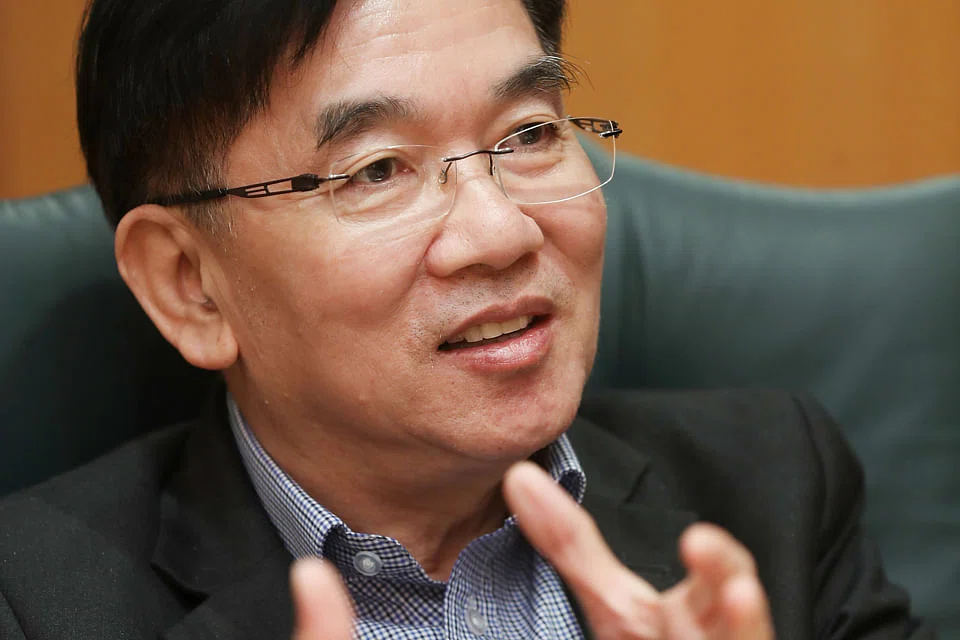
SIZE matters a lot in the building industry, and Hong Leong Asia (HLA), a leading supplier of ready-mixed and precast concrete to Singapore's construction industry, could strengthen its lead if Covid-19 accelerates consolidation in the market, chief executive Tan Eng Kwee believes.
Mr Tan told The Business Times last week: "Any prolonged (work) stoppages from Covid-19 or arising from Malaysia's movement control order will cause cash drain to players, so size matters."
HLA is the industrial manufacturing and distribution division of Singapore's Hong Leong Group.
The growth of any ready-mixed concrete player is also limited by the land available for batching plants. Currently, HLA's Island Concrete falls behind Pan-United, which is the market leader with the highest number of plants scattered across the island.
But word is that the Singapore government may soon require all plants to be centralised in two or three locations.
Mr Tan noted: "That means if you don't have the financial resources to bid for the land (and invest in raising throughput), you're going to be out of business. So you'll see consolidation happening very soon... marginal players will disappear."
Mr Tan, who is 65 but still brimming with energy, was previously HLA's chief financial officer from 2008 to 2011. He left and returned as CEO in Dec 2018.
In Mr Tan's first year as CEO, HLA's building materials division, which includes Malaysian cement producer Tasek, swung back into profitability, led by a turnaround in the Singapore business.
Tasek remains loss-making amid a prolonged price war, though Mr Tan sees signs of a price recovery after YTL acquired rival Lafarge Malaysia last year.
Players in the construction supply chain must reckon with notoriously thin margins, and this is where HLA's size advantage comes in handy once more.
Mr Tan said: "It's definitely a commodity business. So if it's a commodity business, what do you do? You must be a least-cost producer. Therefore your ability to buy raw materials cheaper than the market makes a lot of sense. It's where your margins are. We believe we are (the least cost producer)."
He also gave the example of HL Building Materials, the HLA unit that is the largest producer of precast concrete elements for public housing construction. Private developers rarely use prefabricated modules.
Mr Tan said: "A precast business is basically a fixed-price contract (with delivery in nine months). And if it's a fixed-price contract, when I tender for the job, I will know what kind of margin I'm going to make. So I just need to lock in my costs (because in nine months' time raw material prices can change). Our mistake (in 2018) was we didn't lock in the costs."
Almost every precast player made losses in 2018. But HLA's business turned around in 2019 after it rectified its strategy, he said. "So, we don't speculate. If we are unlucky and the price of steel falls, so be it. We don't make supernormal profits but we make the profit we expect to make when we submit the tender. That gives us peace of mind.
"We also have a precast plant in Singapore, which puts us at an advantage with the other precasters with plants only in Malaysia."
Better profit mix
Looking ahead, Mr Tan said he is excited about how the performance of the building materials supply business is shifting HLA's bottom line.
Last week, HLA posted a 39 per cent jump in net profit to S$34.4 million for 2019, up from S$24.8 million in 2018. The PATMI (profit after tax and minority interests) mix between the Singapore building materials unit and China Yuchai International, HLA's Chinese diesel engines unit, was 30:70.
Mr Tan said: "Compare that to 2018, where the PATMI mix was almost 100 per cent Yuchai. This means that HLA is increasingly less reliant on the performance of Yuchai vis-à-vis building materials. And this is the strategic direction that HLA is moving towards.
"I don't think Yuchai will always be the major contributor. One of my goals is to try and balance the contributions from the different business units at a PATMI level."
That said, 2020 will be a challenging year as Covid-19 puts many economies into deep freeze.
Prime Minister Lee Hsien Loong announced last Friday that most workplaces except for essential services would be shut down for at least a month to contain the virus outbreak.
Mr Tan said: "The news broadcast by the Prime Minister will certainly affect our building material business volumes for ready-mix, precast, cement and trading activities. Due to the sudden announcement, we are not able to estimate the financial impact on us, but it will not be immaterial when combined with the shutdown of precast and cement plants in Malaysia."
However, Mr Tan remains hopeful that the Singapore government will pump-prime the economy by accelerating public projects this year.
Meanwhile, HLA has earmarked S$88.8 million of proceeds from its 2018 rights issue for general corporate purposes, strategic investments and acquisitions.
The group plans to grow its building materials business via acquisitions, and is searching for targets with a technology spin or environmental sustainability angle.
Earlier this year, Kwek Pei Xuan, the daughter of HLA's executive chairman Kwek Leng Peck, joined the company as a senior business development manager to help look at merger and acquisition (M&A) opportunities, and to help re-energise HLA.
Ms Kwek, 28, said: "I think there's a lot of opportunity for the future. We just have to cultivate more internal innovation, and we have different business units, so more exchange of ideas. I'd like to contribute to some changes in the company."
Last year, China Yuchai made an after-tax profit of S$167.2 million, down 14 per cent from 2018, despite an 8 per cent rise in revenue to S$3.5 billion.
"We did well versus the industry," Mr Tan said. The fall in profits was due to sales of new National (Nat) VI diesel engines, which meet China's National VI emissions standards that come into effect in July 2021. Yuchai also incurred higher costs from extending its warranty period by one month as part of its marketing strategy.
Like any other engine maker, Yuchai suffered negative margins from selling Nat VI engines last year because production is still in the prototype stage and volumes are not high.
Mr Tan said: "We are proud to say that we are probably the first one in China to introduce Nat VI engines."
Yuchai's aggressive rollout at the expense of margins will help it establish a stronger foothold with OEMs (original equipment manufacturers), he believes. "In 2022, you will see the impact of Nat VI in volume terms. And because of the investments made, we think the industry as a whole will have to raise prices for Nat VI."
Nat VI is a completely new series from Nat V, whereas the latter was only an incremental change from Nat IV, Mr Tan explained. "Our total investment (in Nat VI engines) is almost 2 billion yuan (S$400 million), of which about 1.3 billion yuan is in fixed assets. This means we have to reconfigure our lines, build new facilities, so that's quite a heavy investment. Obviously we get government grants but by and large the grants are not significant relative to the investments we have to put in.
"So it's a big, big investment for Nat VI. It means the marginal players won't be in the game for too long. So you'll see mainly big players, and that's how we measure ourselves."
Yuchai has a market share of 8 per cent of China's entire diesel engine market. In relation to just the top 11 diesel engine makers in China, however, it has a market share of 14 per cent. Yuchai supplies mainly to makers of medium-duty trucks.
Is there a future for diesel engines given rising environmental concerns?
Mr Tan believes so, at least during his lifespan. "The most important is power. Diesel engines do have a lot of power that hybrid engines, electric engines, fuel cells today don't have. Secondly, of course, the total cost of ownership today is very cheap for diesel engines. Thirdly, a lot of people are doing exhaust after treatment - as you discharge the gas out of the engines, it's actually treated already."
In any case, Yuchai started a fuel cell project last year, though he noted: "We don't want to be the first in the market for this kind of thing because we are unsure."
Getting rid of the drag
Over the longer term, Mr Tan also wants to divest Airwell, the air-conditioning systems unit that's been a drag on HLA's bottom line. In 2018, a major weight was lifted when HLA sold off Xinfei, the ailing refrigerator business that it was never able to turn around.
Back when he was CFO of HLA, Mr Tan had pushed for the sale of Xinfei, as he foresaw that sales would slow drastically once Chinese government subsidies to encourage rural folk to buy electrical appliances were removed in 2011.
Mr Tan recalled: "Sometimes, in the long haul, you must know when to get rid of a business even when it's profitable. But going forward we will know what to do. I think the next few years should be good for us."
TRENDING NOW

Indonesia’s coal tycoon Low Tuck Kwong replaced as Bayan Resources president-director

OCBC names Ang Eng Siong as global corporate banking head in rejig of wholesale banking business

Consider lowering homeownership barriers for some non-resident foreigners

DBS opens flagship investment strategy to retail investors with new fund

