

Buyback consideration in first quarter surpasses S$500 million
Buybacks can enhance key financial metrics such as earnings per share and return on equity
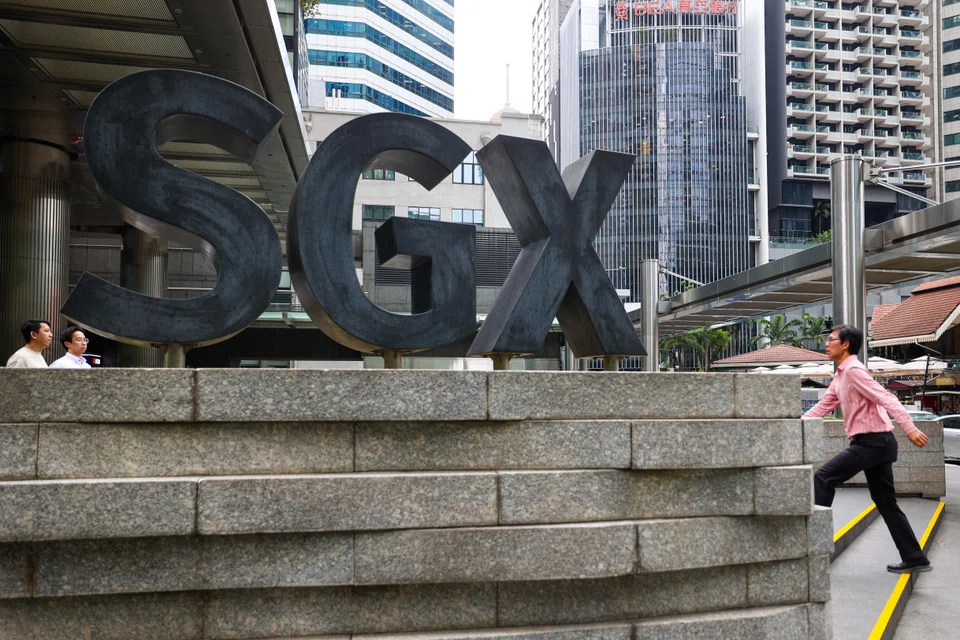
[SINGAPORE] Companies often repurchase shares to support employee compensation plans or to deploy surplus capital more effectively. The Accounting and Corporate Regulatory Authority maintains that buybacks can enhance key financial metrics such as earnings per share and return on equity, take advantage of perceived undervaluation and reduce the overall cost of capital.
In the first quarter of 2026, nearly 50 primary-listed companies in Singapore have collectively repurchased close to S$560 million worth of shares on the open market, from around S$330 million during Q1 2025 and S$232 million in Q1 2024.
The table details the companies that booked more than S$100,000 in share buybacks in Q1 2026, with the average prices including clearing charges. Almost three-fifths of the total consideration was contributed by three companies alone: Singtel , OCBC and Keppel . Note the table does not include buybacks for listing conducted on other exchanges as well as buybacks conducted for Reits, business trusts and stapled trusts.
Singtel: Buybacks deployed as part of ongoing capital management
Singtel led the local market’s Q1 2026 buyback consideration with 24.9 million shares acquired at an average price of S$4.95 each and total consideration of S$123 million.
Of note, the 21.2 million shares bought back in March were conducted under Singtel’s value realisation share buyback programme. This is the first time Singtel’s board authorised a share buyback programme of up to S$2 billion as part of active capital management. Funding for the programme is underpinned by excess capital generated from asset recycling proceeds.
The buyback programme also complements Singtel’s revised dividend policy introduced in May 2024, which added value realisation dividends to core dividends. Execution of the programme is subject to shareholder approval at each annual general meeting with shares purchased in the open market and subsequently cancelled. The programme will be delivered over three years, running till FY28 (ending Mar 31).
Note that the value realisation buybacks are in addition to share purchases undertaken for employee share schemes. On Feb 12, Singtel CEO Yuen Kuan Moon highlighted that the group’s underlying net profit for Q3 FY26 reflected the good performance from its regional associates Airtel and AIS, and focused execution of its Singtel28 plan.
OCBC: Buybacks executed under a defined capital return framework
OCBC had the second highest buyback consideration with 5.4 million shares acquired at an average price of S$21.43 each and total consideration of S$116 million. OCBC’s share buybacks are undertaken to return excess capital to shareholders and to supply treasury shares for employee share schemes, as part of its broader capital management framework.
In February 2025, OCBC announced a S$2.5 billion capital return programme, to be delivered over FY25 till FY26 via a combination of special dividends and share buybacks. The programme allocates special dividends equal to 10 per cent of core net profit for FY24 and FY25, with the remaining balance returned through share buybacks, subject to market conditions.
During FY25, OCBC purchased 26.7 million shares for S$445 million under its buyback programme. Of these, 13.6 million treasury shares were cancelled, while 17.1 million treasury shares were used to meet employee share scheme obligations. Shares repurchased under the programme are held as treasury shares and may be cancelled, sold or applied to employee share plans, with the capital return programme targeted for completion by the end of FY26.
Keppel: Buybacks within a capital recycling framework
Keppel saw the third-highest buyback consideration with 7.7 million shares acquired at an average price of S$12.28 each and total consideration of S$94 million.
In February, Keppel CEO Loh Chin Hua reaffirmed that its share buybacks serve a purpose to fund its share plans as well as to use as currency should the group conduct mergers and acquisitions.
In FY25, Keppel bought back 13.22 million shares, which were held as treasury shares. During the year, 8.78 million treasury shares were transferred to employees upon vesting under the Keppel share plans, with the balance retained as treasury shares.
The buybacks and dividends were funded by operating cash inflows, divestment proceeds and dividends received; and formed part of Keppel’s broader approach to optimising its capital structure while progressing its asset-light transformation. In line with this framework, Keppel distributed total dividends of about S$0.47 per share for FY25, comprising ordinary dividends and a special dividend linked to completed asset monetisation.
This compared with total dividends of about S$0.34 per share in FY24, when distributions comprised ordinary dividends only, with no special dividend declared.
Broader buyback activity
For non-Straits Times Index (STI) stocks, The Hour Glass recorded the highest buyback consideration at S$7.5 million, with 3.3 million shares repurchased at an average price of S$2.26 each. In August, its board reiterated that share buybacks are a deliberate form of capital return, implemented alongside a long-term balance sheet strategy.
Hong Fok Corporation , Chuan Hup Holdings , Hong Lai Huat Group , and First Resources lodged the next highest considerations outside the STI cohort.
The writer is the market strategist at SGX. To read SGX’s market research reports, visit sgx.com/research
Decoding Asia newsletter: your guide to navigating Asia in a new global order. Sign up here to get Decoding Asia newsletter. Delivered to your inbox. Free.
Share with us your feedback on BT's products and services
TRENDING NOW

DBS, OCBC, UOB rout lops billions off STI as inflation, rate concerns spook investors

Grab CEO’s wife Chloe Tong on life with Anthony Tan and finding her purpose

OCBC sheds S$8 billion in value as shares close nearly 6% down; analysts cautious on banks

Deal between tycoon friends sparks scrutiny of Philippine power sector

