Asia: Shares advance as inflation worries fade to background
 Add BT as a preferred source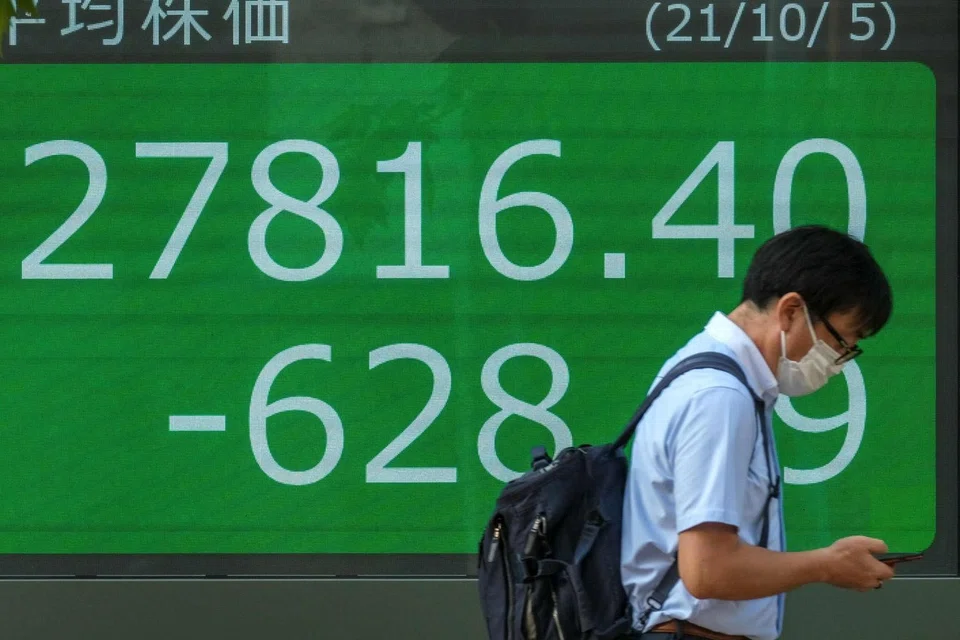
DeeperDive is a beta AI feature. Refer to full articles for the facts.
[TOKYO] Asian share prices advanced on Friday (Nov 12) as a shock from a surprisingly strong US inflation reading ebbed, with investors now hopeful that the worst price hikes could be soon over.
MSCI's broadest index of Asia-Pacific shares outside Japan rose 0.7 per cent to reach its highest level in 2 weeks while Japan's Nikkei gained 1.1 per cent, helped by brisk earnings.
US stock futures were up about 0.3 per cent after a mixed session on Thursday (Nov 11) when the S&P 500 ended 0.06 per cent higher while tech-heavy Nasdaq rose 0.52 per cent.
The world's stock prices posted their biggest fall in over a month on Wednesday (Nov 10) following a surprisingly strong reading on US inflation.
The US consumer price index rose 6.2 per cent year-on-year in October, the strongest advance since November 1990.
"Inflation is obviously a risk to watch. But stock prices will face a major crash only if the Federal Reserve turns out to be completely wrong in its assessment and is forced to raise interest rates rapidly. That's not where we are now," said Norihiro Fujito, chief investment strategist at Mitsubishi UFJ Morgan Stanley Securities.
Navigate Asia in
a new global order
Get the insights delivered to your inbox.
While the inflation data suggested that the current wave of price spikes due to chronic worldwide supply constraints could have more staying power than many had hoped, many investors still think inflationary pressure will eventually ease, rather than strengthen.
"If we get over the year-end holiday shopping season, when demand should be peaking, perhaps inflation could subside," said Hirokazu Kabeya, chief global strategist at Daiwa Securities.
"US holiday sales are expected to rise 8.5 to 10 per cent this year, with some consumers said to be starting to buy earlier than usual because of worries about supply glitches. If that's the case, we could see a pretty strong retail sales number next week, which would be positive for stocks," he added.
US retail sales for October are due next Tuesday.
Bond yields ticked up, with the 10-year US Treasuries yield rising 1.9 basis points to 1.572 per cent on Friday after a market holiday on Thursday.
Money markets have already priced in 2 rate hikes next year.
In the currency market, the dollar held firm after Wednesday's strong US inflation reading fanned expectations the Fed would tighten monetary policy faster than previously thought.
An index of the dollar against 6 other currencies rose to a 16-month high of 95.264 as the euro slipped to US$1.1449, near its lowest since July last year.
The yen softened to 114.26 per dollar, near its 4-year low hit last month while commodity currencies such as the Australian dollar and the Canadian dollar were on a back foot.
The Australian dollar hit a 5-week low of US$0.7286 while the Canadian dollar slipped to C$1.2588 per dollar, a low last seen in early October.
"It is interesting if a growing number of investors are selling commodity currencies on expectations that the Fed's tightening will drive down commodity prices," said Makoto Noji, chief FX strategist at SMBC Nikko Securities.
Oil prices dipped slightly as the market grappled with a stronger US dollar along with concern over increasing US inflation, and after Opec cut its 2021 oil demand forecast due to high prices.
Brent crude futures were down 0.36 per cent at US$82.56 per barrel while US West Texas Intermediate (WTI) futures dropped 0.33 per cent to US$81.32 per barrel.
Gold prices stayed near Wednesday's 5-month highs as investors sought inflation hedges. They last stood at US$1,862 per ounce, near Wednesday's high of US$1,868.50.
REUTERS
Decoding Asia newsletter: your guide to navigating Asia in a new global order. Sign up here to get Decoding Asia newsletter. Delivered to your inbox. Free.
Share with us your feedback on BT's products and services