Asia shares rally in celebration of Biden's win, but reality beckons

Singapore
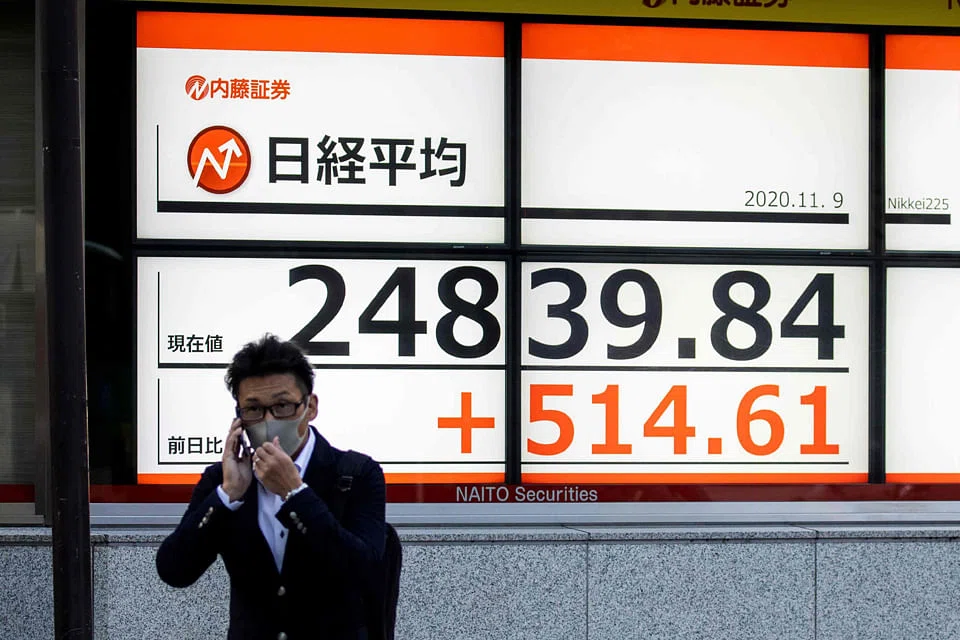
IT was a sea of blue in the Asia-Pacific financial markets on Monday, with Australia's ASX200 smashing through chart resistance, Japan's Nikkei 225 soaring to its highest levels in almost three decades, and the oil price climbing as investors looked forward to a Joe Biden White House after four tumultuous years under the Donald Trump administration, with his Twitter-happy populist rhetoric.
Japan's Nikkei 225 index led the way with a rise of more than 2 per cent as traders in Asia-Pacific got the first chance to give their verdict on the Biden victory. Australia's ASX200 broke the 6,200 ceiling to end 1.75 per cent up, at 6,298 - the highest level seen since the start of the Covid-19 pandemic.
MSCI's broadest index of Asia-Pacific shares outside of Japan jumped 1.4 per cent to 614.73 points, the highest since January 2018. This followed a 6.2 per cent climb last week. In Singapore, the Straits Times Index ended up more than one per cent, at 2,607.68.
Underpinning the markets' exuberance are expectations of fewer regulatory reforms and more monetary stimulus under the US president-elect. Many reckoned that without full government control, Mr Biden will be unable to push through any meaningful fiscal stimulus, and this could prompt the US Federal Reserve to keep borrowing costs at their historically low levels.
"While lots of attention was given to Trump versus Biden, markets have reacted strongly to the (likely) split Congress, which means more confidence that interest rates will be lower for longer," said Dave Wang, portfolio manager at Nuveen Capital in Singapore. "The best opportunities now lie within segments of emerging markets, in particular China and North Asia. I believe earnings momentum and valuation put China in a very attractive risk/reward position."
Chinese shares too started Monday on a stronger note. "While a Biden government should mean a less aggressive and more predictable US policy towards China, we don't think the overall US stance on economic issues vis-a-vis China would soften much," said Louis Kuijs, head of Asia Economics at Oxford Economics.
In Western markets, stocks soared on positive vaccine news.
Pfizer and BioNTech announced on Monday that their coronavirus vaccine was more than 90 per cent effective in preventing Covid-19 among those without evidence of prior infection, hailing the development as "a great day for science and humanity."
But Richard Hunter, head of marketing at Interactive Investor, cautioned: "It is still early days, and the practicalities point to any meaningful distribution not being available until the first few months of next year.
"Even so, the news is without question a positive development and has certainly captured the imagination of investors."
Mark Haefele, global chief investment officer at UBS Global Wealth Management, is sticking to a pro-risk stance, with the focus on medium-term drivers of economic growth notably the Covid-19 pandemic and vaccine developments, as well as monetary and fiscal stimulus.
Markets, according to him, had already begun to price a Biden win as the most likely outcome last week. Large-cap technology stocks rallied strongly on election week on the back of lower bond yields and greater regulatory certainty than under a Democrat blue wave.
"Investors also seem to have been rotating back into growth safe havens due to a likely watered-down fiscal stimulus. Looking forward, we continue to believe there is upside for markets in the months ahead, although we expect it to be driven by more cyclical parts of the market," Mr Haefele added.
He expects a sizable fiscal package, about US$500-1,000 billion, or 2.5-5.0 per cent, of the US gross domestic product, to support growth.
"We also expect a broadening of the economic recovery aided by the widespread distribution of a vaccine by the middle of next year. In this environment, mid-caps should be well-supported. Within technology, recent strong company results in segments like supply chain, payments and digital advertising support our recommendation to broaden exposure into more cyclical areas of tech, which have lagged so far, rather than areas like e-commerce and software which have outperformed through the pandemic," he added.
Outside the US, Mr Haefele recommended that investors position for an influx of stimulus, too, adding exposure to the more economically sensitive areas of the market.
"Areas best positioned include the UK, the EMU (European Economic and Monetary Union) small- and mid-caps and emerging market value stocks, in our view. These areas will also see support from the Bank of England's increased quantitative easing programme, which was announced last week, as well as a likely increase in the size and duration of the Pandemic Emergency Purchase Programme, which we expect the European Central Bank to announce at its Dec 10 meeting," he said.
He is optimistic that an approval of a coronavirus vaccine will be seen in the coming months, with a rollout in the first half of 2021, and expects monetary and fiscal stimulus to remain supportive of equity markets.
"We acknowledge that the move higher in the past week has increased valuations, in the US in particular, but believe that the next leg higher for equities will be driven by more economically sensitive parts of the market, such as mid-caps, industrials and other select cyclicals "catching up" with the secular growth names.
"For investors looking to reduce portfolio risk following last week's run-up in US equities, or who see tail-risk concerns around the peaceful transition of power in the US, structured products can be an effective means of implementation," Mr Haefele noted.
Despite Mr Biden's green agenda, oil prices too rose during Asian trading hours, with global benchmarks up more than 2 per cent - Brent at US$40.34 per barrel and the West Texas Intermediate at US$38 a barrel.
Analysts ventured that a Biden win would not be as bad for oil prices as it would look on the face of it. They expect a weaker US dollar, which will make it cheaper for buyers since crude oil is traded in US dollars. Without full control of the government, Mr Biden will be unlikely to pass climate policies that could be too harsh on the oil industry, they added.
The US dollar index, which tracks the greenback against a basket of its peers, was last at 92.183 following a decline in recent days from levels above 93.1.
The Chinese yuan was sitting at its highest level since June 2018 on easing concerns about relations between Beijing and Washington.