Asia: Stocks closing in on strongest month since January
 Add BT as a preferred source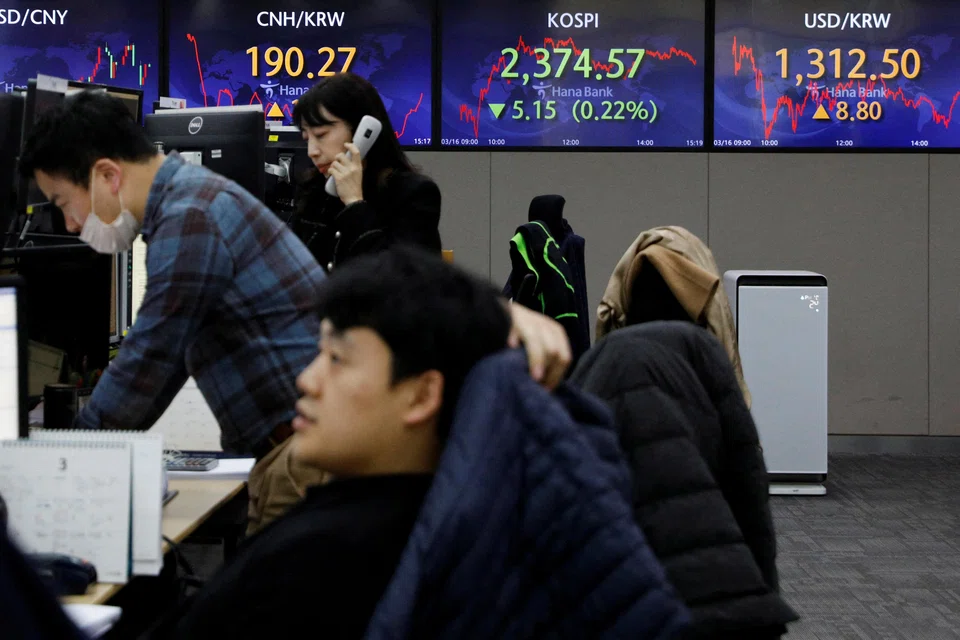
DeeperDive is a beta AI feature. Refer to full articles for the facts.
ASIAN stocks were poised to clock their strongest performance in 10 months at the end of Thursday’s trading, even as most regional stock markets opened listless after mixed messages from the Fed and a similar struggle in US stocks overnight.
The MSCI Asia-ex-Japan stocks index is up 6.7 per cent so far this month, setting it on course to mark the best month since January.
South Korea’s Kospi has led the rally in Asia with 10.5 per cent gains this month, followed closely by Taiwan and Japan’s Nikkei Average index.
Stock markets around the world struggled on Wednesday, after a strong month driven by market expectations of peak Federal Reserve rates, and as a fall in the dollar and in US bond yields loosened financial conditions.
Ten-year US yields are down more than 60 basis points in November, on track for the steepest monthly drop since late 2008.
While US central bank officials on Wednesday sent mixed messages, investors still focused on comments made on Tuesday by Fed Governor Christopher Waller, an influential and previously hawkish voice at the bank. Waller had said rate cuts could begin in months if inflation keeps easing.
Navigate Asia in
a new global order
Get the insights delivered to your inbox.
Meanwhile, data from the US showed a strong economy in the third quarter and also a downtrend in inflation, reinforcing expectations the Fed might cut interest rates earlier than expected.
“We think liquidity and momentum can still support markets through December,” said Redmond Wong, market strategist, Greater China at Saxo Markets, and that rate cuts could be as early as the first quarter as US economy has shown signs of deceleration.
US financial conditions are the loosest since early September and have eased 100 basis points in a month, according to Goldman Sachs. The bank’s global and emerging market indexes ticked up a bit last week, but financial conditions are also looser by around 100 bps from a month ago.


US rates futures markets are now pricing in more than 100 basis points of rate cuts next year starting in May, and the two-year Treasury yield is its lowest since July - it has slumped nearly 40 basis points this week alone.
“Absent rapid Fed easing, we expect a more challenging macro backdrop for stocks next year with softening consumer trends at a time when investor positioning and sentiment have mostly reversed,” analysts at JPMorgan said in a note on their 2024 global outlook.
“Equities are now richly valued with volatility near the historical low, while geopolitical and political risks remain elevated. We expect lackluster global earnings growth with downside for equities from current levels.”
Elsewhere in China, a closely watched factory survey showed manufacturing activity contracted for a second straight month in November and at a quicker pace, suggesting more government support is needed to help shore up economic growth.
Hong Kong’s Hang Seng Index and China’s benchmark CSI300 Index both opened down 0.1 per cent. The Chinese benchmark is down over 2 per cent in November.
Oil prices rose more than US$1 on Wednesday as investors looked past a jump in US crude, petrol and distillate stock piles and focused on an upcoming meeting of Opec+, the Organization of the Petroleum Exporting Countries and allies such as Russia.
Talks ahead of the meeting were focusing on additional cuts, although details have yet to be agreed, sources close to the group told Reuters.
US crude on Thursday dropped 0.33 per cent to US$77.6 per barrel and Brent was down 0.34 per cent at US$82.82.
Spot gold edged up 0.03 per cent to reach US$2,045.29 an ounce. AFP
Decoding Asia newsletter: your guide to navigating Asia in a new global order. Sign up here to get Decoding Asia newsletter. Delivered to your inbox. Free.
Share with us your feedback on BT's products and services