Asian markets rally after Fed pauses interest rate hikes

Tan Nai Lun
Tan Nai Lun

Published Thu, Nov 2, 2023 · 12:06 PM
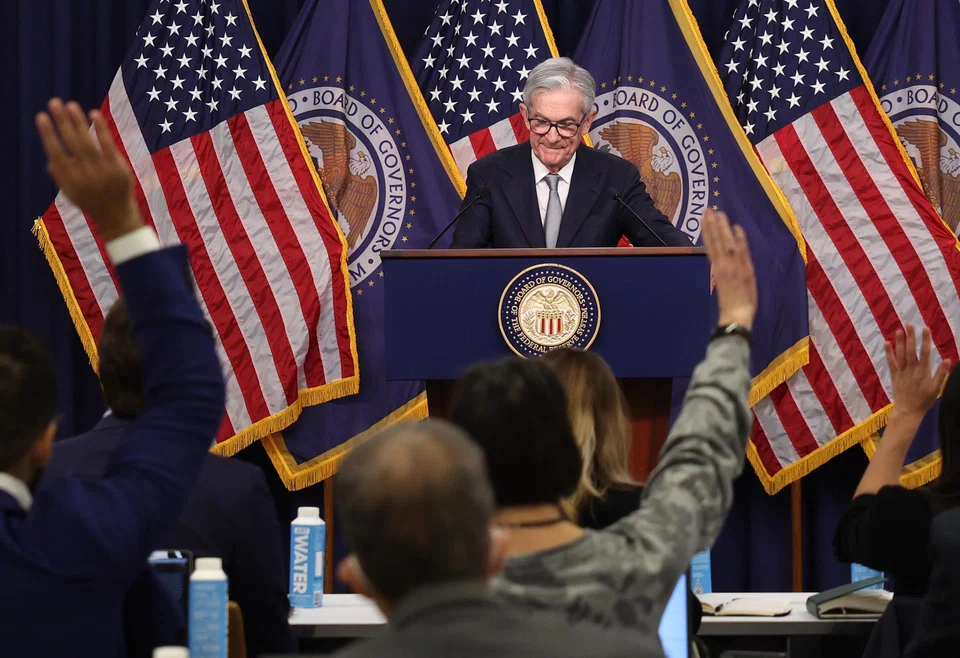
    • Fed chair Jerome Powell has acknowledged that there has been significant tightening of financial conditions in recent months, leading traders to believe that the Fed was done with hikes.
    • Fed chair Jerome Powell has acknowledged that there has been significant tightening of financial conditions in recent months, leading traders to believe that the Fed was done with hikes. PHOTO: AFP

    ASIAN stocks rallied on Thursday (Nov 2) after the US Federal Reserve signalled that the cycle of interest rate hikes may be coming to an end.

    On Wednesday, the Fed kept interest rates unchanged. Fed chair Jerome Powell also acknowledged that there has been significant tightening of financial conditions in recent months, leading traders to believe that the Fed is done with hikes.

    Regional markets ended mostly higher on Thursday. The Nikkei 225 gained 1.1 per cent, the Kospi Composite Index rose 1.8 per cent, and the Hang Seng Index climbed 0.8 per cent.

    In South-east Asia, the Straits Times Index advanced 0.2 per cent, the Jakarta Composite Index gained 1.6 per cent, while the FTSE Bursa Malaysia KLCI edged up 0.3 per cent.

    The rally followed a decline in US 10-year Treasury bond yields, as well as overnight gains in US equity markets. The Dow Jones Industrial Average closed 0.7 per cent higher, the S&P 500 was up 1.1 per cent, and the Nasdaq Composite Index climbed 1.6 per cent on Wednesday.

    It is “no surprise” that Asian markets are responding positively, said Stephen Innes, managing partner at SPI Asset Management.

    Sovereign yields are falling across the board – reflecting a decline in US Treasury yields – providing the “ultimate central relief valve” for global equities, he said.

    “As per the modern-day stock market operator playbook, the lower bond yields go, the higher tech stocks move.”

    Chetan Seth, Asia-Pacific regional equity strategist at Nomura, expects a near-term relief rally in Asian stocks, especially driven by the tech, duration and high-valuation areas that are more correlated to moves in the US bond yields.

    He does not expect a breakout rally, however, as the easing in financial conditions amid a still resilient US economy and sticky inflation will likely invite a stronger Fed reaction in the future.

    Jon Maier, chief investment officer at Global X ETFs, said that investors may still find opportunities, as the pullback in yields can support equities and stabilise the risk-off movements experienced over the past few months.

    “This could potentially stabilise the risk-off movements experienced over the past few months.”

    Kerry Craig, global market strategist at JPMorgan Asset Management, cautioned investors against taking on outsized positions, amid increased macro uncertainty and spiking geopolitical risks.

    He noted that the ability for the US to deliver a soft landing of the economy remains a question mark. He suggested adopting a neutral stance on equities, with a preference for quality companies and those that can protect margins.

    Analysts expect the Fed will pause yet again at the next Federal Open Market Committee (FOMC) meeting in December.

    Maier noted that the recent rise in yields, combined with the Fed’s comments, should mean another pause in December, although it will keep the door open for further hikes if necessary.

    “It appears as though tighter financial conditions since the September FOMC meeting have partially helped the Fed achieve its goals,” he said.

    Ray Sharma-Ong, investment director of multi-asset solutions at Abrdn, also expects the Fed to remain on hold going into next year.

    The pause should enable equity markets to better price assets based on corporate fundamentals, and stabilise rate differentials between the US and other regions, he said.

    This should also support currencies that are popular in carry trade, and reduce market volatility stemming from policy uncertainty, he added.

    But the absence of a Fed pivot is likely to limit rebounds in Asian currencies in the fourth quarter of 2023, said Jeff Ng, head of Asia macro strategy at Sumitomo Mitsui Banking Corporation.

    In the coming month, he expects more currency stability after previous weaknesses in Asia currencies, with those that are most sensitive to yield differentials – including the South Korean won, baht and ringgit – likely to benefit more.