

Asian markets remain jittery, extend losses over Omicron uncertainties

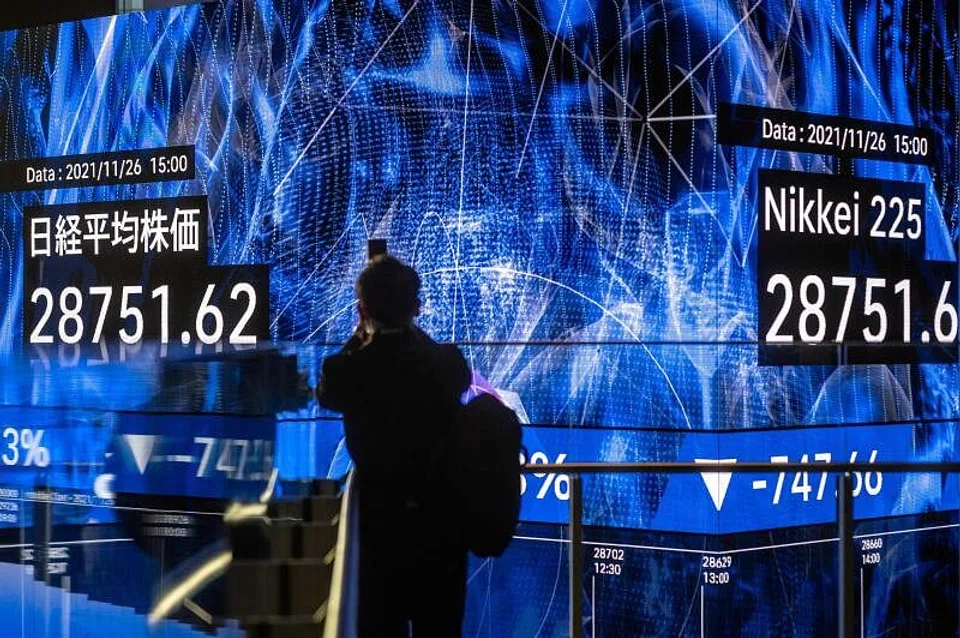
ASIAN equity markets remained bearish on Monday (Nov 29) as the spectre of new Covid-19 variant Omicron continued to weigh on sentiment.
Singapore's key index closed down 1.4 per cent, while Malaysia slipped 0.1 per cent. In East Asia, Japan declined 1.6 per cent, South Korea fell 0.9 per cent, and Hong Kong lost 1 per cent.
Omicron, first detected in South Africa, was declared a variant of concern by the World Health Organization (WHO) on Friday (Nov 26).
According to the WHO, the variant has a large number of mutations, some of which are concerning. Scientists are trying to better understand its properties, although early indications suggest that the large number of mutations in its spike protein may render existing vaccines less effective.
Despite travel restrictions put in place by countries worldwide, Omicron has already been detected in a number of European countries - which were already battling a new wave of Covid-19 infections.
Credit Suisse global chief investment officer Michael Strobaek noted that the eurozone could see downgrades to its near-term growth outlook if restrictions are tightened.
Market volatility is also likely to remain until more is known about Omicron, he added, noting that pharmaceuticals are likely to remain resilient.
Vaccine manufacturer BioNTech said on Friday that it expects more data on Omicron and the efficacy of its vaccines on the variant in about 2 weeks, with a new vaccine targeted at the new strain potentially available in approximately 100 days.
Similarly, UOB Kay Hian analyst Adrian Loh noted that uncertainty will continue to weigh on sentiment in the equity markets as there are still many unknowns about the new variant.
"We don't know what the infection rate of this new variant is, how it will affect the government's decision to reopen; there's just a whole host (of questions)," he said.
Furthermore, Loh noted that traders will be watching the meeting of the Organization of the Petroleum Exporting Countries and its allies (Opec+) this week. Without the variant, Opec+ may have stopped their production increase or maybe even dialled production back down; the new variant has cast some uncertainty as to how the organisation may proceed, he said.
Opec+ has postponed technical meetings to Thursday (Dec 2) instead of Tuesday (Nov 30), saying they need more time to assess the impact of Omicron on oil demand and prices. Both Brent crude futures and US West Texas Intermediate crude were both up by about 4 per cent after tumbling on Friday.
Citi Research analysts expect further volatility in markets, noting that the Atlanta Fed President Raphael Bostic had played down the risk of Omicron to the US economy and suggested that he was open to scaling back asset purchases at a stepped-up pace to keep inflation in check. This ran counter to the market's expectations that a Federal Reserve interest rate hike could be delayed.
Jeffrey Halley, Oanda's senior market analyst, said that South-east Asian markets have underperformed as their tourism and reopening plans could be "thrown into disarray". He also noted that Prime Minister Lee Hsien Loong on Sunday (Nov 28) said that Singapore could roll back the easing of restrictions as the government continues to track Omicron closely.
"The market direction is a binary outcome to the Omicron headlines. Positive headline, stocks higher, negative headline, stocks lower," he said, adding that news about Omicron will likely continue to drive market direction and volatility for the rest of the week.
DBS Group Research analysts said that more downside can be expected in the immediate term as vaccine efficacy rates against Omicron remain unknown. Domestic and international border restrictions could be tightened again to stem its spread.
Under the worst case scenario where Omnicron overtakes Delta as the dominant strain globally, the analysts expect the re-opening of borders in Singapore to be pushed back by 6 to 9 months.
Sectors that will benefit in this scenario will be shipping, healthcare, medical supplies and industrial real estate, while aviation, hospitality, technology, banks, oil and gas, and plantations are expected to be more badly hit.
Prashant Bhayani, chief investment officer, Asia, at BNP Paribas Wealth Management said that he expects markets with higher technology sector weightings, such as the US and China, to do well in the short-term as compared to markets in Europe and Japan as e-commerce, online usage and "stay at home" equities perform better with potentially increasing restrictions.
However, he noted that South Africa's infection rate has not materially risen and he does not suggest making any portfolio allocation changes yet since recent declines in the market could have been a result of some profit taking, as seen in last Friday's steep declines.
READ MORE:
TRENDING NOW

Far East Organization’s The Serra Residences sells less than a quarter of units released at average S$3,460 psf

A bumpy road ahead for some of Singapore’s fresh graduates in their job search

Philippine power giant First Gen rebuffs foreign offers, plans up to US$2.6 billion in expansion

No chicken feed: How Malayan Flour Mills built an empire from flour to fowl

