Asian stocks fall as South Korea, Taiwan stocks lead declines
MSCI’s broadest index of Asia-Pacific shares outside Japan falls 1.7%
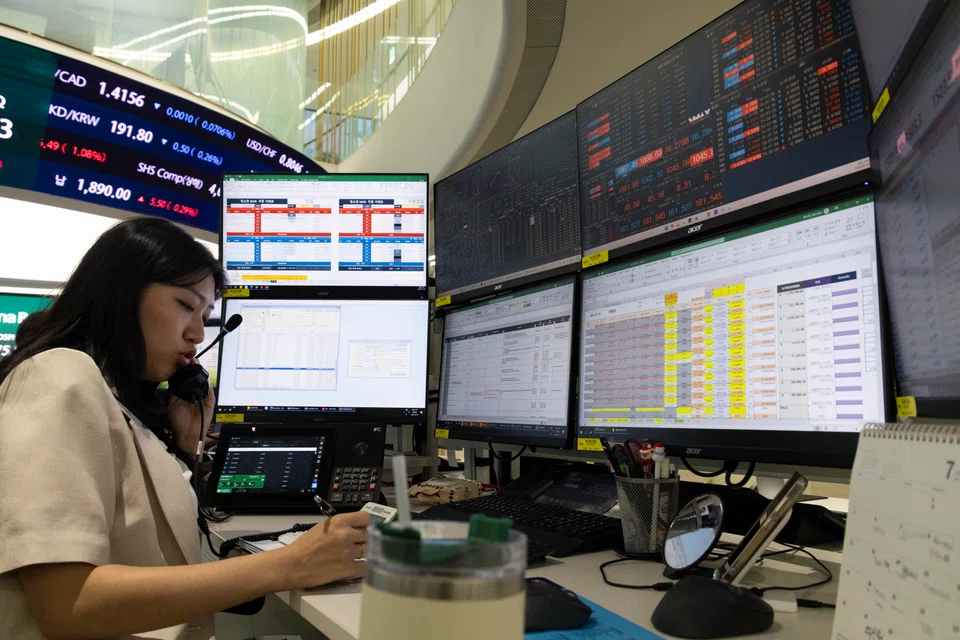
[SINGAPORE] Stocks fell and oil hit a one-month high in Asian trading on Tuesday (Jul 14) after US President Donald Trump said the US was reinstating its blockade of Iranian shipping in the Gulf and would collect a 20 per cent fee on cargo traversing the Strait of Hormuz.
Following a volatile start to the session, MSCI’s broadest index of Asia-Pacific shares outside Japan was down 1.7 per cent, led by declines for shares in Taiwan and South Korea, which at their lowest point exceeded 3 per cent and 5 per cent, respectively.
Japan’s Nikkei 225 fell 0.8 per cent, while S&P 500 e-mini futures eased 0.3 per cent. Chinese stocks fell by less than the regional benchmark, with the CSI 300 0.4 per cent lower after export and import data for June released on Tuesday beat economists’ expectations.
Brent crude futures climbed 1.7 per cent to US$84.72 a barrel, after earlier hitting their highest since mid-June at US$85.64.
Markets were also rattled by hawkish comments on Monday from Federal Reserve governor Christopher Waller, who said the US central bank may need to raise interest rates “in the near term” if data shows inflation continuing well above the 2 per cent target.
US consumer price index data is due for release later on Tuesday, followed by comments from Federal Reserve chair Kevin Warsh, who will deliver the central bank’s semi-annual monetary policy report to Congress.
“While the risk had been building in the system over the past week, markets reacted aggressively” to the latest headlines from the Iran conflict, said Chris Weston, head of research at Pepperstone in Melbourne.
“The prospect of tighter monetary policy into a potential energy shock is rarely supportive for risk assets.”
Overnight, stocks on Wall Street sold off and oil futures surged more than 9 per cent as the conflict between the US and Iran re-ignited, once again throttling the flow of goods through the Strait of Hormuz.
The S&P 500 closed 0.8 per cent lower and the Nasdaq Composite fell 1.6 per cent.
Fed funds futures are pricing in an implied 43.3 per cent probability of a 25 basis point hike at the US central bank’s next two-day meeting on Jul 28 to Jul 29, compared to a 34.2 per cent chance on Friday, according to the CME Group’s FedWatch tool.
The yield on the US 10-year Treasury bond was up 1.6 bps at 4.624 per cent.
The US dollar index, which measures the greenback’s strength against a basket of six currencies, nudged 0.1 per cent lower to 101.18, trading around its highest levels of the month. Gold was up 0.3 per cent at US$4,012.37.
“The risk to Asian markets from the re-escalation in US-Iran tensions runs mainly through the impact of higher energy prices on currencies and policy interest rates,” said Eastspring Investments’ chief investment officer Vis Nayar in a note.
“Persistently higher oil prices would increase the risk that the US Federal Reserve would hike the Fed funds rate later this year.”
The Taiwanese benchmark fell to a one-month low, leading regional declines.
In Seoul, stocks moved between negative and positive territory as shares in SK Hynix veered between gains and losses, falling as much as 5.6 per cent after an earlier rally.
The volatility for the memory chipmaker comes after a dramatic plunge a day earlier following its Nasdaq debut last week.
In cryptocurrencies, bitcoin was 0.4 per cent higher at US$62,415.22 while ether was up 0.7 per cent at US$1,778.30. REUTERS
Decoding Asia newsletter: your guide to navigating Asia in a new global order. Sign up here to get Decoding Asia newsletter. Delivered to your inbox. Free.
Share with us your feedback on BT's products and services