Asian stocks rise on drop in US inflation rate, with South Korea’s Kospi up 7%
The index’s surge comes ahead of the next test for the AI rally, with earnings due at ASML
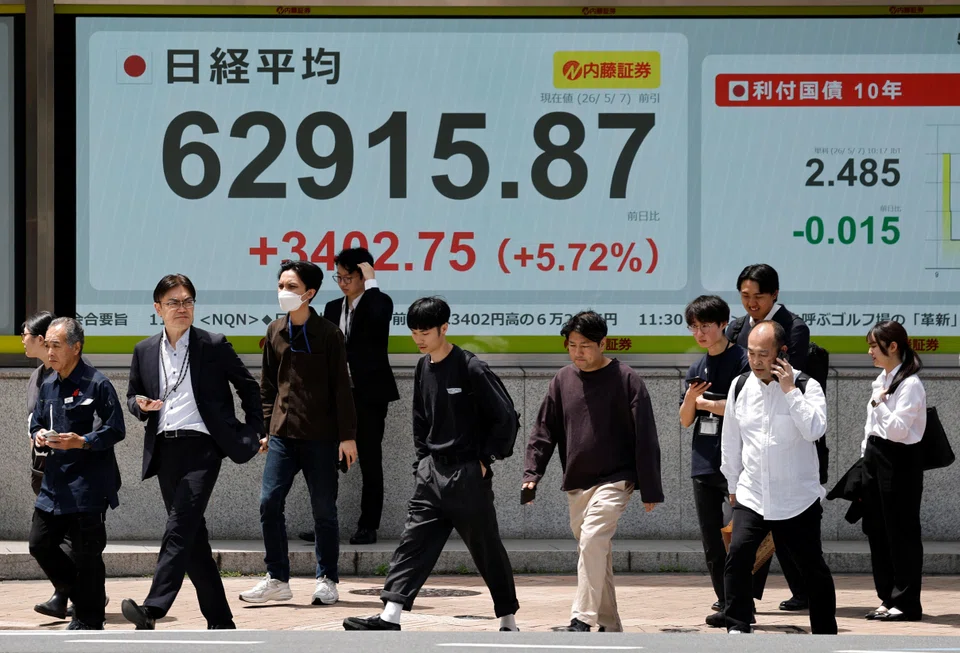
[SINGAPORE] Asia’s bumpy stock markets rallied on Wednesday (Jul 15) after a surprise slowdown in US inflation scaled back expectations for interest rate hikes, while oil took a breather as the US scrapped a plan to levy shipping through the Strait of Hormuz.
South Korea’s volatile Kospi index surged 7 per cent ahead of the next test for the artificial intelligence rally with earnings due at ASML, Europe’s most valuable company and the world’s biggest supplier of equipment used to make AI chips.
Japan’s Nikkei rose 1 per cent and MSCI’s broadest index of Asia-Pacific shares outside Japan rose 2.4 per cent.
Still, a 25 per cent drop in IBM’s share price overnight, after the technology company’s revenue forecast missed analyst expectations, showed how stretched and skittish the market’s rally in AI-related stocks has become.
Stellar profit at Wall Street banks, though, helped broader gains for the S&P 500 and Nasdaq on Tuesday which extended in Asia with US futures rising.
In currencies, the US dollar was broadly lower except against the stubbornly weak yen.
Meanwhile, short-end bonds rallied, taking two-year Treasury yields down 11 basis points to 4.19 per cent from Tuesday’s 17-month high of nearly 4.3 per cent.
The US headline consumer price index fell 0.4 per cent in June, its first decline since the Covid-19 pandemic, while annualised core inflation of 2.6 per cent compared with expectations for 2.8 per cent.
“For market bulls this is even better than Goldilocks could have imagined,” JPMorgan analysts said in a client note.



“Inflation (is) lower with positive earnings growth. This print should remove any fears over a July rate hike and may assuage fears on September, too. This sets up the market to move higher and to broaden as it does so.”
Market pricing for the chance of a US interest rate hike in July halved to 16 per cent.
China growth miss
China’s annual economic growth slowed sharply to 4.3 per cent in the second quarter, official data showed on Wednesday, missing analysts’ expectations as weak domestic demand and the oil shock tied to war in the Middle East outweighed stronger production and exports.
A rebound in Chinese retail sales June, relatively strong nominal gross domestic product and hopes authorities will respond were the positives for investors.
“I don’t think they will be worried enough to announce any big stimulus, but it is going to be targeted, since they are aware that growth is only for the tech areas whereas the broader economy is continuing to underperform,” said UOB economist Ho Woei Chen.
China’s yuan traded at a one-month high of 6.7635 to the US dollar. The euro steadied above US$1.14 and the Australian dollar was hanging on to a 0.8 per cent gain and testing US$0.70.
Brent crude futures steadied around US$85.80 a barrel, having gained almost 13 per cent this week on a flare-up in Middle East fighting.
US President Donald Trump reimposed a naval blockade of Iranian ports on Tuesday and threatened to attack power plants and bridges next week unless Iran resumes negotiations to end their conflict, though he scrapped a plan for a 20 per cent fee on shipping through Hormuz.
In the US, BNY, Morgan Stanley, Johnson & Johnson and Blackrock are set to report earnings before the morning bell and United Airlines, after market close. REUTERS
Decoding Asia newsletter: your guide to navigating Asia in a new global order. Sign up here to get Decoding Asia newsletter. Delivered to your inbox. Free.
Share with us your feedback on BT's products and services