

Asian stocks rise on US-Iran deal hopes amid Hormuz blockade, oil falls
Since the US and Israel launched the war in late February, the Trump administration has taken repeated steps to contain prices
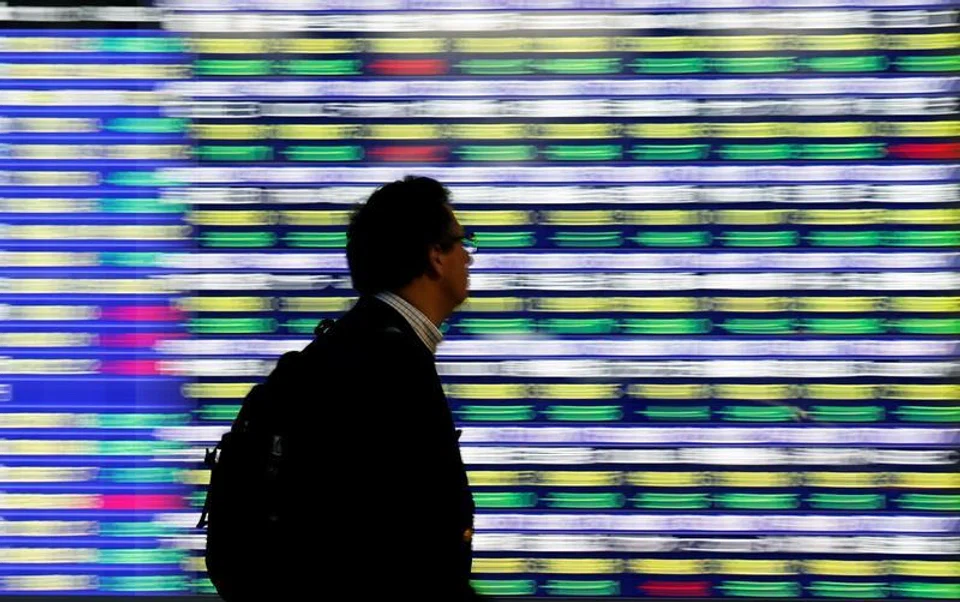
[SINGAPORE] Asian stocks advanced while oil prices and the safe-haven dollar fell on Tuesday (Apr 14) as investors banked on a resolution to the Middle East war even as the US blocked Iran’s ports after the collapse of peace talks over the weekend.
Sources told Reuters that Washington and Teheran have left the door open to dialogue, and a US official said there was forward motion on trying to get to an agreement.
US President Donald Trump also said that Iran wants to make a deal, though he will not come to any agreement that allows Teheran to have a nuclear weapon.
Investors latched on to hopes for an off-ramp, lifting the overall market mood and sending MSCI’s broadest index of Asia-Pacific shares outside Japan up nearly 2 per cent, while Japan’s Nikkei rose more than 2 per cent.
Nasdaq futures advanced 0.2 per cent while S&P 500 futures held steady, following an overnight rally on Wall Street, while Eurostoxx 50 futures gained 0.41 per cent and DAX futures added 0.6 per cent.
“Markets are trading hope, not resolution. The failed weekend talks did not produce a deal, but they also did not close the door on diplomacy, and that is enough for equities to keep pushing higher for now,” said Saxo’s chief investment strategist Charu Chanana.
“The problem is that markets may be pricing the chance of de-escalation faster than the proof of it, so I would still expect a choppy, headline-driven tape rather than a clean risk-on trend,” she added.
The US military began a blockade of Iran’s ports, angering Teheran and adding uncertainty around the crucial waterway, though shipping data showed a US-sanctioned Chinese tanker passed through the Strait of Hormuz on Tuesday.
Trump has said Washington would block Iranian vessels and any ships that paid such tolls and that any Iranian “fast-attack” ships that went near the blockade would be eliminated.

“The US has actually played that trump card. To me, it’s important because they forced the onus back on Iran to open the Strait without the need to put those boots on the ground,” said IG market analyst Tony Sycamore.
“It’s now forced the Iranians back to the drawing board.”
Oil prices slid as expectations for further dialogue to end the war outweighed concerns over supply disruptions, leaving Brent crude futures down 1.5 per cent at US$97.90 a barrel. US crude futures fell 2.3 per cent to US$96.78 per barrel.
In China, data on Tuesday showed the country’s export engine slowed in March as buyers chasing an artificial-intelligence-fuelled future ran into the hard reality of the war.
Still, the country’s CSI300 blue-chip index tracked the regional rally and was up 0.7 per cent. Hong Kong’s Hang Seng Index rose 0.4 per cent.
US dollar on the back foot
The US dollar fell to a 1 ½ month low of 98.298 against a basket of currencies on Tuesday, as buoyant risk sentiment dampened demand for the world’s reserve currency.
That left the euro trading 0.1 per cent higher at US$1.1769 while sterling rose to a more than six-week peak of US$1.3521.
“The US and Iran have started to walk down the path of coming up to an agreement,” said Commonwealth Bank of Australia strategist Joseph Capurso.
However, “the markets are still facing a global economic outlook that is deteriorating, and I think the risks are high that you get equity markets and credit markets and the like fall again, and that would push up the US dollar against probably all currencies.”
US Treasury yields were little changed, with the two-year yield last at 3.7678 per cent while the benchmark 10-year yield stood at 4.2775 per cent.
The inflationary pressure from the steep rise in energy prices has prompted investors to prepare for the possibility that a number of major central banks will lean towards raising rates, marking a sharp reversal from expectations prior to the war for rate cuts or a prolonged pause.
Elsewhere, spot gold was up 0.7 per cent at US$4,770.31 an ounce. REUTERS
Decoding Asia newsletter: your guide to navigating Asia in a new global order. Sign up here to get Decoding Asia newsletter. Delivered to your inbox. Free.
Share with us your feedback on BT's products and services
TRENDING NOW

ComfortDelGro appoints two new independent directors

Once staunchly pro-China, Malaysian Chinese businesses are now distancing themselves from Beijing

NoonTalk needs continued financial support from CEO Dasmond Koh, auditors warn

DP Architects sets the benchmark for sustainability disclosure and design

