

Asian stocks rise as rate hike bets ease, South Korea’s Kospi Index rallies 3.7%
US CPI reading and a cooler-than-expected US jobs report ‘may keep hawkish Fed officials at bay in September’, says Wells Fargo Investment
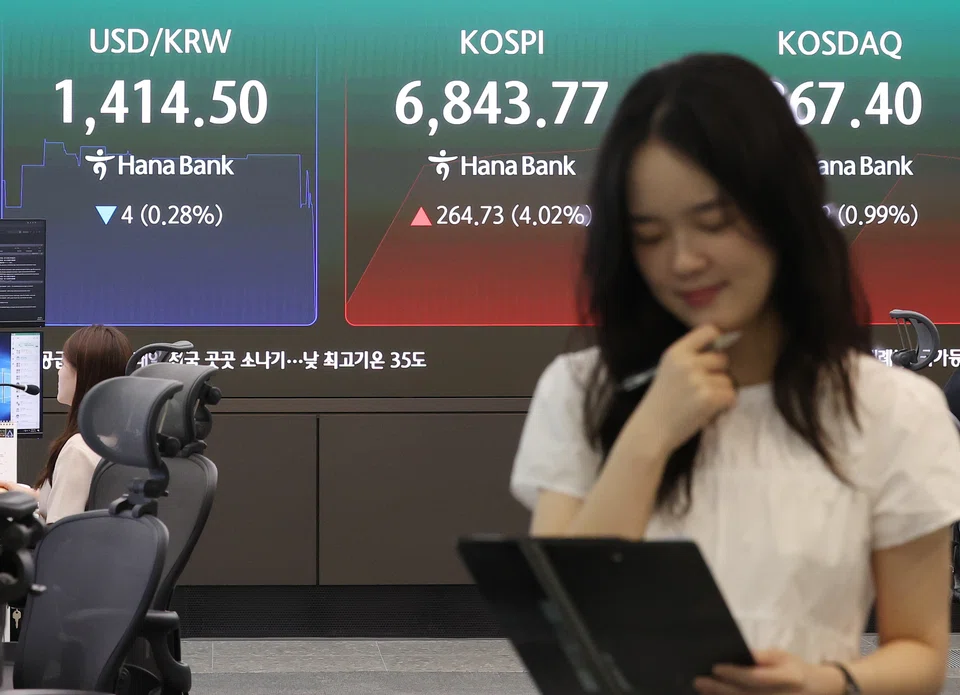
ASIAN stocks rose as technology shares rallied and a subdued US inflation report eased concerns about an imminent interest rate hike by the US Federal Reserve. Brent snapped a six-day rally.
MSCI’s Asia-Pacific equity index rose 0.8 per cent, with chipmakers Samsung Electronics and SK Hynix the biggest contributors.
South Korea’s Kospi Index rallied 3.7 per cent to enter a technical bull market as a rebound in the artificial intelligence trade fuelled a reversal from July’s sell-off.
Among the main market moves, S&P 500 futures were little changed as at 11.42 am Tokyo time.
Japan’s Topix rose 0.5 per cent, Australia’s S&P/ASX 200 fell 0.6 per cent, Hong Kong’s Hang Seng was little changed and the Shanghai Composite rose 0.5 per cent.
Caution lingered as Cisco Systems’ earnings failed to impress, sending its shares down 4.1 per cent in extended trading. Cerebras Systems tumbled 17 per cent after sales declined at its hardware business.
“The good thing is that we have managed to digest the historical unwind in the momentum trade,” Arun Sai, senior multi-asset strategist at Pictet Asset Management, said on Bloomberg TV.
“We are in the early innings of the capex buildout. We are going to have a cycle around it. We have digested a fair bit of uncertainty in the AI ecosystem.”
Elsewhere, Brent dropped 1.2 per cent to under US$88 a barrel.




Attention was also on the yen as it traded around the key level of 160 per US dollar, keeping investors on the lookout for more intervention by officials in the foreign exchange market.
Shorter-maturity Treasuries extended gains, with the two-year yield falling two basis points to 4.18 per cent as traders pared expectations for Fed tightening.
Money markets assigned less than a 50 per cent chance of a September rate increase. Bonds in Australia and New Zealand also advanced.
US consumer prices rose 0.2 per cent in July from a month earlier, a government report showed on Wednesday, in line with economists’ forecasts, while a key underlying inflation measure matched its slowest pace since March 2021.
The US inflation data offered some relief to investors after signs of a cooling labour market had already tempered expectations for rate hikes.
Still, persistent price pressures and volatile oil markets are complicating the outlook, leaving traders sensitive to incoming data for clues on whether policymakers can remain on hold.
The consumer price index reading and a cooler-than-expected jobs report “may keep hawkish Fed officials at bay in September,” said Gary Schlossberg, a global strategist at Wells Fargo Investment Institute.
“However, we remain guarded on the near-term outlook for inflation amid volatile oil prices tied to the ongoing Middle East conflict along with lingering core price pressures from a strong economy and the AI boom.”
Still, concern about sticky inflation and widening budget deficits have helped keep longer-maturity Treasury yields elevated.
Thursday’s 30-year bond sale is expected to price at the highest financing rate in 25 years, after a US$42 billion auction of 10-year notes drew the highest yield since 2007.
“The big surprise with a report that had no surprises is that a situation where inflation isn’t re-accelerating, coupled with the most recent, weak jobs report gives the Fed more time to wait,” said Chris Zaccarelli at Northlight Asset Management.
“Asian investors are returning to a familiar strategy: long Korea, short Hong Kong. That theme was briefly abandoned during the Kospi’s violent July sell-off. But August has brought a sharp reversal,” said Mark Cranfield, Markets Live strategist.
In other corners of the market, the US dollar was steady, while gold was little changed.
Traders remained focused on the yen, which was little changed at 159.31 per US dollar after ending the previous session 0.1 per cent weaker.
The currency has depreciated more than 1 per cent in August, unwinding some of the US-Japanese efforts to strengthen it at the turn of the month.
“Japanese authorities have already demonstrated a willingness to act, including coordinated action with the US Treasury, and levels approaching or exceeding the recent intervention zone are likely to keep traders cautious,” said Nathan Thooft at Manulife Investment Management.
“We definitely are still on intervention watch.” BLOOMBERG
Decoding Asia newsletter: your guide to navigating Asia in a new global order. Sign up here to get Decoding Asia newsletter. Delivered to your inbox. Free.
Share with us your feedback on BT's products and services
TRENDING NOW
DBS remains analysts’ pick ahead of Q3 earnings after Singapore banks’ share slump

Singapore identifies 7 firms responsible for haze fires, notices issued urging action: Grace Fu

Good Class Bungalow market activity picks up pace on ‘realistic’ pricing

High Court rules against Julius Baer’s Singapore trust arm in US$50 million family trust dispute

