Kospi leads gains as Asian stocks rise amid US inflation, tech rebound
SK Hynix and Samsung Electronics take their advances for the week to around 15%
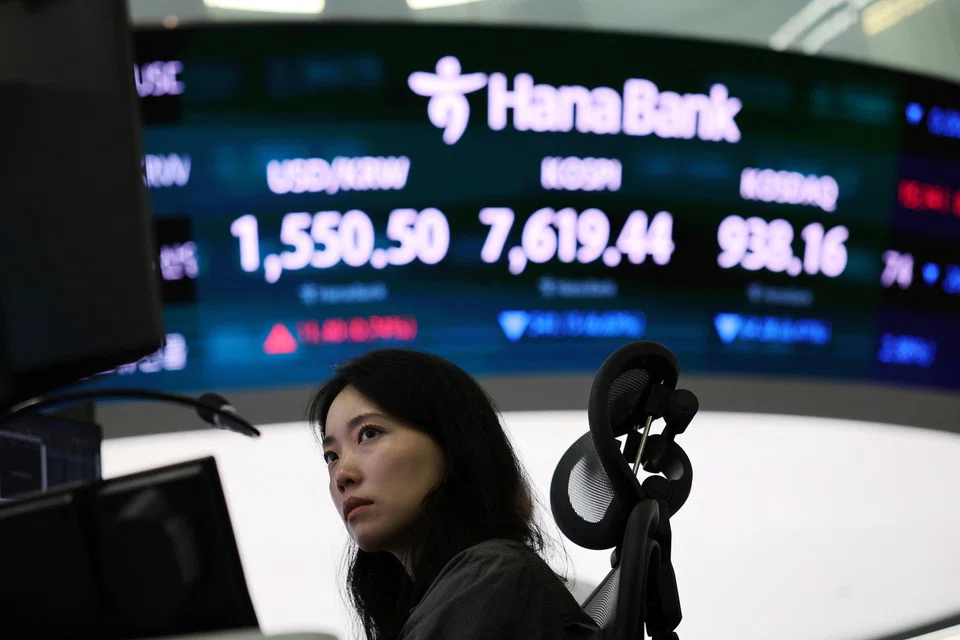
ASIAN stocks rose, adding to a fourth week of gains, as moderating US inflation reinforced bets that the US Federal Reserve will refrain from raising interest rates in September and technology stocks extended their rebound.
MSCI’s Asia Pacific equities gauge climbed 0.5 per cent, taking its weekly advance to 2.7 per cent. South Korea’s Kospi Index, a bellwether for the artificial intelligence trade, led the region, with Samsung Electronics and SK Hynix taking their gains for the week to more than 15 per cent.
Among the main moves across markets, S&P 500 futures were little changed as at 11.47 am Tokyo time.
Japan’s Topix rose 0.7 per cent, Australia’s S&P/ASX 200 fell 0.8 per cent, Hong Kong’s Hang Seng fell 0.7 per cent and the Shanghai Composite fell 0.2 per cent.
Advances in Asia on Friday (Aug 14) came as investors redoubled their bets on the AI trade after July’s sell-off, sending MSCI’s All Country World Index to a record high this week.
The S&P 500 Index closed at an all-time high on Thursday, while the Nasdaq 100 climbed more than 1 per cent to its highest level since late June.
“The modest easing of uncertainty surrounding US monetary policy has become catalyst for tech rebound,” said Yugo Tsuboi, chief strategist at Daiwa Securities.
“With US inflation showing no signs of worsening, excessive concerns over the Fed turning hawkish have eased. That is prompting buying particularly in high-growth stocks.”
Elsewhere, Treasuries held Thursday’s advance after US wholesale inflation cooled in July.


The yield on the rate-sensitive two-year note was little changed at 4.15 per cent, after falling six basis points in the prior session. Money markets are now pricing in about a 35 per cent chance of a Fed rate increase in September.
Back-to-back benign inflation prints, following last week’s softer-than-expected jobs report and a pullback in oil prices, are easing pressure on the Fed to tighten policy at its meeting in September.
While the lack of a deal in the Middle East remains a concern, equity traders are also focusing on a revival in the AI trade after a sell-off in semiconductor stocks in July.
“The next round of data that we get in September and the lead up to the meeting will be pretty critical,” said Bank of America securities economist Stephen Juneau.
At the same time, “the market obviously has started to really discount hikes more and more given that the data in recent months has been more dovish”.
US wholesale inflation decelerated by more than economists forecast in July. The producer price index rose 4.7 per cent from a year earlier, down from a 5.5 per cent annual increase in June, and was unchanged from the previous month.
In other corners of the market, Brent held its losses from the prior session, trading around US$87.10 a barrel.
Gold slipped 0.7 per cent to US$4,320 an ounce. China’s 10-year bond yield fell to the lowest since July last year after the central bank conducted reverse repos on Friday, its first such operation in the middle of a month.
A Bloomberg gauge of Asian chip-related stocks rallied almost 1 per cent, a fifth day of gains.
“A huge amount of hyperscaler money is flowing into hardware,” said Hitoshi Asaoka, chief strategist at Asset Management One.
“That is translating into extremely strong sales and profit growth for hardware companies. Investors are returning to the idea of, ‘let’s look at the earnings themselves again’.”
Even as Treasuries rallied on Thursday, the US sold 30-year bonds at the highest yield in a quarter century, underscoring the premium investors are demanding to finance the nation’s deficits.
The Trump administration is applying a 100 per cent tariff on imports of unmanned aircraft systems and their components in a bid to cut the US’ reliance on foreign supplies of drones.
In Asia, the yen remained within striking distance of 160 per US dollar, even after Prime Minister Sanae Takaichi’s government was said to support an interest rate increase. The Japanese currency was little changed on Friday, near 159.40 per US dollar.
The Bank of Japan is likely to raise rates in either September or October, according to people familiar with the matter.
Concerns at the central bank that yen weakness will fuel inflation are converging with the government’s desire to reinforce the impact of recent US-Japan currency intervention, strengthening the case for a near-term hike, the people said. BLOOMBERG
Decoding Asia newsletter: your guide to navigating Asia in a new global order. Sign up here to get Decoding Asia newsletter. Delivered to your inbox. Free.
Share with us your feedback on BT's products and services