

Asian stocks skid, Wall Street and bonds aided by oil slip
MSCI’s broadest index of Asia-Pacific shares outside Japan eases 0.3% as markets face tech concerns
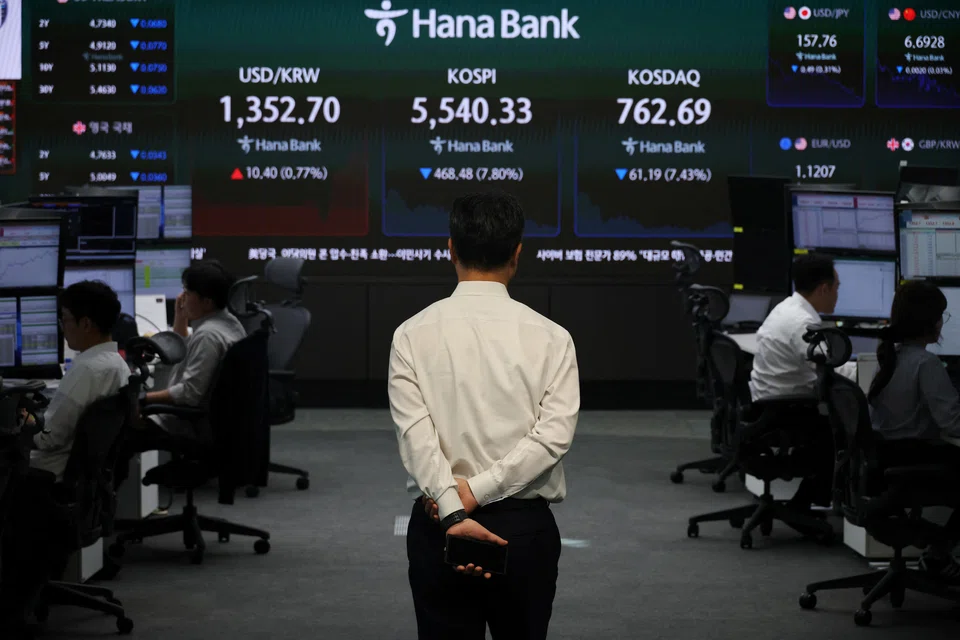
[SYDNEY] Asian share markets slipped on Monday (Oct 19) as unease over artificial intelligence’s enormous funding needs undermined confidence ahead of a week packed with earnings, while the euro eased in the wake of rioting across France.
A fall in oil prices offered some support to bonds and Wall Street stock futures, limiting Asia’s losses. Oil fell following US President Donald Trump’s decision to waive some sanctions on Russia, though he later said a final decision on the matter had not been made.
US Secretary of State Marco Rubio said on Saturday that the president would take up to 60 days to assess the economic impact of such a move. Brent futures still fell 1.6 per cent to US$108.06 a barrel, while US crude futures lost 0.7 per cent to US$100.70 a barrel.
Meanwhile, Iran reported another tanker had hit a mine in the Strait of Hormuz.
Geopolitical tensions combined with safe haven flows from equities to extend a rally in sovereign bonds, with 10-year Treasury yields down 3 basis points at 5.0645 per cent, having just recorded their largest weekly fall in over eight months.
All of this helped S&P 500 futures edge up 0.5 per cent, while Nasdaq futures rose 0.8 per cent.
Asian markets were hampered by concerns about tech; Japan’s Nikkei fell 2 per cent after losing 5.4 per cent last week as the tech sector took a beating. South Korea dropped 1.6 per cent, having shed more than 14 per cent last week.
MSCI’s broadest index of Asia-Pacific shares outside Japan eased 0.3 per cent.
“Investors have long worried that AI revenues won’t be sufficient to recoup the massive upfront investment, while AI infrastructure may need to be written down as it ages and depreciates in the meantime, which lowers book value massively,” said My Bui, an economist at fund manager AMP.


“Rising government bond yields and wider corporate credit spreads are increasing financing costs, making it harder to borrow, refinance, and keep the AI infrastructure buildout going.”
A lot riding on earnings
The PHLX Semiconductor Index shed 11.4 per cent last week in its longest losing streak since 2008.
Investors will be hoping Meta will beat Wall Street forecasts when it reports earnings on Wednesday, along with semiconductor firms Lam Research and Texas Instruments and Elon Musk-led companies SpaceX and Tesla.
Meta is one of five AI hyperscalers that combined are expected to increase their capital spending to about US$1.2 trillion in 2027, according to Goldman Sachs.
Others reporting include Netflix, Procter & Gamble , General Motors and GE Aerospace.
Earnings are still expected to rise 30 per cent overall thanks to the huge profits made by tech firms.
European stocks were weighed down by political uncertainty in France with Eurostoxx 50 futures off 0.4 per cent, while DAX futures lost 0.3 per cent and FTSE futures were flat.
Those same concerns saw the euro ease 0.2 per cent to US$1.1212 , nearer to last week’s 16-month low of US$1.1113.
The US dollar dipped 0.1 per cent against the yen to 157.75 and has spent the entire month so far in a tight range as the threat of Japanese intervention has kept speculative sellers at bay.
In commodity markets, non-interest-bearing gold got a lift from falling yields and rose 0.4 per cent to US$4,181 an ounce. REUTERS
Decoding Asia newsletter: your guide to navigating Asia in a new global order. Sign up here to get Decoding Asia newsletter. Delivered to your inbox. Free.
Share with us your feedback on BT's products and services
TRENDING NOW

Far East Organization’s The Serra Residences sells less than a quarter of units released at average S$3,460 psf

Once staunchly pro-China, Malaysian Chinese businesses are now distancing themselves from Beijing

Ageing in Asia: Huge potential for the consumer economy

DBS, OCBC, UOB face rate hike reality check

