Bank of England raises rates for first time since 2023, warns another move likely
Looming inflation from months of high energy prices requires an immediate rate hike, says central bank
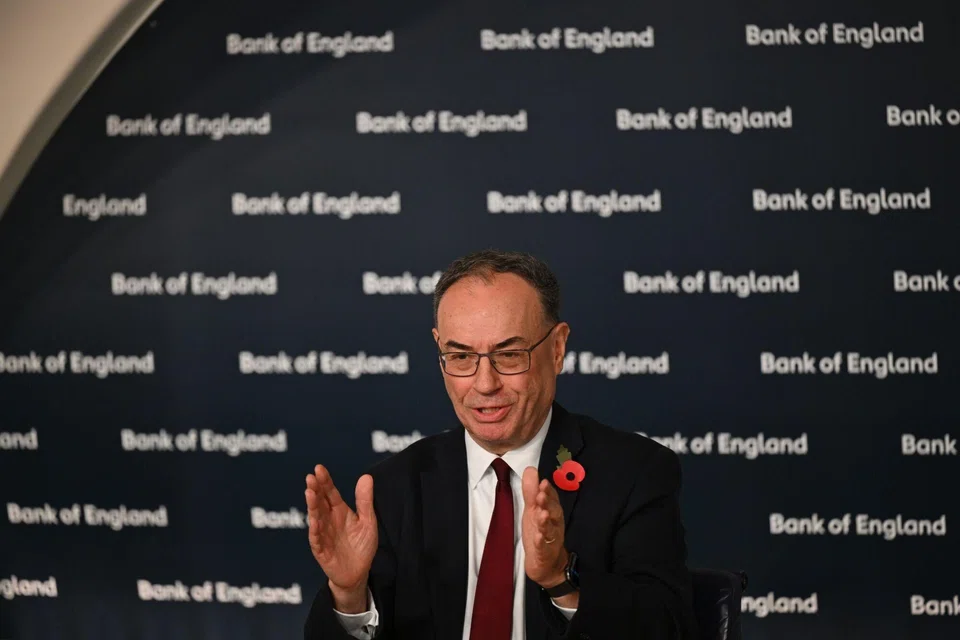
[LONDON] The Bank of England (BOE) raised interest rates for the first time in over three years on Thursday (Nov 5).
It warned that at least one more increase was likely if the US-Iran conflict continues, as it started on a path that its main peers have already embarked on.
British inflation is likely to reach around 5 per cent in the middle of 2027, the BOE said, more than double the central bank’s target and a blow to Prime Minister Andy Burnham, who has sought to ease cost of living pressures.
While there was little evidence so far of faster inflation outside sectors directly affected by higher energy costs, the BOE said the amount of inflation pressure coming down the road from months of high energy prices required a rate rise now, even though that will increase borrowing costs for businesses and many homeowners.
In his opening remarks at a press conference, BOE governor Andrew Bailey said: “Today’s increase should not be seen as the first in an inevitable long sequence of hikes. That is not inevitable.
“But unless the conflict in the Middle East is resolved, neither does it seem likely to be the last increase.”

MPC unaimous over rate hike, divided on size
The central bank’s Monetary Policy Committee (MPC) voted 8-1 to raise rates to 4 per cent from 3.75 per cent, but in contrast to expectations in a Reuters poll, the dissent came not from a policymaker seeking to keep rates on hold but one seeking a bigger hike.
Catherine Mann, who said in October that the BOE had been slow to reassure markets that it had a grip on inflation, voted for a half-point interest rate increase to 4.25 per cent.
The sterling strengthened against the US dollar after the decision and two-year British government bond yields – which are sensitive to expectations of future rate moves – rose by a relatively sizeable five basis points.

“Today’s (rate) move still feels like a measured, credibility-preserving one rather than the start of an aggressive cycle. Inflation is elevated, but the evidence that it is broadening beyond energy remains mixed,” said Madison Faller, a global investment strategist at JPMorgan Private Bank.
Until now, the BOE had not followed the US Federal Reserve, the European Central Bank and other central banks in raising rates in response to inflation pressures from the Iran war.
Bailey said a dip in oil prices over the last 48 hours – a move largely driven by the results of US midterm elections – was positive, but warned “there is already a significant amount of inflationary pressure in the pipeline”.
He added: “We’ve seen encouraging news in the last 48 hours. That is not going to cause me to tell you that there is no need to move interest rates up again, because there is a lot that we need to see and observe and understand about this.
“But, obviously, it has an impact on my view certainly of where the outlook, where the profile of inflation will go to.”
MPC disagree on likely extent of further rate rises
In minutes of November’s decision, Mann said she was concerned about “non-linear inflation risks” as consumer price inflation had risen to 3.5 per cent in September, which she viewed as a potential trigger for a loss of confidence in the central bank.
In previous months, Bailey had argued that the BOE could take its time before deciding to raise, as it had higher interest rates at the start of the conflict than other central banks and investors had previously expected it to cut rates this year.
Coming into Thursday’s decision, both investors and financial markets had been near-certain there would be a rate rise this month. But financial markets also priced in three quarter-point rate rises for 2027, more than most economists think is likely.
Bailey said such differences reflected financial markets pricing in tail risks of a sharp further rise in energy prices, while economists’ expectations were based on the single most likely path, of a smaller amount of further tightening.
“Without news which softens the risks to inflationary pressures, I can see the argument for a further increase in rates,” he said in the policy minutes.
Deputy governor Clare Lombardelli said a further rate hike was likely to be needed in the near term.
External MPC member Megan Greene and chief economist Huw Pill – who like Mann had voted for a rate hike in September – talked of a need for “further tightening” and “additional hikes”, respectively.
MPC members Swati Dhingra and Alan Taylor – who had previously been reluctant to raise rates – said they would need stronger evidence of second-round effects before backing more tightening.
BOE predicts faster growth, higher inflation
In its central forecast for growth and inflation, the BOE revised up its expectations for growth in 2026 and 2027 to 1.6 per cent and 1.3 per cent, respectively – notably stronger than the government’s Office for Budget Responsibility predicted last week.
The upgrade follows strong official data this year, and the BOE attributed some of the strength to spending on artificial intelligence and to a small, temporary boost from finance minister John Healey’s annual Budget last week.
But the BOE now expects inflation to peak at an average 4.8 per cent in the second quarter of next year. In a more adverse scenario where oil prices peak at around US$130 a barrel compared with around US$100 currently, inflation hits 6.2 per cent in the third quarter of 2027.
Under the central scenario, inflation is not seen returning to 2 per cent until the third quarter of 2028, six months later than the BOE predicted in July, when forecasts were prepared during a lull in the US-Iran conflict which had lowered energy costs.
After inflation and taxes, British households’ income from work was set to fall both this year and next, the BOE noted.
Healey’s annual Budget would lower inflation by 0.25 percentage point at its peak but raise it later on when temporary cost-of-living assistance expired, the BOE added. REUTERS
Decoding Asia newsletter: your guide to navigating Asia in a new global order. Sign up here to get Decoding Asia newsletter. Delivered to your inbox. Free.
Share with us your feedback on BT's products and services