Bitcoin stalls short of US$100,000. What next?
The cryptocurrency fails to breach this level despite the tailwind from Donald Trump’s election win


THE world’s biggest cryptocurrency has been volatile as a wave of profit-taking caused Bitcoin to fall short of hitting the key US$100,000 level.
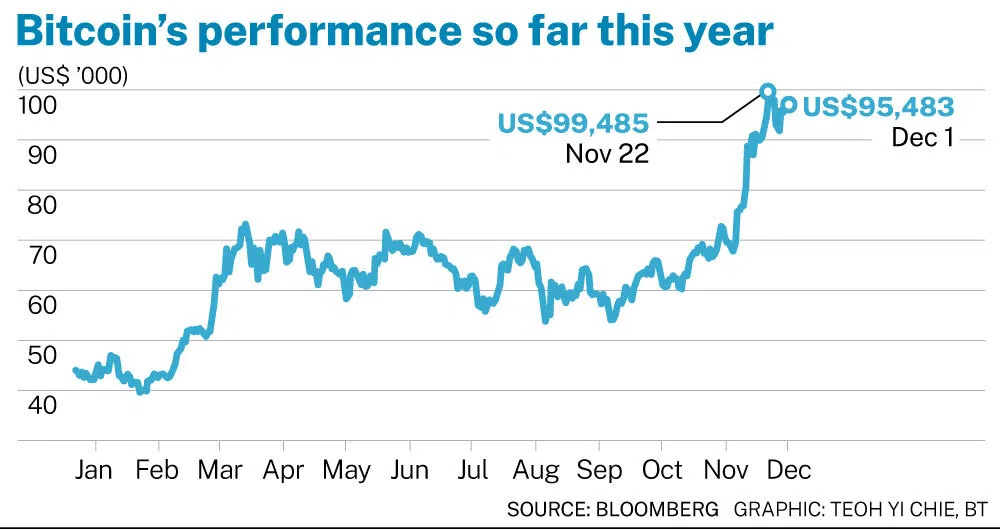
Despite the pullback, market watchers believe the road to US$100,000 is intact, citing heightened investor interest and the promise of a more crypto-friendly regulatory climate in the US. The asset has still soared some 120 per cent so far this year.
US president-elect Donald Trump’s win had fuelled Bitcoin’s blistering rally – the asset surged more than 40 per cent since Nov 6 to a record US$99,485 on Nov 22 – adding around US$1 trillion to its total market value.
Trump had embraced cryptocurrencies during his campaign, pledging to make the world’s largest economy the “crypto capital of the planet”, with plans to accumulate a national stockpile of Bitcoin.
But the rally did not hold. It was last trading at US$95,843 on Dec 1.
“There could be some pullbacks due to profit-taking...but we are of the opinion that once the price resistance of US$100,000 is broken, the next price resistance level of US$120,000 could be reached with ease,” said Revo Digital Family Office chief investing officer and managing partner Zann Kwan.
She believes that Bitcoin could end 2025 as the world’s third-biggest asset, behind gold and US chip giant Nvidia. The market value of the digital currency ranks it as the world’s number seven, according to Singapore-based crypto exchange Independent Reserve.
Analysts also point to rising interest since January, when the US Securities and Exchange Commission’s (SEC) approval of US-listed Bitcoin exchange-traded funds (ETFs) helped start 2024 on a bullish note for the asset. Bitcoin, which was trading above the US$40,000 range during the month, rode on the wave of optimism to vault over US$70,000 in March.
Independent Reserve said Bitcoin’s current bull run has more legs to go, particularly after halving.
Occurring once every four years, halving essentially cuts the supply of Bitcoins, creating a scarcity effect. Coded into the Bitcoin protocol by Satoshi Nakamoto – the pseudonym used by the creator or creators of Bitcoin, the process will continue until all 21 million coins have been mined, estimated to be in the year 2140. The four-year period is derived from calculating how much time is needed to mine 210,000 blocks.
“In the past three cycles, Bitcoin reached new all-time highs 12 to 18 months post halving. The most recent halving occurred in April, indicating that we are still in the early stages,” Lasanka Perera, chief executive officer of Independent Reserve Singapore, told The Business Times.
“Considering ETFs have opened the floodgates to passive portfolio allocation into Bitcoin and Trump is assembling a pro-crypto administration, this cycle may well be longer than previous cycles,” Perera added.
With the SEC’s January greenlight for Bitcoin ETFs, a group of 12 issued by the likes of BlackRock and Fidelity Investments, has amassed US$107 billion in assets since their launch. This performance is making the group among the most successful fund category launches in history.
However, options activity indicated more declines might be in sight in the short term. According to on-chain options decentralised protocol Derive, with a trade volume of US$7.1 billion, investors are looking to Dec 27, when US$11.8 billion in Bitcoin options expire. It said this could trigger major moves in either direction – to as low as US$81,493; or as high as US$115,579 that day.
Some market players are already looking ahead to the next big resistance of US$200,000 as they view breaching US$100,000 to be a matter of time.
Standard Chartered in a November report predicted Bitcoin rising to US$200,000 by the end of 2025.
While FalconX general manager for Asia-Pacific and Middle East Matt Long declined to provide price forecasts, he highlighted Bitcoin’s limited supply.
“There will only ever be 21 million coins and US-listed ETFs alone hold more than one million. I’d expect to see further positive demand side shocks as regulatory clarity accelerates, facilitating deeper adoption,” he said.
Independent Reserve’s Perera said: “I see Bitcoin as a far superior asset to gold in many aspects including scarcity, portability, divisibility and fungibility. At US$200,000, the Bitcoin market cap will only represent 20 per cent of the gold market cap.”
More developments that are positive for Bitcoin are said to be in the works. Bloomberg News reported that Cantor Fitzgerald is in talks with stablecoin issuer Tether Holdings, to receive support for Cantor’s planned US$2 billion programme to lend dollars to clients who put up Bitcoin as collateral.
Cantor’s CEO Howard Lutnick is co-chair of Trump’s transition team and the president-elect’s pick to run the Commerce Department.
The president-elect’s transition team has also held discussions over whether to create the first White House position dedicated to digital-asset policy.
Tight regulations may also ease, potentially boosting demand. Crypto investors see an end to increased scrutiny under SEC chair Gary Gensler, whom Trump has said he will replace.
“In the US, we are potentially seeing, for the first time, a crypto-positive SEC, which would continue to drive the bullish outlook for digital assets. This will have spill-over effect to the regulators in the rest of the world,” said Revo Digital Family Office’s Kwan. She added that the US, China and UK collectively own more than 2 per cent of the world’s supply of Bitcoins.