

CapitaLand tops buyback table; Heliconia raises stake in CSE Global

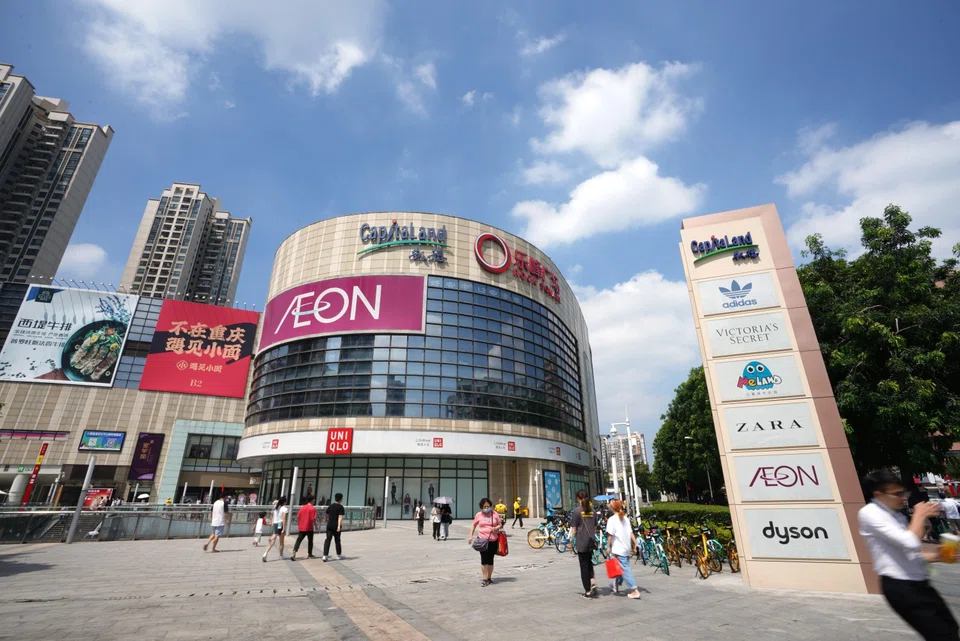
REAL estate group CapitaLand Investment (CLI) was an active buyer of its stock in the past week. From Jun 21 to 28, the company bought back 2.5 million shares over four transactions. Its purchase price ranged from S$2.64 to S$2.65, and total buyback spend was S$6.6 million.
ShareInvestor data also shows CLI has spent the most on buybacks this year, among Singapore-listed counters. It has purchased 100.5 million shares over 43 transactions, and spent a total of S$273.7 million.
OCBC , which is in second place on the buyback table, has spent S$147.6 million over 30 transactions.
CLI’s rate of buybacks is high relative to its recent history. Last year, CLI bought back 21.4 million shares over nine transactions, spending S$64.4 million. In 2002, the company bought back 6.9 million shares over two transactions, spending S$26.7 million.
The company was listed in its present form in September 2021 following a restructuring designed to unlock value.
Prior to this restructuring, the listed entity then known as CapitaLand included a property development arm. It had also been trading at a discount to its book value.
To address this undervaluation, CapitaLand separated its property development business from its asset management and lodging businesses.
The latter businesses were listed as CLI – an asset-light entity that would grow its revenue from funds under management and fee-related earnings.
On its first day of trading, CLI’s shares closed at S$2.95 – above the company’s pro forma net asset value of S$2.823. It rose as high as S$4.16 in April 2022.
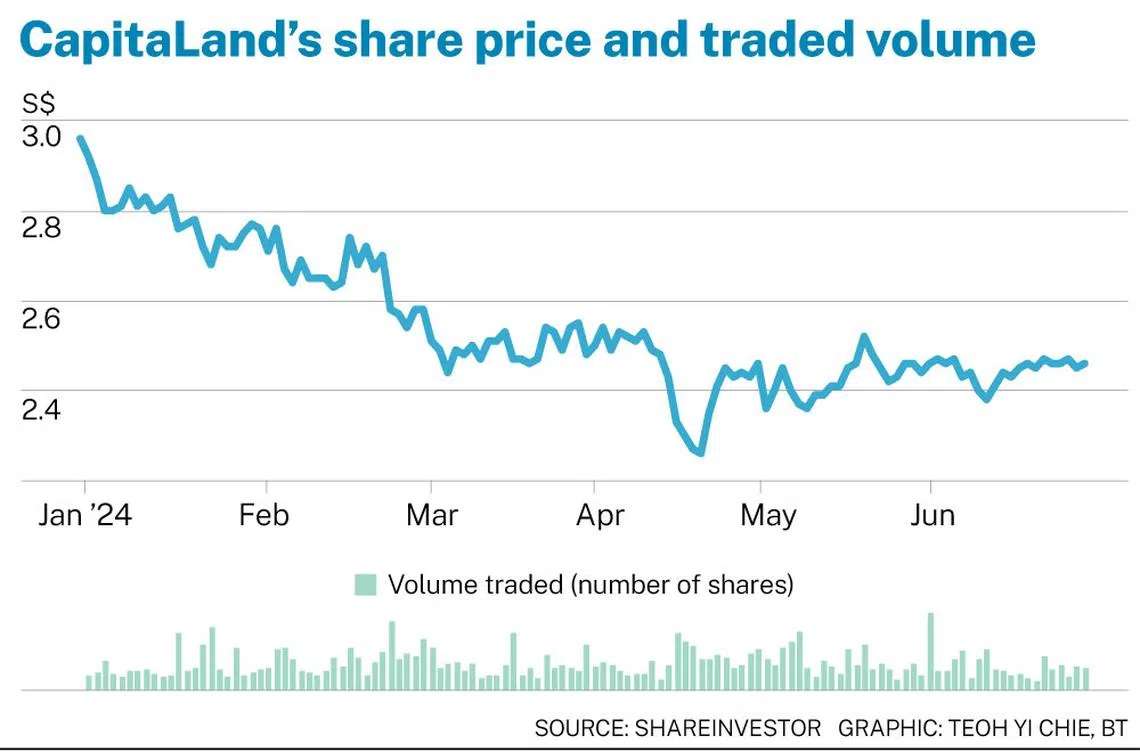
Since the start of 2023, however, CLI’s shares have been steadily declining. They are down 14.7 per cent this year, closing at S$2.66 on Friday (Jun 28) – or 97 per cent of its book value of S$2.74 as at Dec 31, 2023.
In a response to questions from shareholders ahead of its annual general meeting in April, CLI said increased finance costs and a slowdown in dealmaking activities have strained its operational performance.
China’s weak operating environment has also led to fair value losses and impairments on some parts of its portfolio.
It added, however, that it had managed to secure S$3.5 billion in commitments through its private fundraising activities last year – a 42 per cent increase from 2022 – and that the proportion of its operating profit contributed by fee-related business had increased to 54 per cent in 2023 from 40 per cent in 2021.
Several brokerages continue to rate CLI a “buy”, although at least one has recently cut its price target.
Maybank analyst Krishna Guha, in an April report, trimmed his target price to S$3 from S$3.15. Guha reduced his estimate for CLI’s earnings before interest, taxes, depreciation and amortisation by 14 per cent.
This was on a lower assumption for assets under management, and slower growth in CLI’s lodging business.
Heliconia signals confidence in CSE
Heliconia Holdings’ stake in systems integrator CSE Global has risen to 23.04 per cent, from 22.64 per cent previously, following an issue of new shares under CSE’s scrip dividend scheme.
For its FY2023, CSE had declared a final dividend of S$0.015 per share. Shareholders could opt to receive this in either cash or shares. Those who chose to receive shares would be issued new shares at an issue price of S$0.375.
On Jun 24, CSE announced it had issued 14.9 million shares as part of the scrip dividend scheme. The participation rate was 54.79 per cent, and the company’s share base increased by 2.19 per cent. Heliconia’s units received 6.1 million of the total number of new shares issued.
Heliconia, an investment company owned by Temasek, emerged as a substantial shareholder of CSE in July 2020 following a married deal with Serba Dinamik.
The latter, a Malaysian company providing engineering services to the oil and gas (O&G) industry, had acquired its stake in CSE in 2018.
CSE is best known as a provider of control systems, telecommunication networks and security solutions to O&G companies.
The company has, however, diversified into several trending sectors. Its offerings now include data centre electrification, the integration of electric vehicle charging stations with power grids and the manufacture of solar solutions.
Last year, the company’s revenue increased 30 per cent to S$725.1 million. Its net profit came in at S$22.5 million, up from S$4.8 million in 2022. Net cash generated from operations increased substantially – from S$9.1 million to S$72 million.
In the first quarter of the year, CSE continued to build on that growth. Revenue increased 23.9 per cent to S$197.5 million
Maybank analyst Jarick Seet – who rates CSE a “buy” with a 12-month price target of S$0.64 – sees CSE as a proxy for the electrification, artificial intelligence and data centre investment themes.
He expects revenue growth in subsequent quarters to be higher as Q1 is typically CSE’s weakest quarter.
In a May report, Seet also noted that CSE recently installed a power management system for a data centre in the United States. Seet believes this system is for a major cloud provider and that the company “will likely win more data centre contracts from existing and new customers”.
Investors have shown little excitement about CSE’s prospects, however. The stock is down 9.1 per cent this year, closing Friday at S$0.40.
At the company’s recent annual general meeting, one shareholder expressed concern about the company’s debt levels. Its net debt stood at 76 per cent of equity as at end-2023.
The scrip dividend scheme may help address that further. Over the last three years, CSE’s dividend level has been unchanged even as its revenue and profits varied: It has paid an interim dividend of S$0.0125 per share and a final dividend of S$0.015 per share.
The company has only just introduced the scheme. The rationale is to retain cash for expansion, strengthen its working capital position and enhance its financial flexibility.






