

China national team’s US$68 billion exit alters stock strategies
Trading activity onshore has eased from a frenzied pace of nearly four trillion yuan earlier this month
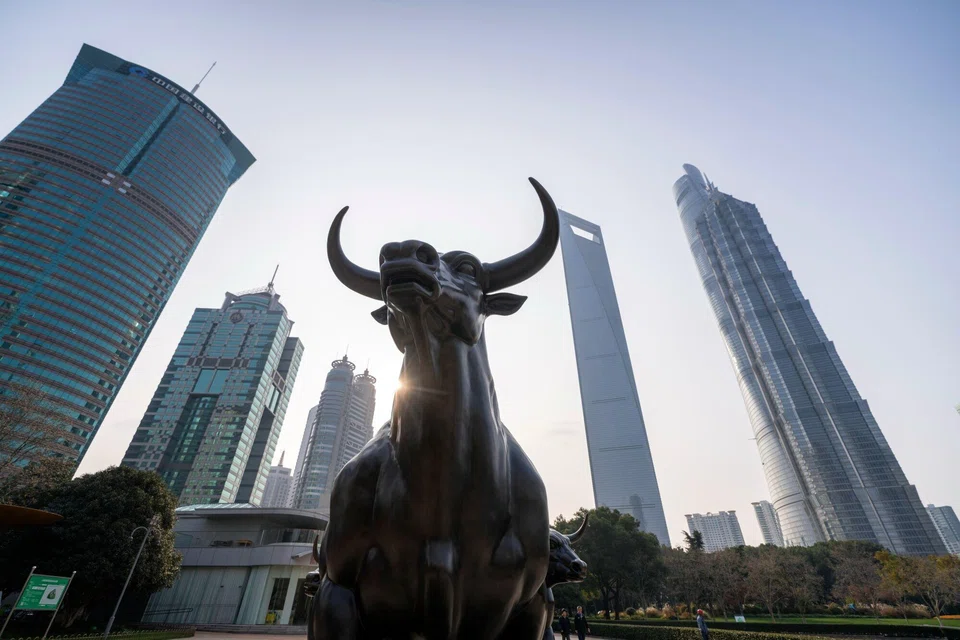
FOR years, investors in China’s stock market took comfort in an unseen backstop: the so-called national team, quietly deploying vast firepower to cushion sell-offs and stabilise prices.
The script flipped last week.
Record outflows from exchange-traded funds (ETFs) held by Central Huijin Investment, a sovereign wealth fund, sent the clearest signal yet that Beijing is no longer simply propping up the market, but actively reining in the rally, a sharp break from past rescue playbooks.
While many investors see the selling as an effort to drain speculative excess from pockets of the technology sector rather than cool the broader market, the national team’s shift from one-way support to two-way trading is already changing behaviour. Bloomberg Intelligence (BI) estimates Central Huijin sold US$67.5 billion across 14 ETFs in just six sessions to Thursday (Jan 22).
“If enough people are watching what this player is doing, its actions could be enough to alter expectations,” said Chen Da, founder of Dante Research.
The ETF outflows have coincided with regulators’ efforts to tighten rules on margin financing, signalling unease over rapid gains in sectors such as rockets and AI applications, where profitability is unclear. The broader onshore benchmark CSI 300 has advanced 1.8 per cent over the past month, while the chip-heavy Star 50 Index has jumped 16 per cent.
“These days it’s probably smart to focus trading on the stocks that the team owns less of to avoid being in the line of fire,” said Wu Wei, a fund manager at Beijing Win Integrity Investment Management. “My trading has slowed a bit, because it’s not a bullish signal at the end of the day.”
While the national team’s trading activity won’t be revealed until ETFs’ quarterly reports, investors and analysts are busy estimating just how much ammunition there’s left. Central Huijin started aggressively investing in China’s ETFs in 2023, amassing US$180 billion in such assets by the end of August 2025, according to Bloomberg Intelligence.
The “scale of liquidation suggests a proactive effort to facilitate a price correction in overheated sectors”, wrote BI analysts, including Rebecca Sin. After record outflows from a fund tracking the Star 50 Index, they estimate 5 per cent of Central Huijin’s firepower is left for that product.


In recent sessions, intraday gains in certain gauges were quashed as turnover surged in ETFs that track the corresponding index, now widely seen as a sign that the national team is selling.
On Wednesday, turnover for CSI 1000 ETFs started to climb as the underlying gauge rebounded nearly 2 per cent within an hour of trading, before slipping lower.
Such patterns have repeated through the week, though strong risk appetite means the interventions have not always pushed indexes into the red. The E-fund ChiNext ETF saw sizeable outflows on Thursday, but the gauge eventually recouped an intraday drop.
Though the selling surprised some investors, many view it as a step towards fostering a gradual bull market. Short-term volatility on the CSI 300 has fallen to the lowest since May. Trading activity onshore has eased from a frenzied pace of nearly four trillion yuan (S$729 billion) earlier this month.
“Instead of reading the state funds’ selling as a signal that the rally is over, we should consider this in the context of the structural, slow bull,” said Yang Ruyi, a fund manager at Shanghai Prospect Investment Management, adding that it makes sense for Central Huijin to reposition into other thematic ETFs.
For consultancy Z-Ben Advisors, the absorption of massive sell-offs without major volatility shows strong institutional demand for A-shares.
“Selling right now will free up positions so that they can provide a boost at a future time of risk,” said Zhu Zhenxin, head of Asymptote Investment Research in Beijing. “Such intervention will prevent a ‘mad bull’ like the one we saw in 2015.”
With national team flows under heavy scrutiny, investors may reignite the tech rally once they judge little remains to sell. Strong demand for tech stocks makes the euphoria hard to quell. Despite obvious signs of intervention, the CSI 1000 Index – home to rocket stocks such as Hunan Aerospace Huanyu Communication Technology and those along the chip supply chain – is still at its highest since 2017.
There’s also the lingering question of whether such heavy involvement in ETF trading is distorting market dynamics.
For now, Niu Chunbao, fund manager at Shanghai Wanji Asset Management, is looking at the blue chip stocks that have been swept up in the latest round of ETF selling.
“I am pleased to see the team exit some of the ETFs as gains in some stocks were making the market restless and impulsive,” he said. “Dips caused by their selling may render some value stocks even more attractive to us.” BLOOMBERG
Decoding Asia newsletter: your guide to navigating Asia in a new global order. Sign up here to get Decoding Asia newsletter. Delivered to your inbox. Free.
Share with us your feedback on BT's products and services
TRENDING NOW

Once staunchly pro-China, Malaysian Chinese businesses are now distancing themselves from Beijing

Inside Singapore’s government team that kills its own products

Johor’s investment boom is real, but actual contribution from JS-SEZ unclear
Inside F1: How ‘reactive’ DHL acted quickly to fit Malaysia race just before Singapore’s

