China stocks suffer mauling; central bank injects 1.2t yuan to calm markets
Economists expect calm to return after initial knee-jerk selling
 Add BT as a preferred source
Singapore
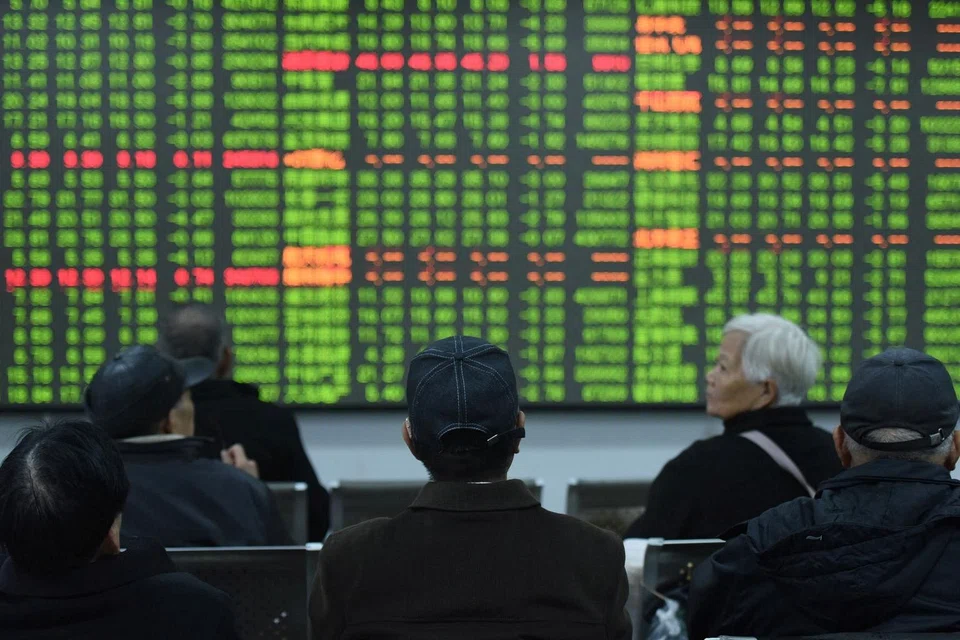
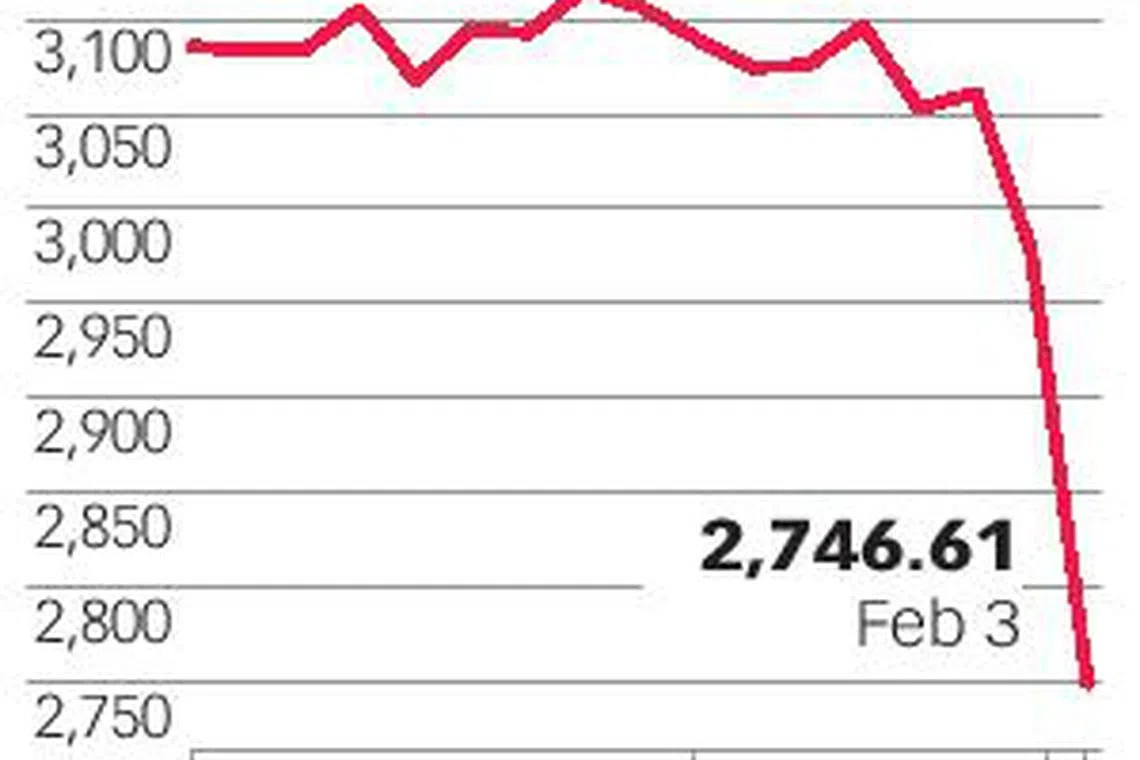
CHINA markets reopened on Monday to a massive sell-down as nervous investors dumped stocks which had been shielded by the Lunar New Year holidays since Jan 24.
The rout lopped US$393 billion off the benchmark Shanghai Composite index, or nearly 9 per cent, when trading opened. The dive also dented sentiment in some regional markets.
The mauling had been widely expected as investors had not had the opportunity to unload their shares amid the spread of the novel coronavirus in over 20 other countries, with the Chinese mainland accounting for 17,190 of the 17,373 cases. So far, the virus has killed 362.
Numerous Shanghai counters hit their daily limit just minutes into trading, leading to the bourse's worst showing since August 2015's "Black Monday". Commodities and agriculture futures, too, were hammered, with China's benchmark iron ore contract falling by its daily limit of 8 per cent. Copper, crude and palm oil also sank by the maximum allowed.
Elsewhere in the region, stock markets opened lower as well, though losses were less dramatic as they had already reacted to the developing epidemic the past week.
Navigate Asia in
a new global order
Get the insights delivered to your inbox.
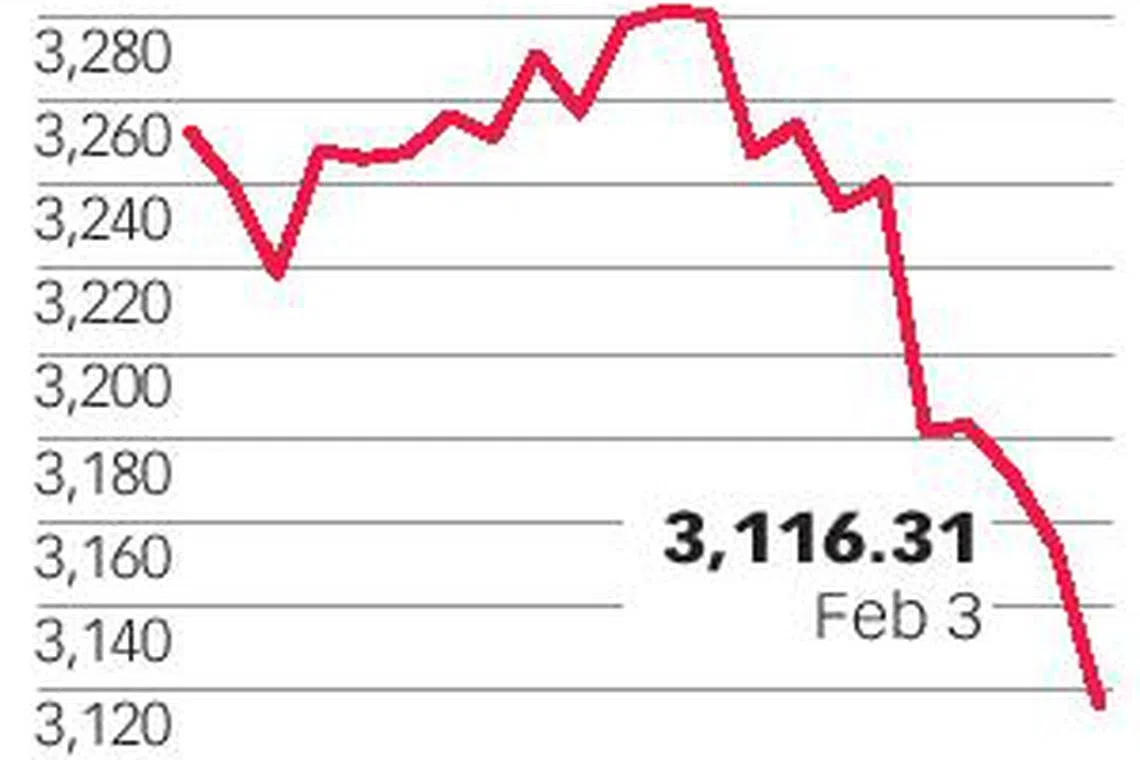
On Monday in Singapore, which has 18 confirmed cases, the benchmark Straits Times Index (STI) gave up 1.19 per cent at 3,116.3.
In Japan, where 20 cases of the virus have been confirmed, the Nikkei 225 fell more than one per cent. In South Korea, which has 15 confirmed cases, the benchmark Kospi dropped 0.5 per cent, before recovering to end almost flat at 2,118.88. Hong Kong, which has also 15 confirmed cases, saw the Hang Seng Index buck the downtrend to end up 0.17 per cent, at 26,356.98, after it had lost more than 6 per cent last week when the Hong Kong market reopened last Wednesday.
Going by the futures markets at the time of writing, the forecast is for a positive opening for Wall Street and a mixed day for shares in Europe.
The fear factor driving behavioral response to avoid infection risk is the major source of economic growth risk, Citi Research's Asia economics team said.
"The current rates of infection are still highly concentrated in Wuhan City, which accounts for only 1.6 per cent of China's gross domestic product (GDP), and other cities in Hubei province, which accounts for 4.3 per cent of China's GDP," the economists said, adding that Thailand, Hong Kong and Singapore are most vulnerable if the virus were to become a pandemic, while Korea, China and Taiwan are less so in this region.
China's GDP growth is projected to fall to 5 per cent in the first quarter of 2020.
Song Seng Wun, an economist with CIMB Private Banking, said the market tumble in China was not a surprise.
"China's reaction was an expected knee-jerk reaction. Investors are nervous about the potential fallout."
But he added that China's government doesn't want a panic sell-off and has worked hard over the weekend to pump liquidity into the market.
China's central bank sent a powerful message about its intent to support the economy, with a larger than expected injection of 1.2 trillion yuan (S$236 billion) into the money markets and a deep 10-basis-point cut to its regular reverse repos. China's securities regulator moved to limit short-selling and urged mutual fund managers not to sell shares unless they face investor redemptions, sources told Reuters.
It is clear the government wants growth-supportive measures to reassure the market, said Mayank Mishra, macro strategist at Standard Chartered Bank in Singapore.
Mr Song reckoned the selling in China would ease in a day or two after the knee-jerk sell-off. As for the Singapore market, he expects the STI to hold steady unless sentiment sours and the three local banks - DBS, UOB and OCBC - are sold down on fears that the global economy is headed for a recession.
"For STI to breach 3,100, we have to see investors more worried about the broader impact on Singapore and region and banks' earnings severely reduced because of the sharp pullback in economic activities." Developers have to start seeing people returning units, which has not happened yet, Mr Song explained.
Helping to support a floor for the STI are investors hoping for that 10 per cent correction to re-enter the market. In the broader market, economists are watching the impact of the virus on tourist arrivals here before they revise their estimates for Singapore's GDP.
"Assuming the worst case, we see a 50 per cent fall in Chinese visitor arrivals this year. That alone, assuming no growth from the other markets because of bad first-half 2020, will still mean a 10 per cent fall in overall international visitor arrivals this year.
"Singapore doesn't have much meat on the bone to shave. Even though tourist receipt is only 5 per cent of GDP, when you are looking at 1.0-1.5 per cent GDP growth, you could see no growth or worst case, a contraction," Mr Song said.
Selena Ling, Head of Treasury Research and Strategy, OCBC Bank, said it was still early days, but Singapore's 2020 growth forecast could see downside risk if the duration and severity of the outbreak worsens further. "Using the SARS experience in 2003 as a reference, we estimate that Singapore's GDP growth could potentially be shaved off by up to 0.5-1.0 percentage point from the baseline if the current epidemic lasts more than three-six months and constrains business and consumer confidence, restricts travel (air, land and sea included), and impacts productivity (with workers under voluntary/involuntary quarantine), albeit this is not our base case scenario at this juncture," Ms Ling said.
Read more virus outbreak reports:
Copyright SPH Media. All rights reserved.