

China’s market revival hinges on gloomy economy turning corner
The country’s equities, currency and onshore fixed-income markets remain on course to hand investors positive returns for 2025
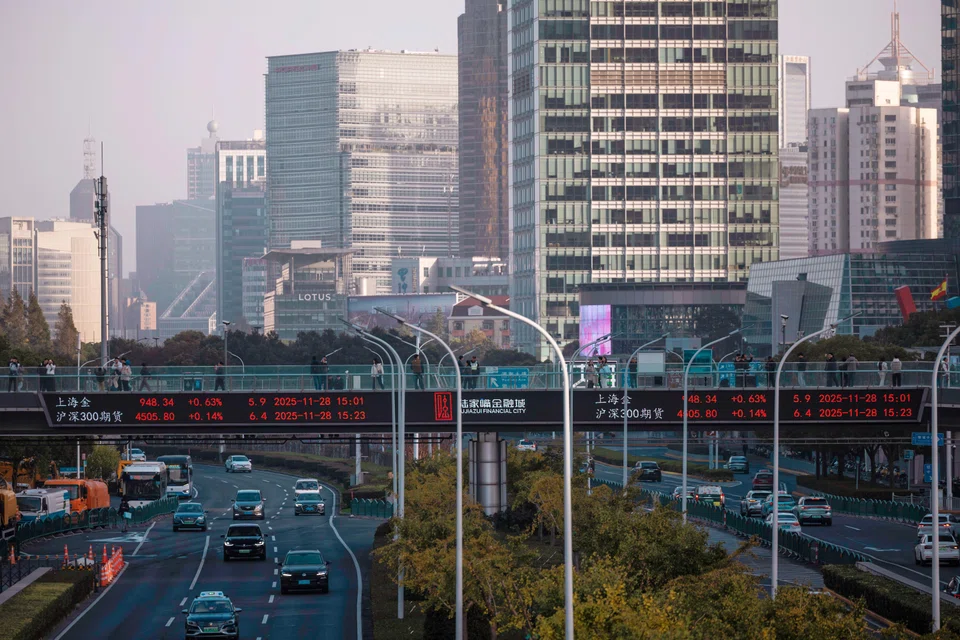
[BEIJING] China’s markets shed the “uninvestable” tag this year. To bury it for good, investors say an acceleration in the domestic economy is needed so the bullishness does not fizzle out.
The country’s equities, currency and onshore fixed-income markets remain on course to hand investors positive returns for 2025, a scenario unseen in half a decade. Yet the stock market’s rally has lost steam in recent weeks, while bond yields are low due to widespread deflation.
Heading into the new year, consumers remain downbeat and the property market is stuck in the doldrums. That leaves the economy being propped up by an ongoing export boom that should be just enough to allow the nation’s leaders to meet their growth target of about 5 per cent.
Overseas fund houses, including BlackRock, Fidelity International and Amundi, said there could be more inflows into Chinese markets in the coming year. And if that optimism spills over to consumers and helps fund companies’ expansion plans, the hope is that the bullish mood could begin to fuel momentum for the real economy too.
“What was once ‘uninvestable’, then ‘selectively interesting’, is now ‘indispensable’ for some,” said Aidan Yao, senior investment strategist for Asia at Amundi Investment Institute. “As sceptics turn into believers, sidelined capital should re-enter China, helping to fuel the next phase of market ascent.”
In a turnaround that caught many off guard, Shanghai-listed stocks surged to the highest in a decade, the yuan is set for its first annual gain since 2021 against the US dollar and global funds swamped China’s offerings of US dollar and euro government bonds.
Overseas investors boosted their holdings of Chinese stocks at the fastest pace since 2020 as at the end of September, according to data from the central bank. They have also significantly reduced the selling of government bonds seen in the past three years, despite subdued yields, official data show.
The market enthusiasm took hold early this year with the so-called DeepSeek moment, when the local artificial intelligence (AI) startup stunned the world and challenged US tech dominance by demonstrating AI models that offer comparable performance to the world’s best chatbots at seemingly a fraction of their development cost.
Sentiment was also bolstered by China’s stronger trade footing, underpinned by a near-monopoly on rare earths and a strategic pivot away from reliance on American consumers.
SEE ALSO


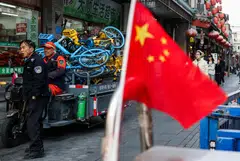

As China navigated US President Donald Trump’s tariffs and growing economic protectionism elsewhere around the world, the country amassed a trade surplus of US$1.1 trillion in the first 11 months of the year, a record haul.
It’s a stark reversal from the pandemic years, when China’s draconian Covid lockdowns paralysed supply chains and crushed consumer confidence. At the same time, Beijing’s crackdowns on technology and private education sectors added to global investors’ aversion, prompting the “uninvestable” tag.
Since 2023, President Xi Jinping’s government has eased off on the crackdown on tech companies. A firmer shift of stance came early this year, when he held a rare meeting with tech bosses, including Alibaba Group Holding co-founder Jack Ma, signalling his embrace of private entrepreneurs as the nation geared up for the trade war with the US.
Authorities also boosted support for capital markets, beginning with a major stimulus package in late 2024 that showed investors they still cared about growth. Since then, the central bank has provided unprecedented liquidity support to the stock market via new tools, including arrangements similar to a stabilisation fund.
“A combo of stabilisation in the economy, controlled property-market risks and stronger earnings could lift foreign investors’ interest even further,” said Joseph Zhang, a portfolio manager for Fidelity who’s been overweight China stocks. “A slow bull market can boost social sentiment and consumer confidence, though the wealth effects may be limited.”
While households have gained roughly 4.5 trillion yuan (S$824 billion) over the past couple of years from the equity-market rally, that’s been more than offset by the 20 trillion yuan decline in the value of residential housing stock, said Christopher Beddor, deputy China research director at Gavekal Dragonomics.
And the property market is not out of the woods just yet, with the slump in home prices worsening in recent months. The crisis has been epitomised by China Vanke’s financial stress, with the embattled developer rattling markets this month with an unexpected request to delay a local bond payment.
Growth in the country’s retail sales was the weakest since the Covid-19 breakout while investment slumped further in November, according to data released by the National Bureau of Statistics on Monday.
The economy is also mired in deflation, with prices across both consumer and producer sectors set to decline for the third straight year in what would be the longest streak since China transitioned towards a market economy in the late 1970s.
The stock market rally has faltered in recent weeks amid the gloomy data releases and lack of big-bang stimulus moves. On Tuesday, the Hang Seng China Enterprises Index and MSCI China Index both briefly tumbled into technical correction territories.
“China is investable again in some sense, but many fund managers are still wary of investing large sums into such a speculative market,” said Beddor. “They would prefer if Chinese equities were rallying because the economy was clearly turning a corner, but that’s not the case.”
Foreign investors make up 2 per cent of China’s interbank bond market and about 4 per cent of local equities. That means the key to healthy growth is more dependent on endogenous drivers such as the entry of long-term domestic capital from insurance companies and pension funds, said Fidelity’s Zhang.
For Adrian Zuercher, co-head of Global Asset Allocation at UBS Global Wealth Management, a rallying stock market and active initial public offering can shore up confidence among private entrepreneurs, which is crucial for reviving investment. The better market momentum could eventually lead to a recovery in foreign direct investment, which has been weak for years, he added.
Strong demand for China’s offshore sovereign bonds, which were priced almost on par with US Treasuries despite the country’s lower credit ratings, could help lower funding costs for companies selling debt overseas. Meanwhile, sustained gains in the yuan could also prompt more exporters to bring their earnings back onshore and boost spending to aid growth at home.
For 2026, China’s leaders have signalled they will maintain economic support but refrain from ramping up stimulus. The leadership will “flexibly and efficiently” use interest rate and reserve requirement cuts, and maintain a “necessary” level of budget deficit and government spending, according to a readout following the conclusion of the Central Economic Work Conference.
Egon Vavrek, head of the emerging markets and Asia equities at BlackRock, expects there could be meaningful inflows into Chinese stocks next year too.
It’d be a “really, really nice scenario” if improving economic fundamentals can help carry the market, he said. BLOOMBERG
Decoding Asia newsletter: your guide to navigating Asia in a new global order. Sign up here to get Decoding Asia newsletter. Delivered to your inbox. Free.
Share with us your feedback on BT's products and services
TRENDING NOW

LTA proposes combining car COE categories, adding rebate-surcharge system

StarHub to acquire MyRepublic’s mobile business amid ongoing telco consolidation

DBS, OCBC, UOB rout lops billions off STI as inflation, rate concerns spook investors

Grab CEO’s wife Chloe Tong on life with Anthony Tan and finding her purpose

