

China’s new tech stock boom leaves its economic malaise behind
Momentum may gain further support as DeepSeek rolls out a new AI model and China unveils a tech-focused five-year plan
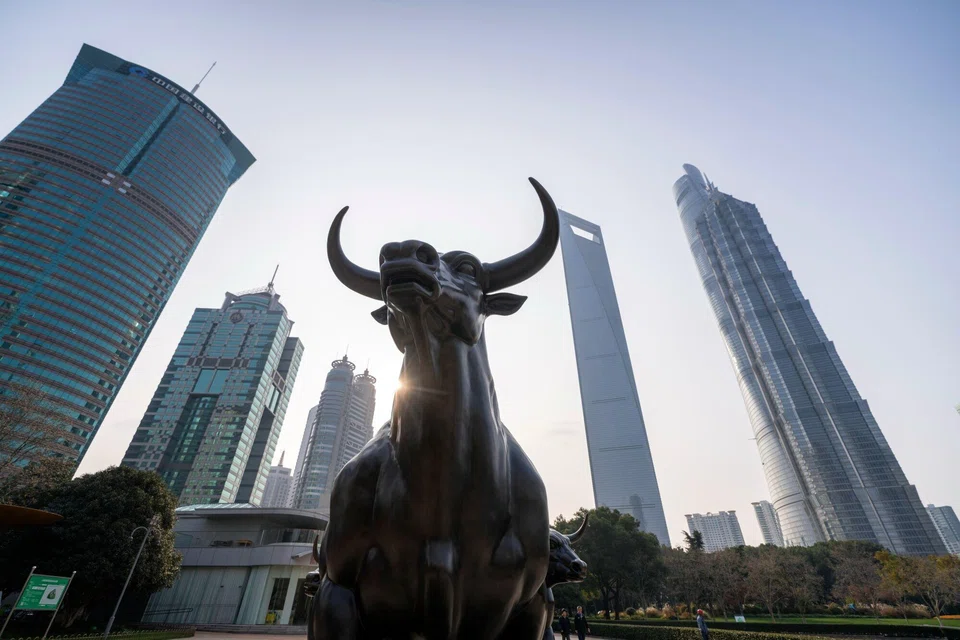
[BEIJING] Nearly a year after DeepSeek’s artificial intelligence (AI) breakthrough rattled global markets, China is entering 2026 with a fresh wave of technological advances that are powering a stock rally, even as its economy remains fragile.
Thanks to fresh progress in sectors from commercial rockets to robotics and flying cars, Chinese tech shares have begun the new year with a bang. An onshore Nasdaq-like tech gauge has shot up almost 13 per cent so far this month, while a measure of Hong Kong-listed Chinese tech firms has climbed nearly 6 per cent. Both have outperformed the Nasdaq 100.
Enthusiasm about home-grown technologies has been the single biggest driver of China’s equities bull run since April, even as the world’s second-largest economy remained mired in a housing slump and anemic consumption. The momentum may gain further support in the coming months as DeepSeek rolls out a new AI model and China unveils a five-year economic blueprint prioritising technological self-reliance.
“The stock market is telling us that what China is doing in technology sector is going to be very exciting going forward,” Mark Mobius, managing director of Mobius Emerging Opportunities Fund, told Bloomberg TV on Friday (Jan 16). “You must remember China’s goal now is to overtake the US in technology, in high-level chips, in all kinds of AI. So the money is going in that direction.”
Since DeepSeek shocked global markets with its cheap and equally well-performing AI models on Jan 27 last year, fellow Chinese firms have accelerated efforts to develop their own versions. Adoption of generative AI has also surged among the country’s Internet giants from Alibaba to Tencent.
Elsewhere, Chinese robots have competed in marathons, sparred in boxing matches and performed folk dance routines. In manufacturing, large language models are being embedded into advanced equipment, such as flying taxis and precision machine tools. The developments are recasting China in investors’ eyes from a low-cost manufacturing base into a credible challenger to US tech leadership, just as global capital hunts for the next growth engine.
In a basket of 33 Chinese AI stocks tracked by Jefferies Financial Group, the rally in the past year expanded their combined market value by about US$732 billion, the brokerage said in a Jan 13 report. Jefferies said it sees further upside because China’s AI’s market capitalisation represents only 6.5 per cent of the US’.
The exuberance is spilling beyond the secondary market. A flurry of recent listing debuts of Chinese AI-related companies posted blockbuster gains, emboldening their peers to tap public markets. Among those in the pipeline are XPeng’s flying-car unit, rocket maker LandSpace Technology and BrainCo, a potential rival to Neuralink Corp.
“Looking ahead, we anticipate that the next major breakthrough in AI will occur at the application layer,” said Joanna Shen, JPMorgan Asset Management’s emerging market and Asia-Pacific equities investment specialist. “China, in particular, is well-positioned to lead this evolution, given its vast array of user cases across wearables, edge devices, and Internet platforms.”
SEE ALSO
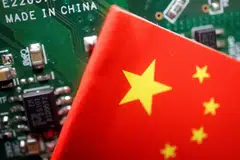







To be sure, the stellar rally has triggered concerns about stretched valuations. Cambricon Technologies, an AI chipmaker that competes with Nvidia, is trading about 120 times to forward earnings. A gauge tracking Chinese robots is trading at more than 40 times forward earnings, higher than the Nasdaq 100’s 25 times.
Beijing’s latest decision to tighten margin financing was also a sign of authorities’ growing unease with speculative excess, especially in pockets of the technology sector.
That said, some investors remain optimistic about the industry’s prospects due to advantages such as a low-cost base and strong state backing and planning.
“China’s low-cost model for AI may well pay off faster” than its US peers, Gavekal Research’s technology analyst Tilly Zhang wrote in a note dated Jan 16. “The ‘DeepSeek moment’ encouraged China to focus on a strategy of cheap, good-enough models.”
Expected within this quarter, the release of DeepSeek’s R2 model may provide the next catalyst. The new model, which will likely boast leading-edge performance at an ultra-low cost, “has the potential to disrupt the sector again, underscoring China’s position as the main rival to US AI supremacy”, Bloomberg Intelligence wrote in a recent note.
Details of China’s new five-year plan due for release in March, which places great emphasis on technological self-sufficiency, may offer stock bulls another reason to buy.
Chinese stocks may further outperform their US counterparts if earnings growth continues to accelerate, especially in sectors with advanced technologies and strong exports, said Vivian Lin Thurston, portfolio manager at William Blair Investment. “I expect to see attractive investment opportunities in these industries as we have seen in 2025, including Internet, AI, semiconductor-related hardware tech, robotics, automation and biotech.” BLOOMBERG
Decoding Asia newsletter: your guide to navigating Asia in a new global order. Sign up here to get Decoding Asia newsletter. Delivered to your inbox. Free.
Share with us your feedback on BT's products and services
TRENDING NOW

Once staunchly pro-China, Malaysian Chinese businesses are now distancing themselves from Beijing

Britain’s mansion tax shows the difficulty of targeting wealth

Three hats, one goal: How Ng Kian Swan runs sustainability at NUHS

COE review: The gap between luxury and mass-market cars isn’t the only one worth bridging

