

‘Diverging’ trajectories: Taiwan dethrones South Korea atop global markets as AI trade widens
The Taiex and Kospi have traded places at the top of the global leaderboard in 2026
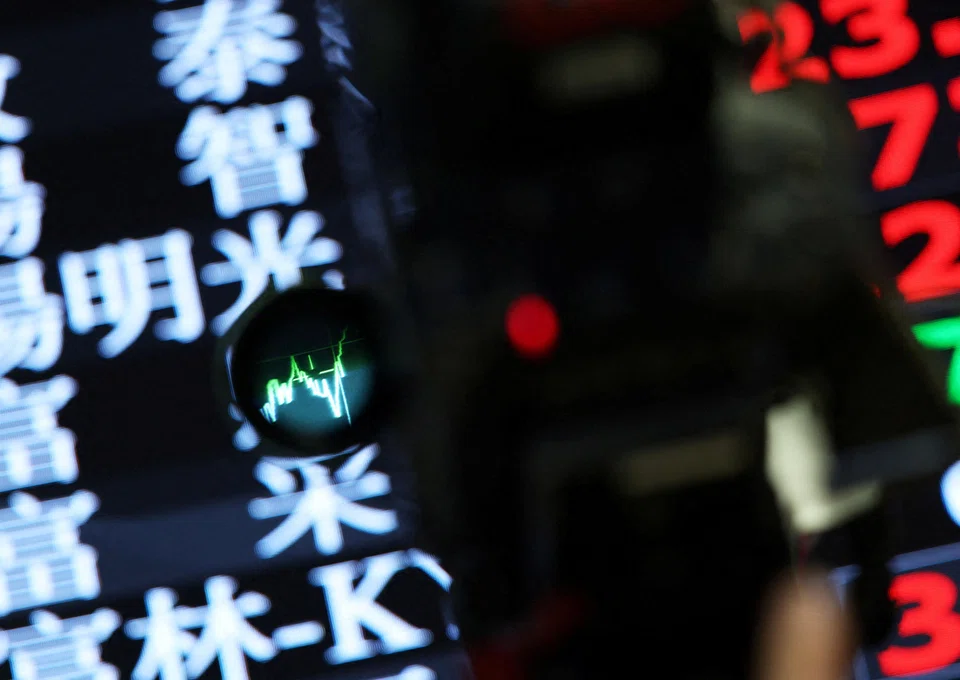
[SINGAPORE] As equity investors enter the final stretch of a pivotal year that has propelled South Korea and Taiwan to the forefront of the global artificial intelligence trade, Taiwan is emerging as the stronger bet.
The Taiex Index beat the Kospi by about 23 percentage points last quarter, the widest margin since the turn of the century.
Earnings upgrades also outpaced those for its Korean peer for the first time since March 2025.
About 40 per cent of the fund managers surveyed by Bank of America in September said they were overweight on Taiwan, versus 25 per cent for South Korea.
Taiwan offers “broader and deeper” opportunity
Driving the optimism are Taiwan’s deeper linkages across the AI supply chain and a more upbeat earnings outlook.
“The distinction for us is not simply the amount of AI exposure, but the nature of the earnings supporting it,” said Vikas Pershad, a portfolio manager at M&G Investments in Singapore.
“Taiwan offers a broader and deeper opportunity set. Its earnings come from volume and that makes its earnings upgrades broader and stickier. (South) Korea’s earnings, in the near-term, are coming from price.”
Taiwan offers investors exposure across chip design and manufacturing, packaging, networking and servers, meaning it has more ways to benefit as AI spending broadens.
South Korea’s market leadership, meanwhile, remains heavily concentrated in chipmakers Samsung Electronics and SK Hynix, leaving it more vulnerable as doubts emerge over how much longer the current memory upcycle can run.



The Taiex and Kospi have traded places at the top of the global leaderboard in 2026, even as the latter has dominated headlines for its more eye-catching moves.
Up 72 per cent in 2026, Taiwan’s benchmark is currently the top performer among more than 90 equity indices tracked by Bloomberg.
The Kospi is ranked second, with gains of about 65 per cent.
“Diverging earnings growth trajectories”
Taiwan’s lead comes as shares of Samsung and SK Hynix plunged between 19 per cent and 33 per cent in the three months ended September.
That followed a six-quarter winning streak as surging memory chip prices drove blockbuster earnings and fuelled rapid profit upgrades from analysts.
Societe Generale is “keeping a preference for Taiwan over Korean equities, given the diverging earnings growth trajectories”, strategists including Rajat Agarwal wrote in a note.
Memory “price appreciation is expected to slow over coming quarters, before normalisation in 2028” as Chinese competition rises, while South Korea’s July deleveraging has broadened into a wider retreat from the market, they wrote.
The counter view is that AI-related demand will exacerbate the ongoing semiconductor supply shortage, keeping prices for high-bandwidth memory (HBM) chips supported.
Peter Lee, a managing director at Citigroup who jointly oversees its global tech and communication research, said last week that investors should start buying shares of firms like Samsung and SK Hynix as the market is underestimating how much HBM chips will be needed in 2027.
“Korea discount”, fears of memory cycle nearing peak
In terms of valuations, the Taiex is trading at about 18 times its one-year forward estimated earnings.
The Kospi trades at around 5.5 times, reflecting concern that the memory cycle may be approaching a peak, and in part the longstanding “Korea discount” that has kept the market cheap relative to global peers.
Still, when asked which market would benefit the most from the next phase of the AI cycle, 35 per cent of the respondents in the Bank of America survey chose Taiwan. Just 5 per cent picked South Korea.
Shares of Taiwan Semiconductor Manufacturing rose 2.9 per cent in the three months to September, capping a sixth straight quarterly advance.
But the Taiex is delivering broader gains than its other tech-heavy peers, reflecting a wider range of investment opportunities.
About 10 per cent of the gauge’s stocks have at least doubled in 2026, compared with 4.1 per cent for the Kospi and 5.7 per cent for Japan’s Nikkei 225.
“The next leg of upside for Taiwan stocks is likely to depend less on broad AI enthusiasm and more on local tech companies that remain exposed to genuine bottlenecks in the AI value chain,” said Gary Tan, portfolio manager at Allspring Global Investments. BLOOMBERG
Decoding Asia newsletter: your guide to navigating Asia in a new global order. Sign up here to get Decoding Asia newsletter. Delivered to your inbox. Free.
Share with us your feedback on BT's products and services
TRENDING NOW

Government to bring forward raising of retirement age, give employers more financial support to create flexi-load jobs
If Europe goes to war, the fallout will be felt in East Asia

Indonesia stocks suffer worst plunge in nearly 30 years as MSCI proposes standalone status

Vietnam’s northern provinces, not Hanoi or Ho Chi Minh City, are powering near 10% GDP growth

