

Europe: Stocks drop as ECB warns of slowing growth next year
 Add BT as a preferred source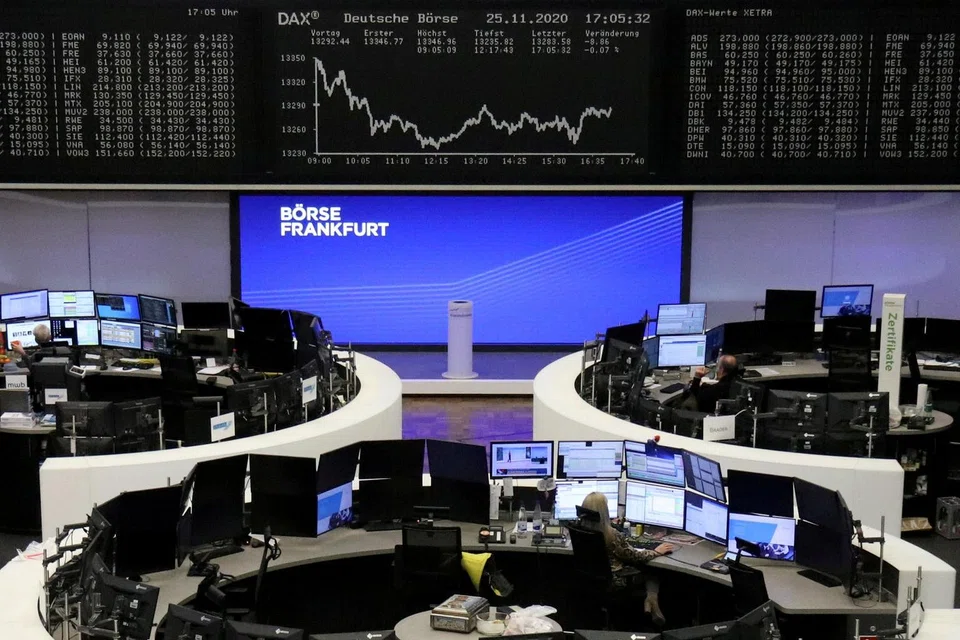
DeeperDive is a beta AI feature. Refer to full articles for the facts.
[BENGALURU] Eurozone stocks hit a two-week low on Thursday, with banks taking a knock after the European Central Bank (ECB) forecast a slower rebound in growth next year even as it rolled out more stimulus measures to support the bloc's pandemic-hit economy.
The STOXX eurozone index and Germany's DAX both fell as much as 1 per cent before paring losses to close 0.2 per cent and 0.3 per cent lower respectively, with oil stocks jumping on a surge in crude prices.
An index of eurozone banks ended down 2.1 per cent despite the ECB agreeing to provide lenders with even more ultra-cheap liquidity.
Spain's lender-heavy IBEX index led declines in the region, down 0.6 per cent.
The ECB increased the overall size of its Pandemic Emergency Purchase Programme (PEPP) by 500 billion euros (S$810.48 billion), in line with market expectations and also extended the scheme by nine months to March 2022.
At a press conference following the decision, ECB president Christine Lagarde said the bank expects eurozone GDP to expand by 3.9 per cent next year, slower than its September forecast of 5 per cent. But growth is seen at 4.2 per cent in 2022, above a previous projection of 3.2 per cent.
Navigate Asia in
a new global order
Get the insights delivered to your inbox.
"Central bankers have flooded bank balance sheets, but those funds are not flowing through the economy normally. In other words, the quantity of money is up but velocity is way down, muting the economic impact," said Aaron Anderson, senior vice-president of research at Fisher Investments.
The European STOXX 600 index was down 0.4 per cent.
Rising prices of copper and iron ore lifted Europe's materials index 0.3 per cent to near 8-month highs.
London's blue-chip index, heavy with oil and commodity-linked stocks, closed up 0.5 per cent, further helped by a pound hammered by Brexit trade deal uncertainty.
A meeting between British Prime Minister Boris Johnson and European Commission president Ursula von der Leyen on Wednesday yielded no breakthrough with the leaders giving themselves until the end of the weekend to seal a new trade pact after failing to overcome persistent rifts.
Around US$1 trillion in annual trade, currently free from tariffs and quotas, is at stake if there is no agreement by the end of the month when Britain leaves the bloc.
Meanwhile, the European Union summit began on Thursday with leaders likely to unblock a stalled 1.8 trillion euro (S$2.92 trillion) package as Poland and Hungary appeared to be edging toward an agreement on the EU budget.
REUTERS
Decoding Asia newsletter: your guide to navigating Asia in a new global order. Sign up here to get Decoding Asia newsletter. Delivered to your inbox. Free.
Share with us your feedback on BT's products and services
TRENDING NOW

Autobahn Rent A Car directors declared bankrupt over S$50 million each owed to DBS

Higher costs, lower returns: Why are Singaporeans still betting on real estate?

Richard Eu on how core values, customers keep Singapore’s TCM chain Eu Yan Sang relevant

Loyang Valley sold for S$880 million to SingHaiyi-led consortium

