

Europe: Stocks hit by worst selloff in almost two months on new virus strain fears
 Add BT as a preferred source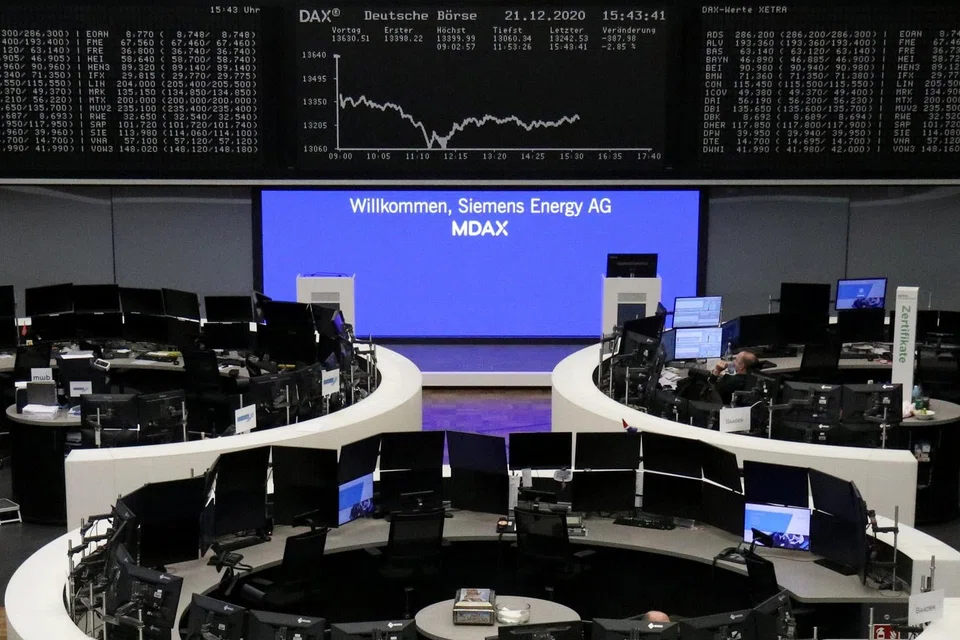
DeeperDive is a beta AI feature. Refer to full articles for the facts.
[BENGALURU] European shares fell on Monday in their worst session in almost two months as the rapid spread of a new strain of the coronavirus forced more stringent curbs in Britain and travel bans from several countries.
Broad-based losses pushed the pan-European Stoxx 600 index down 2.3 per cent, its lowest close since mid-November, after the UK imposed an effective lockdown and reversed plans to ease curbs over Christmas as the new strain is up to 70 per cent more transmissible than the original.
A long list of countries from around the world closed their borders to Britain, with European neighbour France's ban also including freight carriers.
A plunge in the pound limited losses in London's FTSE to 1.7 per cent, while main indexes in Germany, France, Spain and Italy all dived close to 3 per cent.
Spain's IBEX posted its worst day in six-months.
"Markets are reeling from the latest twist in the coronavirus crisis which has clouded the outlook for the remainder of 2020 and much of the first quarter of 2021," said AJ Bell investment director Russ Mould.
Navigate Asia in
a new global order
Get the insights delivered to your inbox.
"Restrictions on traffic between the UK and other countries, including in the case of France on freight, has raised the pressure on a supply chain already creaking under the weight of an online Christmas and Brexit uncertainty."
Travel and leisure stocks had their worst day in three months, with British Airways owner IAG, Trainline and travel company TUI down between 1 per cent and 10.5 per cent. Cruise operator Carnival Corp shed 5.6 per cent.
As crude oil prices slid, energy companies BP, Total and Royal Dutch Shell lost almost 5 per cent, leading losses in Europe.
Shell was further weighed down by a US$3.5 billion to US$4.5 billion writedown in the value of oil and gas assets.
Banks lost 3.6 per cent - their worst day since September, as risk aversion sent investors fleeing to the safety of bonds.
Uncertainty over Brexit trade deal negotiations added to pressure on the market. With less than two weeks before Britain leaves the European Union's orbit, neither side has budged far enough for a breakthrough.
Worries about the new virus strain also reduced the impact of an agreement on a US$900 billion fiscal aid package in the United States that will be voted on Monday.
Vaccines should still be effective against the new strain, scientists said. Britain has already rolled out the Pfizer-BioNtech vaccine, while the European Medicines Agency approved the vaccine on Monday. A European Commission nod is expected later in the day for a European roll-out.
Frankfurt shares of BioNtech rose 1.7 per cent.
Among the few gainers were healthcare and consumer stocks such as Reckitt Benckiser and grocery retailer Ocado.
REUTERS
Decoding Asia newsletter: your guide to navigating Asia in a new global order. Sign up here to get Decoding Asia newsletter. Delivered to your inbox. Free.
Share with us your feedback on BT's products and services
TRENDING NOW

From 1MDB to ‘corporate mafia’: Is Malaysia facing a new governance test?

Higher costs, lower returns: Why are Singaporeans still betting on real estate?

South-east Asian markets account for 8.8% of global capital inflows from 2021 to 2024: report

Richard Eu on how core values, customers keep Singapore’s TCM chain Eu Yan Sang relevant

