

Europe’s Stoxx 600 ends at record high as US-Iran deal lifts sentiment
Analysts expect energy costs to remain elevated until flows gradually return to pre-war levels
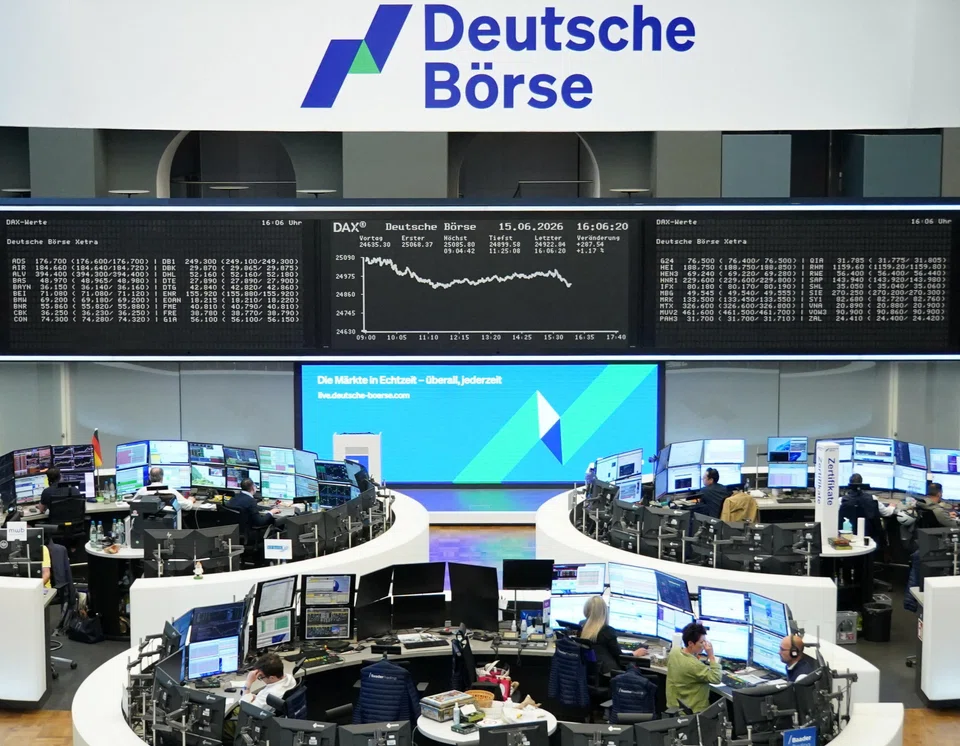
EUROPE’S Stoxx 600 hit a record high on Monday (Jun 15), boosted by a relief rally across most sectors after the United States and Iran reached a preliminary agreement that would open the Strait of Hormuz and end the three-month-long war in the Middle East.
Brent crude prices fell to three-month lows, while the pan-European index closed 0.2 per cent higher, recouping its losses since war began on Feb 28, after US President Donald Trump, Vice-President JD Vance and Iranian parliament speaker Mohammad Bagher Qalibaf signed the memorandum of understanding.
The index surpassed its Feb 27 peak, while the Euro Stoxx volatility index hit its lowest since late January.
European shares had broadly underperformed their peers in the US and Asia since March, largely due to the continent’s reliance on the Strait of Hormuz for crucial oil supplies and its smaller exposure to artificial intelligence technology stocks.
With Monday’s gains, the Stoxx 600 is now up 7.2 per cent for the year, narrowing its gap with the US benchmark S&P 500 that has risen more than 10 per cent.
“It’s probably the time you should see some rotation ... you might be taking gains in some of the AI names that have rallied very hard over the last month or two and could be recycling that into areas such as defence in Europe, which have been weak,” said Michael Field, chief equity strategist at Morningstar.
Broad rally in Europe
Spain’s financials-heavy index led gains among major regional indexes, climbing 1.4 per cent to record highs. Germany’s DAX index rose 1.1 per cent to a near two-week high. France’s CAC 40 index gained 0.4 per cent to pre-war levels.
Banks were among the biggest boosts to the Stoxx 600, adding 1.5 per cent to hit their highest since January 2008. Energy price-sensitive auto stocks gained 2.6 per cent, while airlines such as Lufthansa and Air France jumped 4.5 per cent and 3.4 per cent, respectively.
Still, analysts expect energy costs to remain elevated until flows gradually return to pre-war levels. Concerns over energy-driven inflation led the European Central Bank (ECB) to hike interest rates by 25 basis points last week.
The yield on eurozone short-term bonds, reflecting interest rate expectations, fell to a two-week low, although traders held onto expectations of another 25-bp ECB rate hike before the end of the year, according to LSEG-compiled data.
“You can feel the palpable relief in Europe. The ECB will be pleased that they do not have to keep talking up a strong game and probably that will outweigh their slight feelings of embarrassment about having to have been bounced into a hike last week,” said Chris Beauchamp, chief market analyst at IG Group.
In corporate news, Renault Group gained 3.7 per cent after the carmaker said that it would develop a military vehicle in partnership with defence technology company Thales. AI equipment maker Schneider Electric climbed 1.8 per cent after entering a strategic collaboration with Taiwan’s Foxconn to develop and scale infrastructure for AI data centres.
Among laggards, energy stocks fell 3.1 per cent, tracking lower crude oil prices. They also weighed on London’s FTSE 100, which closed 0.4 per cent lower. REUTERS
Decoding Asia newsletter: your guide to navigating Asia in a new global order. Sign up here to get Decoding Asia newsletter. Delivered to your inbox. Free.
Share with us your feedback on BT's products and services
TRENDING NOW

DBS, OCBC, UOB rout lops billions off STI as inflation, rate concerns spook investors

Grab CEO’s wife Chloe Tong on life with Anthony Tan and finding her purpose

OCBC sheds S$8 billion in value as shares close nearly 6% down; analysts cautious on banks

Deal between tycoon friends sparks scrutiny of Philippine power sector

