

Funds, brokers still have faith in China's A-shares
They cite economic reforms, quality of its tech companies, BRI and higher trading volume than HK-listed H-shares

Annabeth Leow
Singapore
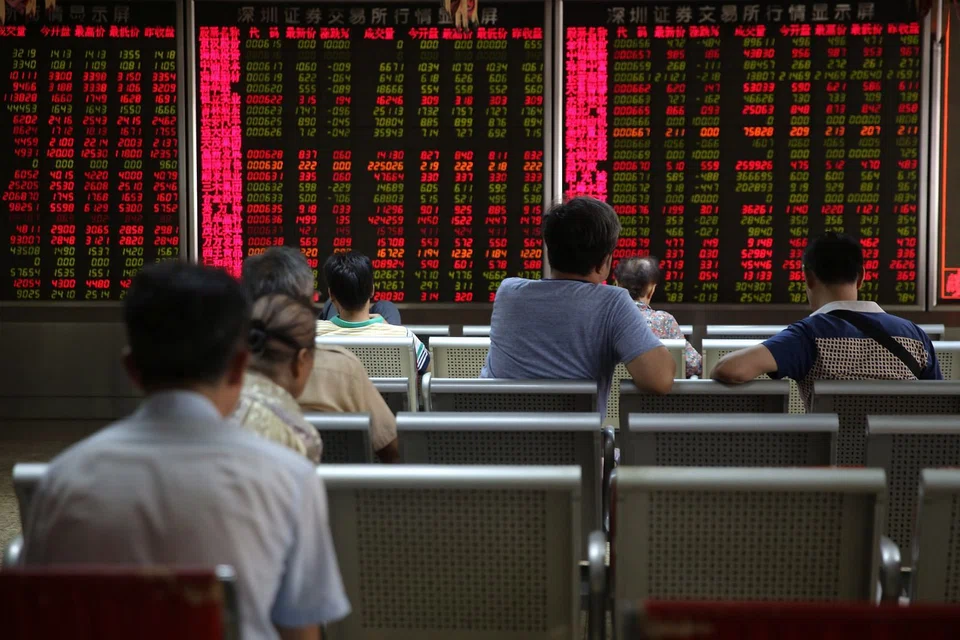
WITH Beijing and Washington set to each slap tariffs on US$34 billion of imports today, onshore Chinese equities now stare a grisly fate in the face.
The benchmark Shanghai Composite lost 8.01 per cent in June, as a sell-off erased some optimism from MSCI index inclusion at the start of the month. Shanghai shed another 0.92 per cent on Thursday, the eve of the tariffs, while the offshore yuan had sagged by 0.1 per cent against the greenback as at 5.40pm, Singapore time.
But investment professionals said they are still putting faith - and money - in long-term Chinese growth, especially in domestic-driven sectors.
"Interest in China from investors in South-east Asia continues to grow," said Ben Waterhouse, head of intermediary business for South-east Asia and the Middle East at Fidelity International. "There is a range of reasons why China is increasingly on the radar, including economic reforms, the quality of tech companies in China and the One Belt, One Road initiative. The inclusion of A-shares into MSCI indices is clearly another factor."
Scott Leiberton, managing director for equities at Principal Global Investors, noted that onshore A-shares have a higher trading volume than Hong Kong-listed "H-shares". "For institutional investors like us, who manage more than $4 billion in investments in Chinese-related shares, the market impact costs will be reduced if we have more liquid choices," he said.
Harriet Steel, Hermes Investment Management's business development head, told The Business Timesat a briefing that her firm's Asia ex-Japan fund has had up to 15 per cent in the A-share market in the past four years "and we think it's a great source of alpha" because of large retail investment.
"The retail investor base tends to respond more to news flow than it does to underlying financial fundamentals, and so there are areas of dislocation that you can find if you're investing as a professional investor," she said. "We've tended to avoid the general risk-on stocks that tend to be in China - for example, the state-owned enterprise type, larger-cap opportunities - and we look for specific bottom-up opportunities that are domestic consumption-led and accessing these transitions in the Chinese economy."
Mr Leiberton said Principal is "intrigued" by the ability to invest in previously inaccessible stocks, "especially among the 'new economy' consumer, alternative energy and technology-oriented sectors, particularly among mid-sized, private-sector companies".
Adam Reynolds, Asia-Pacific chief executive of Saxo Capital Markets, noted: "With all index inclusions, there's a huge build-up in advance. . . because everyone knows there's a large volume of trades that are going to happen from the index-tracking funds." Danish parent Saxo Bank Group added A-shares to its global multi-asset trading platform in mid-June.
Mr Reynolds added: "When the index inclusion occurs, you start to see a bit of a sell-off. That has been exacerbated, of course, by the trade tensions. But, from a long-term perspective, no question, the more the emerging markets index and the global index include the China onshore shares, the better it will be. And also, the more China opens up its economy to two-way capital flows, the better it will be."
Standard Chartered's latest RMB Investors Forum Survey, which polled bank clients in March, predicted that there will be no slowdown in investor demand for Chinese assets such as equities, bonds and currency.
The report noted that index inclusion criteria have driven market enhancements such as the ability to block trade. And Principal's Mr Leiberton pointed out that corporate governance and minority shareholder protections are likely to improve as well.
Alex Treves, investment specialist for Asia-Pacific emerging markets at JP Morgan Asset Management, said on the phone that flows into both China and the region have been "very, very robust in the past six months". "We haven't seen a pattern of substantial redemptions or out-flows."
Ms Steel from Hermes said: "While we have seen our in-flows slow down - net in-flows in our fund are still positive, but we have seen out-flows increase as a result of this sort of immediate market environment - I think professional investors, generally, are sitting back. . . I don't think it necessarily means a giant reversal in allocations, on the data that we've had available to us so far."
But although Deutsche Bank Wealth Management is ramping up coverage and hunting for investment opportunities, Tuan Huynh, its Asia-Pacific chief investment officer and wealth discretionary head, said "we are not aggressive yet in our allocation" amid costly valuations and headwinds such as trade tensions.
"We are starting to receive queries for A-share mandates from clients in this region - not massive at this point, as investors are still not as familiar with China A-shares," he said.
DBS strategist Dylan Cheang said in a note on Wednesday: "The impact of a trade war on financial markets will be severe, there is no question about that. Corporate earnings growth will take a hit amid a contraction in economic activities, and market valuation will undergo a de-rating."
On the other side of the Pacific, a worst-case trade war scenario could drag the S&P 500 down by 15 per cent to 20 per cent, added Mr Cheang, although he did not give a timeframe.
All the same, Kelvin Tay, regional chief investment officer at UBS Global Wealth Management, told BT that concerns over the United States trade spat may be overblown as many of the goods to be hit by tariffs "are largely unrepresented on the two benchmark China equity indexes" of the MSCI China and CSI 300.
Foreign capital in the A-share market could rise from under 2 per cent now, to 7 per cent, "if our five-year inflow estimate holds true".
He added: "We expect positive fundamentals to support further upside for Chinese stocks. Our most preferred stocks are in defensive sectors such as consumer staples, telecoms, utilities and healthcare, which have pure domestic exposure and can continue to provide a safe haven to investors."
Despite a preference for offshore equities, Kevin Anderson, Asia-Pacific head of investments at State Street Global Advisors, shared Mr Tay's view, saying: "We do not think that current measures being contemplated by the US administration would create a significant impact to the Chinese economy."






