

Is the global tech sell-off the start of a bear market or just a correction? What experts say
Investors must assess if underlying drivers are cyclical and temporary, or indicative of a sustained weakening

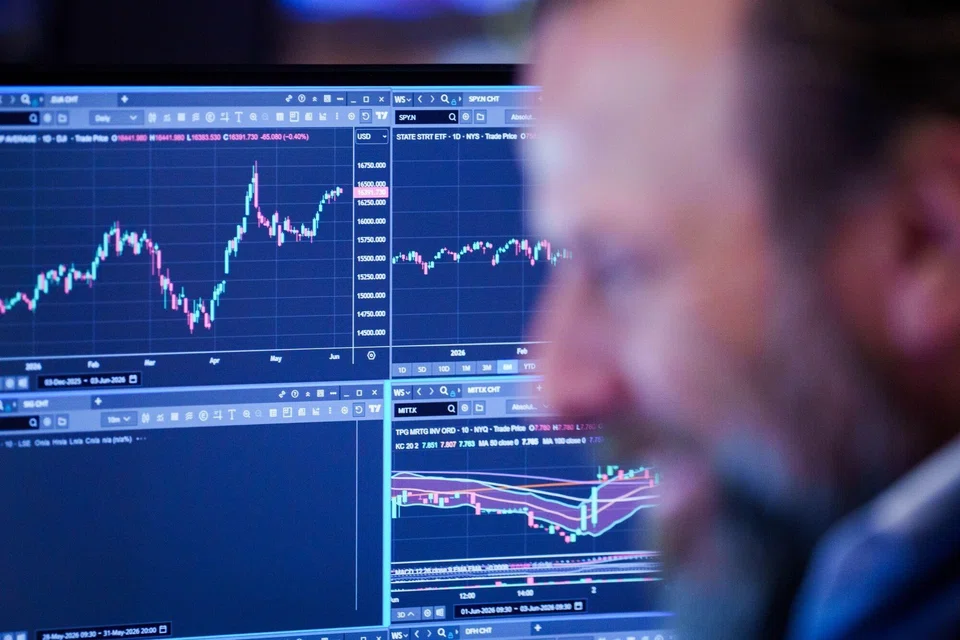
[SINGAPORE] The sell-off in global tech stocks that began on Jun 5 has garnered mixed reactions from investors.
Some have expressed concern that this is the start of a bear market, while others believe it is simply a healthy correction.
The S&P 500 was down 2.6 per cent at 7,383.74 on Jun 5, ending a nine-week run of Friday-to-Friday gains. The Nasdaq Composite declined 4.2 per cent, landing at 25,709.43.
Factors behind the dip were attributed to the release of surprisingly strong US jobs data, rate-hike concerns and continued geopolitical instability due to the Iran war.
So how can investors tell the difference between a market correction and the start of a bear market? The Business Times explains.
Key underlying drivers matter
A correction is typically defined as a decline of 10 per cent or more in a stock index and asset’s market peak, while a bear market refers to a more prolonged decline of 20 per cent or more.
But the distinction is not just about the magnitude of the fall, said Gerald Wong, the founder and CEO of investment advisory platform Beansprout.
Corrections, he said, are often driven by short-term factors such as profit-taking, changes in investor sentiment or temporary uncertainty. Bear markets, meanwhile, are “often associated with a deterioration of economic conditions, corporate earnings or financial liquidity”.
Wong told BT that investors therefore need to “assess whether the underlying drivers of the market phenomenon are cyclical and temporary, or indicative of a more sustained weakening in economic and corporate fundamentals” to distinguish between a correction and a bear market.
Some have also raised concerns about a possible recession. However, a recession has more to do measuring economic activity than with stock market performance.
A recession implies a significant and widespread downturn in real economic activity, and is measured by a decline in gross domestic product over two consecutive quarters. Characteristics of a recession include job losses, lower income levels and reduced consumer spending.
What’s happening now?
Experts BT spoke to said what is happening now is more likely a correction within a bull market, rather than a bear-market shift.
This is because – although painful – the sell-off does not yet have “the classic ingredients of a deeper breakdown: recession stress, disorderly yields, oil spiralling towards extreme levels or a broad earnings collapse”, said Charu Chanana, chief investment strategist at investment bank Saxo.
If anything, the market is now becoming more selective – which is healthy, she added.
Wong said that stronger-than-expected economic data has also led investors to reassess the outlook for interest rates, resulting in higher bond yields and some pressure on equity valuations.
This means that there are no clear signs of the broad-based deterioration in fundamentals that would typically characterise a bear market as corporate earnings have stayed “relatively resilient” too, he added.
A buy-the-dip moment?
Experts said that a broad “buy-the-dip” approach can be risky, especially when valuations are still elevated, earnings expectations are high, and many investors are crowded into the same artificial intelligence winners now.
“This is not the kind of sell-off where investors should blindly chase every AI-linked stock that has fallen,” Chanana warned.
Where real opportunities lie could be in quality AI names which have corrected, but still have balance-sheet strength, pricing power, free cash flow and “a clear monetisation path”, she said.
Cited among such counters are big tech plays including Nvidia and Microsoft, as well as Marvell, which was touted by Nvidia CEO Jensen Huang as the next “trillion-dollar firm”.
Wong said that investors should “stay invested” but “exercise discipline rather than going all in when buying the dip”.
What’s to come?
Investors are naturally curious about how markets will move next – amid developments such as SpaceX’s initial public offering on Friday (Jun 12).
Beansprout’s Wong does not expect the SpaceX IPO on its own to be a key driver of global or Singapore markets.
“It could affect sentiment toward technology, space economy and high-growth companies – especially if the listing attracts significant investor attention,” he noted.
Fundamentally, macro conditions, interest rates, corporate earnings, geopolitical risks and developments in AI are factors which are more likely to shape broader market direction, he added.
Decoding Asia newsletter: your guide to navigating Asia in a new global order. Sign up here to get Decoding Asia newsletter. Delivered to your inbox. Free.
Copyright SPH Media. All rights reserved.
TRENDING NOW

DBS, OCBC, UOB rout lops billions off STI as inflation, rate concerns spook investors

Grab CEO’s wife Chloe Tong on life with Anthony Tan and finding her purpose

OCBC sheds S$8 billion in value as shares close nearly 6% down; analysts cautious on banks

Deal between tycoon friends sparks scrutiny of Philippine power sector

