

Greenback hits four-month low after Fed pivots, ECB leaves rates unchanged
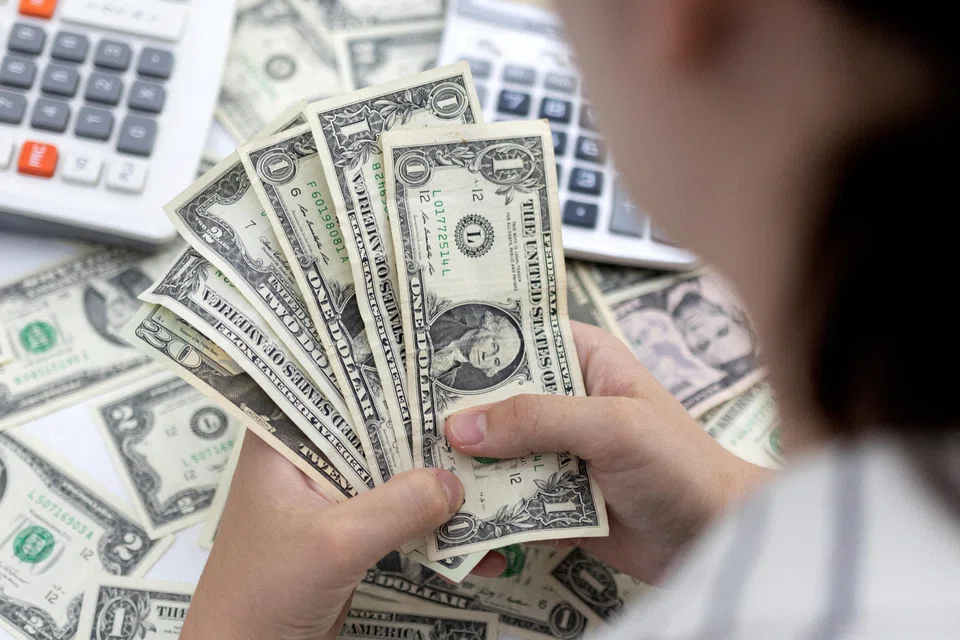
THE US dollar touched a fresh four-month low on Thursday (Dec 14) after the Federal Reserve indicated that its interest-rate hiking cycle has ended and that lower borrowing costs are coming in 2024.
On a busy day for policy announcements in Europe, the euro held gains after the European Central Bank (ECB) said that policy rates would be set at sufficiently restrictive levels for as long as necessary, and the pound rose after the Bank of England (BOE) held interest rates in a “finely balanced” decision.
Meanwhile, the Norwegian krone strengthened after a surprise rate hike, and the Swiss franc was little changed after the Swiss National Bank (SNB) held rates.
Fed chair Jerome Powell said at Wednesday’s Federal Open Market Committee meeting that the historic tightening of monetary policy is likely over, with a discussion of cuts in borrowing costs coming “into view”. The Fed’s projections implied 75 basis points of cuts next year, from the current level.
“The Fed was very dovish yesterday,” said Athanasios Vamvakidis, global head of G10 FX strategy, Bank of America (BofA) Global Research, who was expecting the 2024 projections to show three rate cuts.
“This was a close call and the strong consensus in any case was for a balanced tone by Powell. Instead, Powell doubled down, with a very dovish tone.”
The US dollar index, which measures the greenback against a basket of currencies, slipped as far as 102.27, its lowest since Aug 10. It was last down 0.5 per cent at 102.37.
Markets are now pricing a 90 per cent chance of a rate cut in March, according to CME FedWatch Tool, compared with around 65 per cent a week earlier. Traders are pricing around a 20 per cent chance that the Fed cuts rates next month.
The ECB kept interest rates at a record high, as expected, and offered no clues about whether an easing of policy was around the corner, even as markets have priced rate cuts from early next year.
The euro, which had already been higher against the weak US dollar, held gains after the announcement. It was last up 0.4 per cent at US$1.0922.
The SNB had earlier kicked off Europe’s busy day of central bank announcements by holding rates steady at 1.75 per cent, as expected. The franc remained weaker against the euro but a touch stronger against the softer US dollar after the announcement, as the SNB acknowledged that inflationary pressure has decreased slightly over the past quarter.
The Norwegian krone meanwhile rose against both the euro and US dollar after the Norges Bank unexpectedly raised rates by 25 basis points to 4.5 per cent, adding that they would likely stay at that level for some time.
The pound rose 0.8 per cent against the US dollar to US$1.2725, a two-week high, after the BOE voted 6-3 to leave interest rates at 5.25 per cent, with policymakers Meg Greene, Jonathan Haskel and Catherine Mann preferring to have raised the bank rate by 25 basis points to 5.5 per cent.
In contrast to the Fed, the committee said that interest rates would need to stay high for “an extended period”.
“The main message remains that rates will remain high for as long as it takes, which effectively is a pushback to market pricing early cuts,” said BofA’s Vamvakidis.
“It was broadly as markets were expecting, but looks hawkish compared with the very dovish Fed yesterday,” Vamvakidis added.
The yen continued to strengthen in the wake of the greenback’s tumble, climbing to its highest since Jul 31 at 140.95 per US dollar. It was last up around 0.8 per cent at 141.75 per US dollar.
Expectations that the Bank of Japan (BOJ) could end negative interest rates at its monetary policy meeting on Dec 18 to 19 have largely been dampened, but the BOJ could make tweaks to its statement, such as language that the bank will not hesitate to ease further if necessary, said Masafumi Yamamoto, chief currency strategist at Mizuho Securities.
That kind of change could be regarded as “one step towards normalisation... so that could be positive for the Japanese yen”, he said.
The Australian dollar, meanwhile, hit a more than four-month high at US$0.6728 after domestic net employment jumped by 61,500 in November, compared with an increase of around 11,000 that markets had been forecasting.
The kiwi rose more than 1 per cent versus the greenback to as high as US$0.6249, despite data showing that the New Zealand economy unexpectedly contracted in the third quarter.
Decoding Asia newsletter: your guide to navigating Asia in a new global order. Sign up here to get Decoding Asia newsletter. Delivered to your inbox. Free.
Share with us your feedback on BT's products and services
TRENDING NOW

First Resources blames El Nino, outside fires for Kalimantan hotspots amid haze scrutiny

High Court rules against Julius Baer’s Singapore trust arm in US$50 million family trust dispute

Singapore key exports jump by higher-than-expected 68.4% in September, led by non-electronics

MSCI proposes downgrading Indonesia to standalone market status

