The huge selling pressure coming for Hong Kong's equity market
 Add BT as a preferred source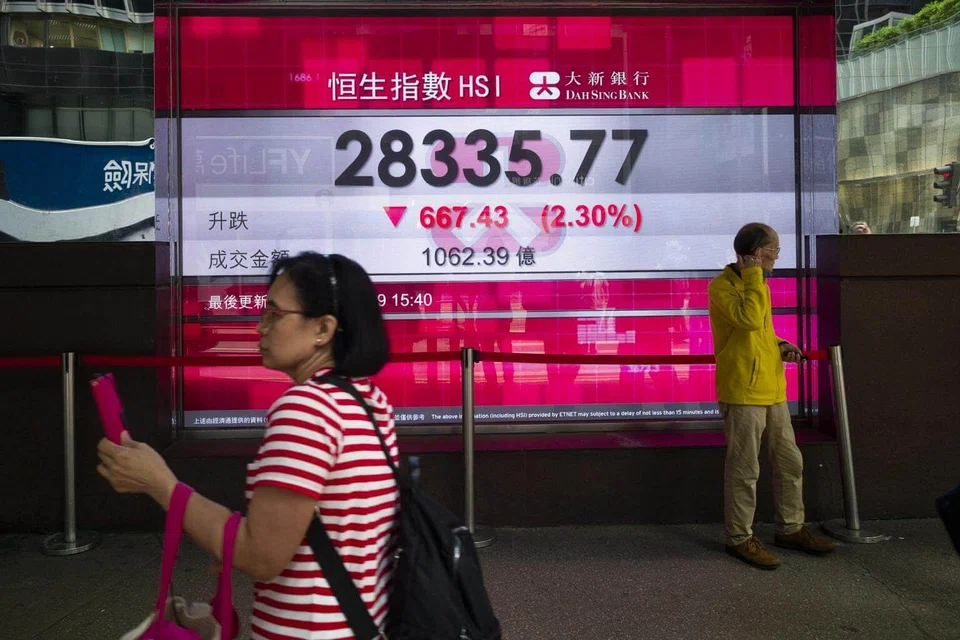
DeeperDive is a beta AI feature. Refer to full articles for the facts.
[HONG KONG] The apparent resilience of Hong Kong's equity market faces a big test as markets reopen Tuesday.
Stock traders in the city, who were off on Monday for a holiday, have yet to react to the latest wave of declines across the globe.
While the benchmark Hang Seng Index has lost 3.9 per cent in May, its performance stands out against the 6.3 per cent decline for China's CSI 300 Index.
Mainland shares fell 1.7 per cent Monday after trade talks with the US ended in stalemate and the offshore yuan weakened past 6.9 per US dollar for the first time this year.
After Chinese markets closed, Beijing retaliated with higher tariffs on a range of American goods, spurring a 2.4 per cent loss in the S&P 500 Index.
As a global financial center with no limits on capital flows, Hong Kong is vulnerable to worsening ties between the two nations and usually does badly during a wave of risk-off sentiment.
Navigate Asia in
a new global order
Get the insights delivered to your inbox.
On top of that, a weaker yuan weighs on earnings for Chinese heavyweights listed in the city. Investors were unprepared last week for a surge in volatility, with hedging costs near the lowest in 15 months.
A slump in China's currency tends to weigh on Hong Kong's equities. Morgan Stanley last year estimated that members of the Hang Seng Index generate about 60 per cent of their earnings in yuan. The offshore rate weakened for six straight days through Monday, taking its decline in May to about 2.4 per cent against the US dollar.
Short selling turnover in Hong Kong's main board has been increasing since early May. It accounted for about 15 per cent of total turnover in the city on Friday, the highest in more than two weeks.
The Hang Seng gauge is showing its strongest downward momentum since a sell-off in October, according to a technical indicator known as the directional movement index. The measure - a tool to assess price direction and strength - also shows a widening gap between the Hang Seng index's bullish momentum and bearish momentum.
Another momentum indicator also points to further declines in Hong Kong. The moving average convergence divergence line - which in April triggered a bearish signal - fell even further last week to turn negative. It has also started to decouple from the Hang Seng Index, a pattern known as a "bearish divergence".
BLOOMBERG
Share with us your feedback on BT's products and services