

Japan’s Nikkei clocks best quarter on record on tech rebound
The broader Topix rose 0.73 per cent to 4,010.88
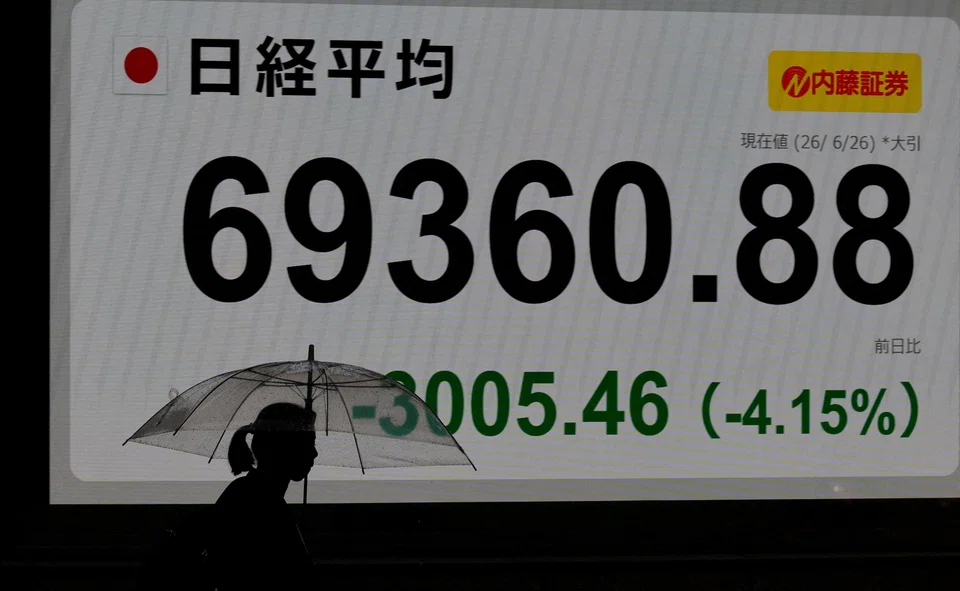
[TOKYO] Japan’s Nikkei share average climbed on Tuesday (Jun 30), powered by a rebound in technology stocks that have helped drive the gauge’s record quarterly gains.
The benchmark Nikkei 225 advanced 0.86 per cent to close at 70,062.32. For the April-June quarter, the index soared 37 per cent, marking its sharpest quarterly advance in data going back to 1965. The broader Topix rose 0.73 per cent to 4,010.88.
The Nikkei’s gains came as US stocks rallied overnight, with the Nasdaq jumping 2.04 per cent on a rebound in major tech-related shares and easing geopolitical concerns after the US and Iran agreed to resume talks.
Japan’s May industrial output, released earlier on Tuesday, rose 0.5 per cent month-on-month, undershooting forecasts but signaling resilience in manufacturing.
The Nikkei was in the red for part of the session, and breadth at the close was mixed, with 104 advancers against 121 decliners.
“While we are seeing a rebound today, centered on certain semiconductor-related stocks and AI-related stocks that had been experiencing notable recent declines, the overall market remains weak,” said Maki Sawada, an equities strategist at Nomura Securities.



The largest percentage gainers in the index were Taiyo Yuden, up 8.28 per cent; Furukawa Electric, up 7.04 per cent; and Screen Holdings, up 6.2 per cent to a record high.
The largest losers were NEC, down 3.01 per cent; Nitori Holdings, down 2.74 per cent; and Konica Minolta, down 2.31 per cent. REUTERS
Decoding Asia newsletter: your guide to navigating Asia in a new global order. Sign up here to get Decoding Asia newsletter. Delivered to your inbox. Free.
Share with us your feedback on BT's products and services
TRENDING NOW

DBS, OCBC, UOB rout lops billions off STI as inflation, rate concerns spook investors

Grab CEO’s wife Chloe Tong on life with Anthony Tan and finding her purpose

OCBC sheds S$8 billion in value as shares close nearly 6% down; analysts cautious on banks

Deal between tycoon friends sparks scrutiny of Philippine power sector

