Japan’s Nikkei sinks on recession fears; benchmark JGB yields hit 27-year high
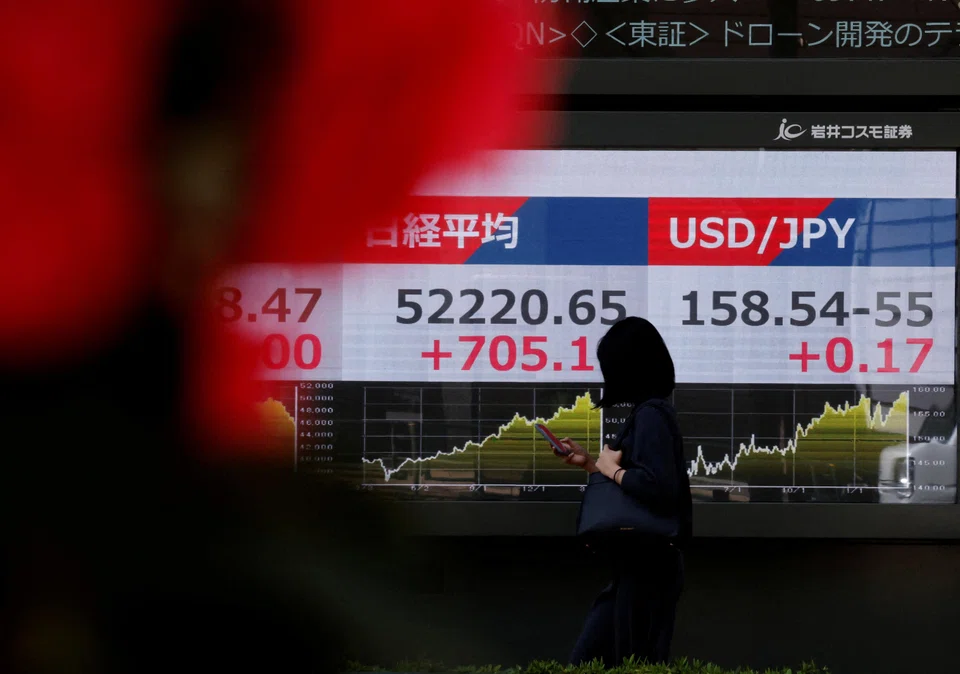
[TOKYO] Japan’s Nikkei share average tumbled on Monday (Mar 30), while benchmark bond yields briefly touched a 27-year high before retreating, as the widening Middle East war fuelled recession concerns.
The Nikkei closed down 2.8 per cent at 51,885.85, having fallen as much as 5.3 per cent earlier in the session before recovering some ground. Japan’s key stock gauge was down nearly 12 per cent for the month so far, on track for its biggest monthly drop since October 2008 at the time of the global financial crisis.
The broader Topix slid 2.9 per cent to 3,542.34 on Monday, after earlier dropping as much as 4.8 per cent.
The benchmark 10-year JGB yield rose to 2.390 per cent, a level not seen since February 1999. It later reversed its course and fell 1.5 basis points to 2.355 per cent. Yields move inversely to bond prices.
“The market is probably now wary not only of inflation and an economic slowdown (from the Middle East situation), but even of a recession. In other words, negative growth – not just a simple slowdown,” said Shingo Ide, chief equity strategist at NLI Research Institute.
On Monday, shorter-term bonds rose after last week’s heavy selloff, as markets grew concerned about the war’s drag on the economy, while longer-term yields extended their rise to a two-month high.
The two-year yield, the one most sensitive to Bank of Japan policy rates, decreased 2 bps to 1.355 per cent. The five-year yield fell 3.5 bps to 1.78 per cent.
On the other hand, the 20-year JGB yield climbed 4.5 bps to 3.305 per cent, while the 30-year yield added 9 bps to 3.790 per cent. The yield on the 40-year JGB, Japan’s longest tenor, rose 10 bps to 4.02 per cent.
There were 17 advancers on the Nikkei index against 207 decliners.



Automaker Mitsubishi Motors led the Nikkei’s decline, losing 7.9 per cent. Chip-testing equipment maker Advantest fell 5.2 per cent, dragging down the index the most. REUTERS
Decoding Asia newsletter: your guide to navigating Asia in a new global order. Sign up here to get Decoding Asia newsletter. Delivered to your inbox. Free.
Share with us your feedback on BT's products and services