

Morgan Stanley trims tech exposure amid tensions, flags S’pore, other Asian defensive winners
There has been a pivot towards AI adopters as beneficiaries
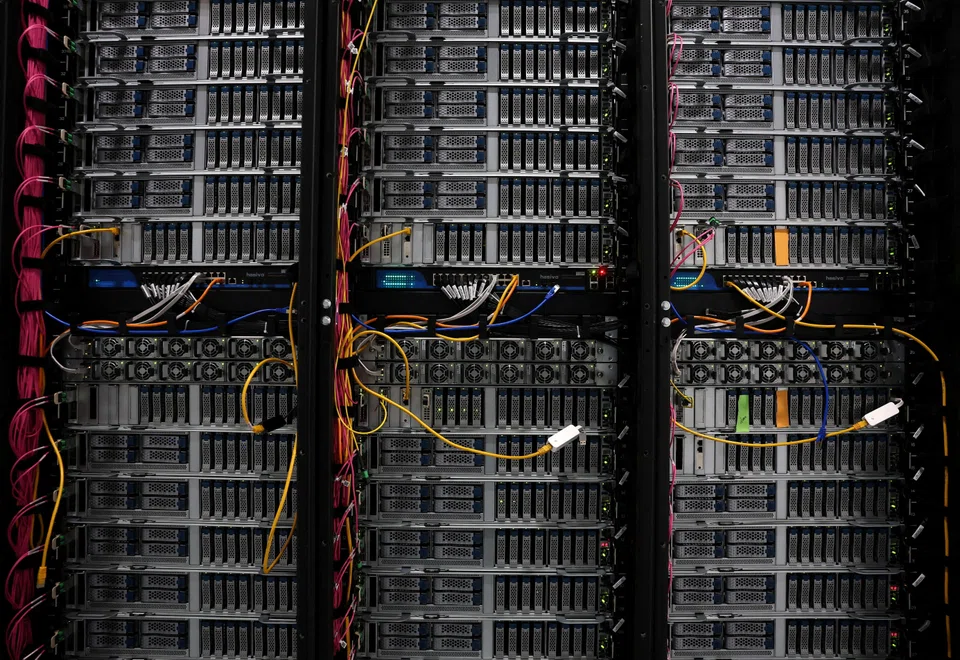
[SINGAPORE] The global artificial intelligence build-out recently has had some headwinds, including the US midterm election results as well as US chip curbs announced last week.
The new US rule restricts shipments of advanced chips to South-east Asian countries such as Malaysia, Singapore and Thailand, which Chinese companies have used to access computing power to train AI models.
Morgan Stanley says that Asean capacity forecasts for data centres and powers are lowered as a result, and that it is a negative for China-linked cloud operators.
“The key bottleneck we see in China remains the ability to produce manufacture compute. That creates greater uncertainty around access to compute and will only reinforce the push for self-sufficiency. For Southeast Asia, I think it will depend on how the industry works through the finer details,” Daniel Blake, Asia equity and thematic strategist, told reporters at a briefing this week. Compute is a term for process power and hardware resources.
But Jonathan Garner, chief Asia and emerging market strategist, sounded an optimistic note at the same briefing.
“Just data-centred capex in Asia generally is not very large within the overall investment theme. Other areas like industrial and energy are much much bigger. So it won’t affect the economic growth outlook very much for the countries in Southeast Asia.”

In the wake of the US midterms, where several Democrat candidates won on the opposition to the data centre build-out, these projects in the US are expected to slow temporarily. That has raised fears on the impact on China’s AI-driven growth as well, said a Bloomberg report.
Winners – or the more defensive – and losers
There are areas of the market that are more defensive amid these geopolitical risks, however.
Morgan Stanley reiterated its overweight positions on Japan and South Korea.

“Japan and (South) Korea... are less impacted by the more restrictive trade and export controls environment… Both offer diversified thematic exposure, including key links into the capex super-cycle, which derives more from industrial, defence and energy investment than AI end-markets,” said Morgan Stanley in a report, by analysts led by Garner.
On the other hand, it is broadly more negative for Taiwan due to heightened US-China tensions, it said.
As for Chinese markets, the bank has a preference for onshore shares, versus offshore and MSCI China shares.
The more restrictive trade environment will affect, to some extent, the business models of key large-cap listed – as well as unlisted – companies that benefited from the use of third-country data centres as part of their AI development strategy, said Morgan Stanley.
The risk premium for foreign investors – in offshore China equities – is also likely raised, amid ongoing US-China trade tensions and tech restrictions, among other factors, it said.
“In contrast, there is a potential benefit for the rapidly growing AI supply chain localisation beneficiaries, mainly listed in the A-share market,” the bank added.
Overall, in terms of less volatile parts of the market, there has been a pivot towards AI adopters as beneficiaries, said Garner, where previously much of the focus was on AI upstream such as semiconductors.
He added that the bank has recently been shifting its recommended focus list stocks towards consumer staples and firms with high free cash flow that can offer “more defensive exposure,” while reducing its overweight position in tech and industrials.
The bank said, however, there is an “increment negative from an investor risk perception” for Singapore, Brazil, Malaysia, Thailand and Indonesia – although it is unlikely to affect the growth outlook.
“The US authorities have specifically identified these countries as representing risk in relation to illegal transhipment of advance chips to China. It is important however to observe that the roll-out of data centres serving US multinationals and hyperscalers is not impacted,” said Morgan Stanley.
But Blake pointed out one theme that is keeping some of these countries afloat in times of heightened risks.
“In parallel, we’re seeing improvements in corporate governance across Japan, South Korea and Singapore, as well as efforts in Thailand and Malaysia to improve governance quality and returns,” he said, naming industrials, defence stocks and companies exposed to sovereign AI.
“Alongside the global AI investment narrative, there is also a corporate reform and reinvestment story that may be underappreciated,” said Blake. “There will certainly be winners and losers, with some markets better positioned than others.”
Singapore is top defensive market
Garner said that amid potential geopolitical and supply chain risks, Singapore stands out as the most defensive market in Asia-Pacific.
“We’ve been structurally very bullish on Singapore, and it has outperformed over the cycle. ROE has improved meaningfully in recent years. Singapore is a AAA-rated sovereign with a large current account surplus and would be highly resilient relative to other countries in an adverse global scenario in 2027, should that materialize,” said Garner.
Decoding Asia newsletter: your guide to navigating Asia in a new global order. Sign up here to get Decoding Asia newsletter. Delivered to your inbox. Free.
Copyright SPH Media. All rights reserved.
TRENDING NOW

LNG, stronger regional power links key to Asean’s energy resilience: Shell

Keppel CEO on telco merger: S$34 million StarHub dividend beats M1’s S$3 million contribution

OCBC opens 100-tonne gold vaulting facility to meet growing institutional demand

As Indonesia picks new vice-president to succeed Gibran, investors see risks and opportunities

