

Panic sweeps South Korean stocks in biggest one-day crash on record
Of more than 800 stocks on the benchmark, only 10 finished in the green
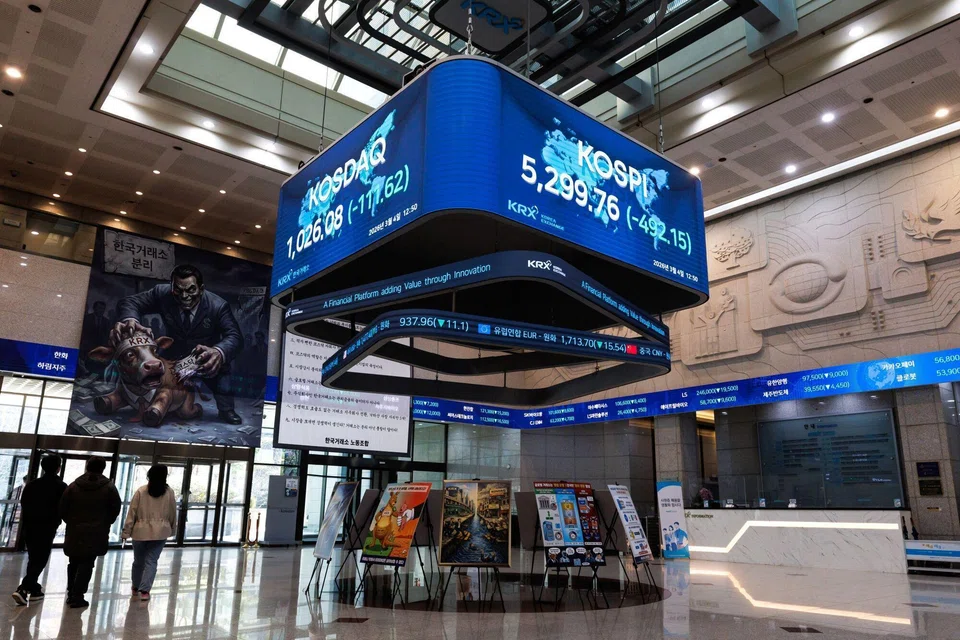
[HONG KONG] Panic swept through South Korea’s trading floors on Wednesday (Mar 4) as concerns over the Middle East war sent the world’s hottest stock market to its biggest-ever sell-off.
The Kospi Index plunged another 12 per cent following a 7.2 per cent drop in the previous session, as heavyweights Samsung Electronics, SK Hynix and Hyundai Motor tumbled. The rout triggered a 20-minute trading halt early in the session. Of more than 800 stocks on the benchmark, only 10 finished in the green.
From Wall Street strategists to mom-and-pop traders, few saw it coming. Optimism on artificial intelligence and the ensuing demand for memory chips was so strong that retail investors were piling in with borrowed money and analysts were raising their already-bullish calls on Korean equities.
Then came the Iran war. While equities worldwide retreated on concern that higher oil prices would stoke inflation, Korea’s losses were exacerbated by a record build-up of margin debt, or borrowed funds for stock buying, before the conflict. Leveraged bets that once magnified gains are now accelerating declines, as heavy borrowing turns into forced liquidation with prices in freefall.
“Moves are too extreme so forecasting feels almost impossible – analysis doesn’t really help,” said An Hyungjin, chief executive officer at Seoul-based billionfold Asset Management. “Retail investors seem to hesitate as well, bids are fading since yesterday. While we’re picking quality names and hedging, this isn’t a clear opportunity.”
The sell-off is a a stark reminder of how swiftly market exuberance can turn into anxiety. Insatiable demand for memory chips and optimism over corporate reforms had helped propel the Kospi up nearly 50 per cent at its peak this year.
Foreign investors ended up net purchasing 231 billion won (S$200 million) worth of Kospi stocks after offloading more than 12 trillion won of holdings over the past two sessions. A key volatility gauge jumped to its highest level since 2008. Even after the swoon, the stock benchmark remains up 21 per cent this year.
There were signs that things were starting to get out of control. Margin debt as well as investor deposits at brokerages surged to new highs as sentiment got overheated, while sceptics questioned the sustainability of a rally driven by a handful of stocks.
“There’s been a lot of buying on credit, especially those heavyweight stocks, with investors putting down only 30 to 40 per cent in margin deposit,” said Kim Dojoon, chief executive and investment officer at Seoul-based Zian Investment Management. Those holdings are seeing forced liquidation, and if there’s another drop on Thursday, nobody will catch a falling knife, he said.
The focus now turns to potential policy measures to stem the slide.
Lee Jae Myung’s administration actively encouraged equity investment, seeing a booming stock market as one way to relieve economic woes ranging from sluggish consumption to a property bubble. Just last week, Lee’s office said the president himself has put his apartment on sale – taking action as top officials encouraged a so-called money move away from real estate into equities.
The government is closely monitoring stock markets and will actively use its 100 trillion won market stabilisation programme in case of excessive market volatility, Financial Services Commission chairman Lee Eog-weon said in a meeting with market experts.
Even with the slide, the benchmark remains above the 5,000 milestone, which was part of President Lee’s campaign slogan.
The macro background has been favourable, with chip shipments buoying exports and consumer sentiment getting a lift from equity gains. Yet economic uncertainties are rising – traders now see two rate hikes by the Bank of Korea on inflation risks.
Energy shares were among those that managed to rise on a bleak day. Daesung Energy, Kukdong Oil & Chemicals and Korea Petroleum Industries all rose about 30 per cent.
This “may create select opportunities to build positions in companies and industries that are now trading at attractive prices,” said Park Sojung, a portfolio manager at Matthews Asia. “Korean industrials such as defence and shipbuilding may again be highlighted as beneficiaries of global instability, constrained supply, and Korea’s growing strategic importance.” BLOOMBERG
Decoding Asia newsletter: your guide to navigating Asia in a new global order. Sign up here to get Decoding Asia newsletter. Delivered to your inbox. Free.
Share with us your feedback on BT's products and services
TRENDING NOW
Easy to rent out, hard to sell: Are buyers losing interest in Singapore’s one-bedroom condos?

GovTech retrenches another 38 staff in second round of layoffs
Stocks to watch: Seatrium, CapitaLand Investment, Keppel DC Reit, Suntec Reit, CLCT, TSH Resources
World’s largest offshore wind platform by Seatrium consortium on track to be completed by 2028

