Private credit interest may turn out to be a tailwind for Tikehau Capital
Asset manager that counts Temasek as shareholder is winning over investors thanks to higher-rate environment and democratisation of private markets

SEVEN years after its listing on the Euronext Paris in 2017, Tikehau Capital may finally be finding its moment.
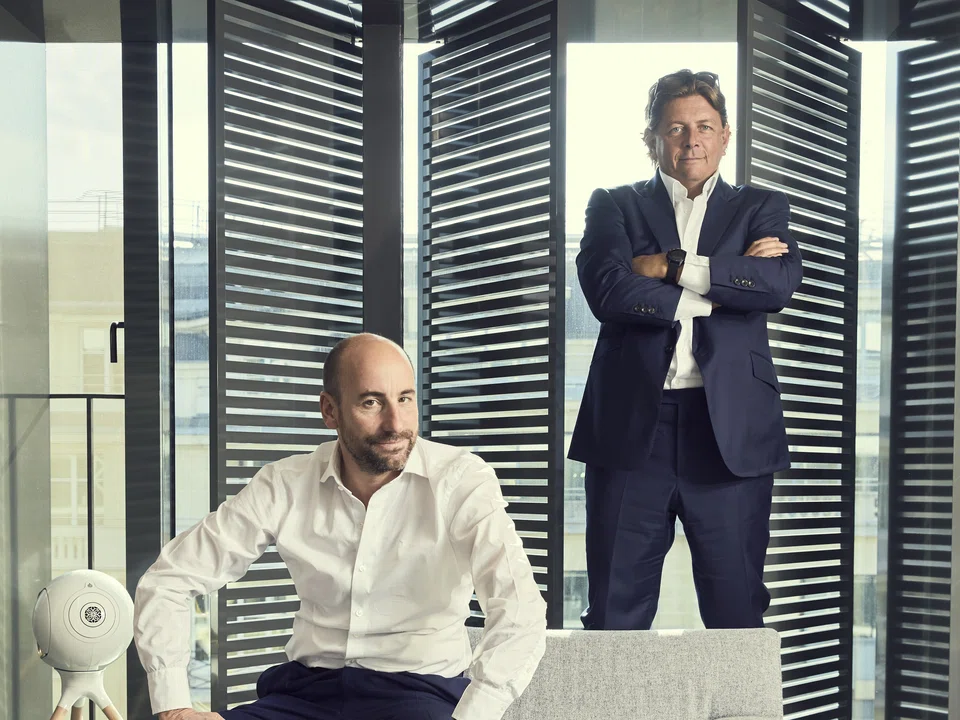
The investment group, founded by former bankers Antoine Flamarion and Mathieu Chabran, is focused on private assets – in particular, the red-hot market of private debt.
Tikehau raised 6.5 billion euros (S$9.4 billion) in net new money last year – 37 per cent more than the average raised annually from 2017 to 2022.
Its assets under management (AUM) climbed 13 per cent to reach 42.8 billion euros at the end of last year. On a compounded basis, AUM has increased 26 per cent annually since 2016.
This fundraising momentum has done little for the stock – shares of Tikehau closed at 21.20 euros on Apr 12, down 0.5 per cent this year.
That’s only slightly above its IPO price of 21 euros per share and below its all-time high of 29 euros in 2018. As private markets attract more investors, however, could its shares also see a rebound?
Credit focus
The rise in global interest rates over the last two years has made private credit attractive.
Eight in 10 investors polled in the EQuilibrium 2024 Global Institutional Investor Survey, commissioned by investment manager Nuveen, said they plan to increase or maintain their allocation to private credit over the next two years.
In Goldman Sachs Asset Management’s 13th Annual Global Insurance Survey, 53 per cent of respondents selected private credit as one of their top five asset classes over the next 12 months.
Part of the attraction lies in the growing demand for private lending. “The public markets are on and off, and you cannot issue bonds,” said Chabran.
At the same time, he believes the current boom in private credit is structural rather than cyclical. Investors like the yields, while companies like the flexibility that private credit often delivers.
Private debt is the largest portion of Tikehau’s AUM, accounting for 42 per cent of AUM as at Dec 31.
Flamarion said Tikehau is comfortable with this ratio for now, and may even increase the size of its private debt business.
“Now that interest rates are higher, it’s been more difficult to borrow money for corporations and leveraged buyouts. So, we feel like credit as a whole is probably one of the best places right now,” he said.
“Sixty-five per cent of the investment of the firm in 2023 was in private credit, so that tells you exactly where we want to put our money. The risk-reward is very good.”
In private assets such as infrastructure, real estate and private equity, he said, returns tend to be back-ended. “When you do private credit, you receive your coupon annually.”
Another trend that is driving Tikehau’s growth is the democratisation of private markets. Roughly a quarter of the money the company manages comes from private investors, Flamarion said.
“Ten years ago, it was only a few high-net-worth individuals who invested in private equity, private debt, real estate and so on,” he said. This has changed, with strong interest in the yield-generating nature of private credit.
Flamarion also noted selective interest in private equity, with a focus on themes such as the energy transition and cybersecurity – industries investors can identify with or feel good about.
Growing pool
As Tikehau’s AUM rises, so have its top and bottom lines. Higher fees and revenues allowed it to raise its dividend by 7 per cent to 0.75 euro per share last year. The company releases its Q1 results on Apr 23.
Tikehau’s large exposure to private debt has allowed it to avoid the fate of several listed peers with larger allocations to the more challenging markets of private equity and real estate.
Blackstone Group, for instance, reported a 1 per cent decline in fee-related earnings for FY2023. Distributable earnings declined 24 per cent.
At Partners Group, management fees – which made up over 80 per cent of revenue – fell 2 per cent. Performance fees increased 37 per cent and accounted for 19 per cent of total revenue, up from 14 per cent in the prior year.
In the private markets space, however, size matters; and Tikehau is still relatively small. Tough market conditions, in particular, tend to push investors towards larger and better-known managers – whether these investors are looking for a money manager, or seeking stock market gains.
As Chabran noted: “You never get fired for investing with Blackstone.”
In the last five years, Blackstone’s shares have gained close to 50 per cent while Tikehau’s have languished.
Flamarion, however, believes momentum takes time to build. Blackstone’s stock did poorly for the first eight years of its listing, he said. “Then suddenly people realise that these businesses are super sexy and super appealing.”
Meanwhile, Chabran added, a public listing has its benefits. “It has helped us dramatically in our brand awareness,” he said. Tapping the public markets via stock and bond issues also gave the co-founders many opportunities to talk to investors.
The next frontier for private credit is Asia, where Tikehau is working to build more ties. It recently announced a tie-up with Singapore brokerage UOB-Kay Hian to launch a fund, and is in discussions with Nikko Asset Management on a strategic partnership.
Flamarion said Tikehau has also been able to tap the network of one of its shareholders – Singapore state investor Temasek – as it expands in the region.
“They have been very good at helping us to grow in Asia,” he said. “They know everybody; they have access to everybody.”