

Regional markets fall as Russia orders strikes on Ukraine
 Add BT as a preferred source
DeeperDive is a beta AI feature. Refer to full articles for the facts.
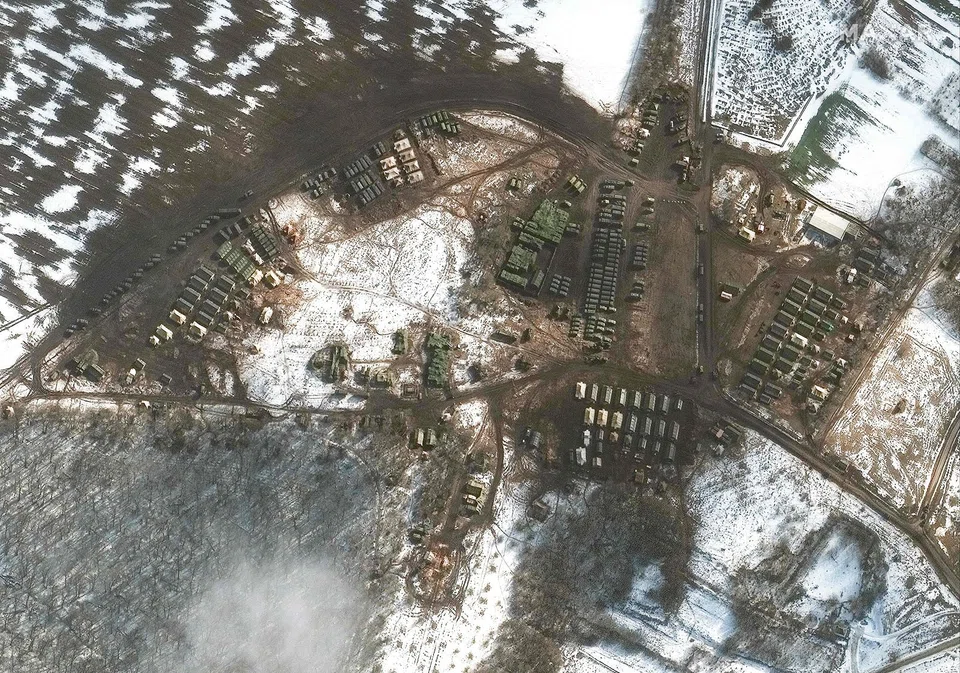
REGIONAL markets fell into negative territory on Thursday (Feb 24), after news broke that Russian President Vladimir Putin had ordered strikes on Ukraine.
When markets opened in Singapore after the midday break, Singapore's Straits Times Index fell 2.9 per cent or 99.85 points to 3,293.15 points as at 1.01 pm.
The trio of local banks all recorded losses, with OCBC falling 4.9 per cent or S$0.61 to S$11.95, DBS sliding 2.7 per cent or S$0.99 to S$35.51, while UOB dropped 4.3 per cent or S$1.39 to S$30.99.
As at 4.17 pm, the STI had fallen 4.1 per cent or 137.71 points to 3,255.29, with all index counters in the red.
Multiple indices across markets in Asia, including Shanghai, Shenzhen, Jakarta, Malaysia and India, also recorded declines.
At the close, Japan's Nikkei closed down 1.8 per cent to its 15-month low at 25,970.82, while South Korea's Kospi ended 2.6 per cent lower at 2,648.8. Hong Kong's Hang Seng Index closed down 3.2 per cent to 22,901.56.
Navigate Asia in
a new global order
Get the insights delivered to your inbox.
Australia's S&P/ASX 200 Index also ended down 3 per cent at 6,990.6, its worst session since Sep 4, 2020.
In the US, Dow futures dropped 600 points after Russia announced its military action, while S&P 500 and Nasdaq 100 equity contracts slid about 2 per cent.
Brent oil prices have also surged above US$100 a barrel for the first time since 2014 as Russia's attack on cities across Ukraine sparked fears of a disruption to the region's critical energy exports.
As for cryptocurrencies, Bitcoin fell as much as 7.4 per cent to US$34,783 after an initial report on Russia's decision. The second-largest token Ether declined as much as 8.7 per cent to US$2,390.61, with other coins including XRP, Cardano and Solana down as well.
US President Joe Biden in a statement condemned the action as an "unprovoked and unjustified attack", and announced he would impose "further consequences" on Russia.
Oanda senior market analyst Jeffrey Halley expects the escalation of the Ukraine situation will likely result in an abrupt leap in energy prices, despite rumours of an Iran nuclear deal that can potentially release 1.5 million barrels per day into global oil markets.
US yields may also fall as investors park their money in the US government debt market, Halley said in a note on Thursday.
"The timing cannot be worse as inflation soars anyway across the world, something that cannot be explained away anymore by 'Covid difficulties' alone," the analyst said.
The situation may also force central banks to halt policy normalisation efforts, which Halley said will likely send the world into a "stagflationary shock", and negatively impact equities, high yield credit, emerging market currencies, anything European and risk sentiment currencies.
Meanwhile, Swissquote senior analyst Ipek Ozkardeskaya warned that the US Federal Reserve may be forced to act more aggressively as rising energy and commodity prices could put further upside pressure on inflation. This would weigh on US equities even though the combined revenue exposure of the S&P 500 to Russia and Ukraine is only about 1 per cent.
"At this point, it's impossible to bet on any scenario. We can only monitor closely the latest developments and stand ready for more volatility," Ozkardeskaya said.
Kelvin Tay, regional chief investment officer at UBS, stressed the importance for investors to "maintain a calm stance and keep a broad perspective". It would also serve them well to build a portfolio robust enough to navigate the Ukraine situation and rising US interest rates, he said.
One way to do this is to have a diversified portfolio. " By diversifying across regions, sectors, and asset classes, investors can reduce their exposure to risks related to the crisis in Ukraine, or to other emergent political risks around the world," said Tay.
Value and cyclical sectors and markets, including energy and financials, should continue to be winners.
In his view, commodities can also be an effective geopolitical hedge for investors.
"Amid the risk of supply disruptions, we think broad commodities can be an effective geopolitical hedge for portfolios, as well as offering an attractive source of returns in an environment of accelerating growth, persistent inflation, and higher rates."
Decoding Asia newsletter: your guide to navigating Asia in a new global order. Sign up here to get Decoding Asia newsletter. Delivered to your inbox. Free.
Copyright SPH Media. All rights reserved.
TRENDING NOW

Autobahn Rent A Car directors declared bankrupt over S$50 million each owed to DBS

Amazon’s MGM Studios gains creative control over ‘James Bond’ franchise

UOB’s Wee Ee Cheong says S$4.9 billion Citi deal ‘paying off’ as Asean push accelerates

In taxing wealth, how far can Singapore push property owners?

