

Ringgit hits year’s high against Singdollar; further gains likely but greenback direction is key
Unit fuelled by strong investment inflows into Malaysia and encouraging follow-through on fiscal policies

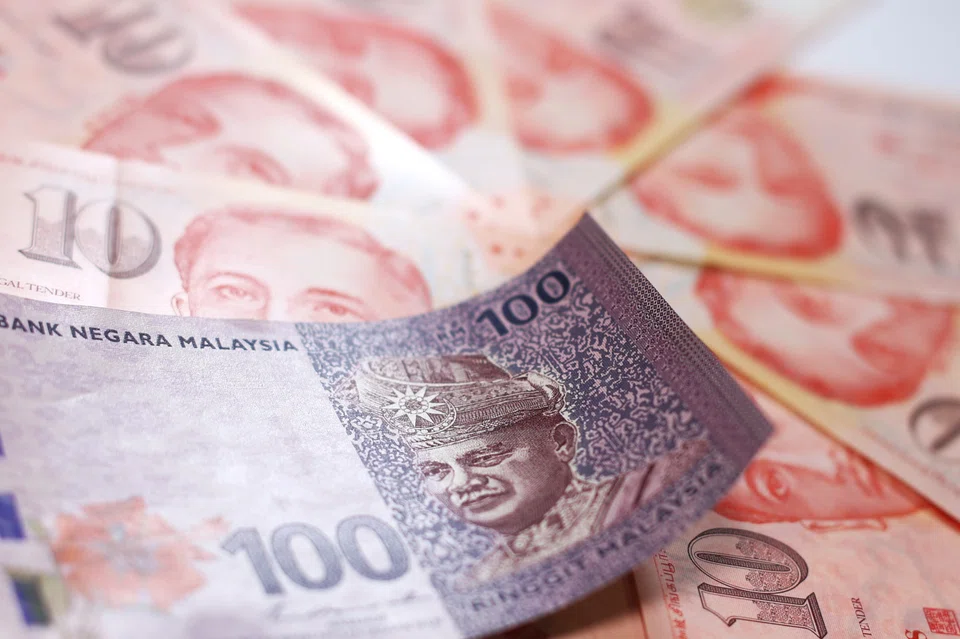
[SINGAPORE] The Malaysian ringgit is on a roll this year.
It has gained about 7 per cent against the US dollar. It broke a 13-month high last week, and has outperformed all other Asian currencies this year.
The currency breached 4.16 against the greenback on Tuesday (Nov 11), hitting 4.159 as at 8.59 am, in a continuation of the strong rally it has had since last week.
The ringgit has also posted significant gains against the Singapore dollar. SGD/MYR stood at around 3.18 on Tuesday, the strongest the ringgit has been against the Singdollar year to date. That represented a slump of nearly 2.8 per cent for the Singdollar-ringgit pair.
Its previous peak against the Singapore currency this year was 3.248 in late January.
As at 10.07 am on Wednesday, USD/MYR was trading at about 4.124, while the Singdollar-ringgit pair was around the 3.157 level.
The ringgit has been unstable and mostly battered the past few years. Since 2022, new lows for the currency have been recorded multiple times. In Feburary last year, SGD/MYR hit an all-time low of 3.5519. In April last year, USD/MYR hit also an all-time low, of 4.7815.
Analysts said this rally is propelled by a powerful combination of strengthening domestic fundamentals and a favourable external environment, particularly a weaker US dollar.
“The outperformance was in line with our favourable outlook for (the ringgit),” said Christopher Wong, FX and rates strategist at OCBC. “Looking ahead, we still see room for (the currency) to stay resilient.”
Broad-based strengthening
He also noted that the ringgit’s strength is broad-based, citing both domestic and external drivers.
“On the domestic front, supportive drivers include quality foreign direct investment inflows, prospects of foreign fund inflows (and a) current account surplus,” he said, adding that “commitment to follow through fiscal consolidation also provides reassurance to foreign investors”.
Externally, the rally is being fanned by a Federal Reserve “easing cycle, a more benign US dollar environment and a relatively steady renminbi”, he noted.
Similarly, Saktiandi Supaat, head of FX research and strategy at Maybank, said that the ringgit’s rally stems from a “combination of external (greenback) softness and, importantly, supportive domestic fundamentals”.
But he noted that external factors were “probably doing slightly more of the heavy lifting”.
Domestically, he cited a mix of “robust bond inflows, resilient growth and policy stability” for the ringgit’s strength.
He pointed to Malaysia’s third-quarter gross domestic product (GDP) growth advance estimate of 5.2 per cent, a predictable framework from the country’s 2026 Budget, and the central bank not being in a hurry to cut rates.
Malaysia’s growth in the third quarter was faster than even the highest estimate in a Bloomberg survey, and had exceeded the pace of expansion in the previous three quarters. Its latest GDP print puts it on track to meet the official forecast of 4 to 4.8 per cent growth this year.
“This has improved confidence in Malaysia’s macro and external position and made the (ringgit) an attractive high-carry, high-beta expression of a softer (US dollar) theme,” he explained.
Meanwhile, Philip Wee, senior FX strategist at DBS, noted that the ringgit’s sharp outperformance against the Singdollar in late October was also “event-led”.
For example, Malaysia hosting the Asean Summit from Oct 26 to 28 “enhanced the country’s appeal as a China Plus One investment destination”, he said.
Furthermore, the ringgit – which has been highly correlated with the renminbi since both were de-pegged from the US dollar in 2005 – was anchored by a stronger Chinese currency heading into the Oct 30 meeting between US President Donald Trump and China’s President Xi Jinping.
That meeting resulted in a one-year extension of the US-China trade truce, boosting sentiment.
Bullish forecasts against the greenback
Analysts are forecasting further gains for the ringgit against the US dollar.
DBS projects a USD/MYR rate of 4.17 for the fourth quarter of 2025, and OCBC expects 4.16 for the end of the year.
Maybank is even more bullish, with Supaat seeing USD/MYR grinding lower to 4.10 by end-2025, 4.05 in Q1 2026, and 4.00 from Q2 next year.
He noted the technical picture is consistent with this, as USD/MYR “has made a clean break below the key 4.18 to 4.20 support”.
Analysts split on Singdollar cross-rate
However, while analysts are aligned on the ringgit’s strength against the greenback, they are divided on how it will fare versus the Singdollar.
The SGD/MYR cross-rate has been falling steadily. OCBC’s Wong said this was expected, as the Monetary Authority of Singapore (MAS) already eased its policy in the first half of 2025.
This “pointed to a more modest and gradual appreciation path” for the Singdollar, just as the ringgit’s own recovery gathered steam, he said. He sees interim support for SGD/MYR at the 3.18 to 3.20 level.
DBS’ Wee noted that the MYR/SGD rate needs to overcome a “major resistance around 0.315” before it can move into a higher trading range of 0.32 to 0.34.
While the outlook for the ringgit remains robust, given that the recent outperformance was event-led, Wee said that “caution is warranted against extrapolating excessive gains” by the ringgit against the Singdollar.
In contrast, Maybank’s Supaat expects SGD/MYR to rebound from its current lows.
“One of our top trade ideas is to be long SGD/MYR,” he said, noting there is room for recovery towards a range of 3.24 to 3.27. He expects the cross to end 2025 at around 3.24, and 2026 at 3.20.
While the ringgit has outperformed in the year to date, the Singdollar’s “safe-haven characteristics and still-positive MAS policy slope should allow the cross to recover off the recent lows rather than trend materially lower”, he added.
Possible downside risks
As for downside risks to the Malaysian currency’s rally, analysts are looking outwards. The main threats are external and US dollar-centric, said Supaat.
Greenback strength could re-emerge, he warned, “if global growth slows more sharply due to (second-order) tariff effects, if US inflation re-accelerates and forces the Fed to stay hawkish for longer, or if risk sentiment sours and triggers a renewed rush into (US dollar-denominated) safe-haven assets”.
He added: “A more disorderly China slowdown, renewed trade tensions or a reversal in global bond inflows would also challenge the current Asean FX outperformance, including” that of the ringgit.
“Our house view is that (ringgit) strength is fundamentally justified, but not one-way: We still see room for appreciation towards 4.10 and eventually 4.00 on USD/MYR, but with two-way risks and the potential for temporary setbacks if the global (US dollar) narrative swings back.”
TRENDING NOW

First Resources blames El Nino, outside fires for Kalimantan hotspots amid haze scrutiny

High Court rules against Julius Baer’s Singapore trust arm in US$50 million family trust dispute

Singapore key exports jump by higher-than-expected 68.4% in September, led by non-electronics

MSCI proposes downgrading Indonesia to standalone market status

