

Seoul: 10-year treasury yield hits 8-year high; stocks fall
 Add BT as a preferred source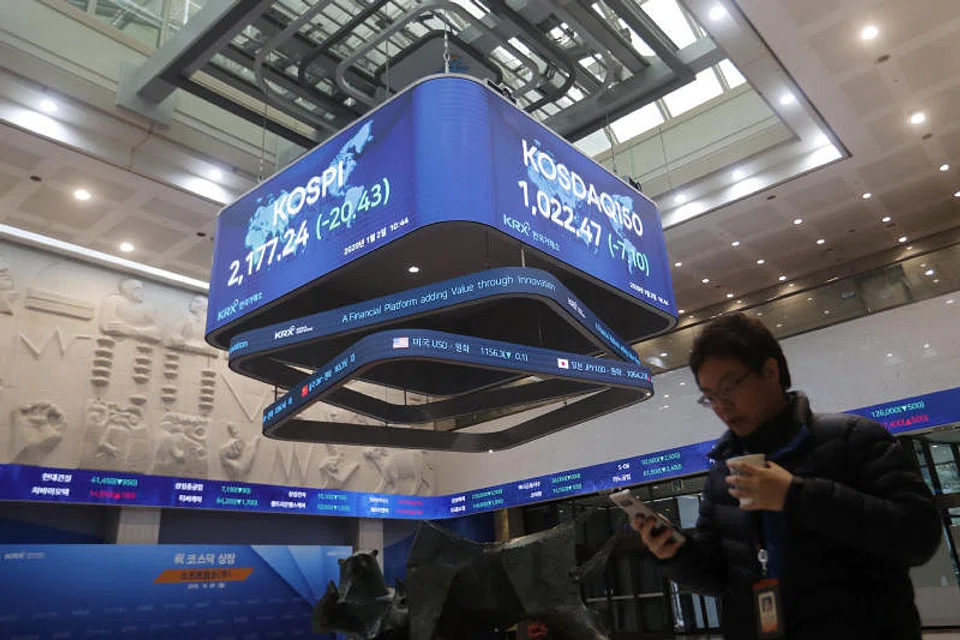
DeeperDive is a beta AI feature. Refer to full articles for the facts.
[SEOUL] South Korea's treasury yields surged to hit fresh multi-year highs on Monday (Apr 11) on bets of faster monetary tightening at home and abroad, while expectations of additional bond issuance for a supplementary budget plan also weighed.
South Korea's benchmark 10-year treasury bond yield rose as much as 13 basis points to 3.297 per cent, the highest level since June 2014.
The most liquid 3-year treasury bond yield also jumped, by 17.4 basis points to 3.159 per cent, a level not seen since June 2013.
The Bank of Korea (BOK), one of the more aggressive central banks in Asia in tightening policy, has raised its benchmark interest rate by a total of 75 basis points to 1.25 per cent since August. Analysts see further rises to 2 per cent by the end of this year.
BOK chief nominee Rhee Chang-yong on Sunday emphasised stabilisation of household debt as an "urgent task".
South Korea's incoming president, Yoon Suk-yeol, on Sunday named Choo Kyung-ho, a conservative lawmaker, to be deputy prime minister and finance minister. The country is facing surging inflation, household debt and demand for welfare.
Navigate Asia in
a new global order
Get the insights delivered to your inbox.
Choo, as a member of the presidential transition committee, has been working to draw up a supplementary budget plan to support small businesses and self-employed people who have been affected by Covid.
Elsewhere, US Treasury yields hit multi-year highs after the Federal Reserve's latest meeting minutes signalled faster monetary tightening.
Sentiment in the South Korean bond market has been negatively affected by issues around surging inflation, US monetary policy outlook and supplementary budget plan, said Kyobo Securities' fixed-income analyst Paik Yoon-min.
June futures on 3-year treasury bonds fell 0.58 point to 104.67 and futures on 10-year bonds dropped 1.05 points to 113.951 in late afternoon trade.
In the stock market, the benchmark Kospi closed down 7.29 points, or 0.27 per cent, at 2,693.10 as China's faster-than-expected inflation data added to inflation concerns.
Among heavyweight stocks, technology giant Samsung Electronics gained 0.15 per cent but peer SK Hynix fell 0.45 per cent, while battery maker LG Energy Solution dropped 3.3 per cent.
The won closed trading at 1,233.1 per dollar on the onshore settlement platform, 0.65 per cent lower than its previous close at 1,225.1. REUTERS
Decoding Asia newsletter: your guide to navigating Asia in a new global order. Sign up here to get Decoding Asia newsletter. Delivered to your inbox. Free.
Share with us your feedback on BT's products and services
TRENDING NOW

Ministry of Home Affairs Permanent Secretary Pang Kin Keong to retire

Shelving S$5 billion office redevelopment plan proved ‘wise’ as geopolitical risks mount: OCBC chairman

Richard Eu on how core values, customers keep Singapore’s TCM chain Eu Yan Sang relevant

China pips the US if Asean is forced to choose, but analysts warn against reading it like a sports result

