

Seoul: Shares end at over 2-year low as auto, battery stocks weigh
 Add BT as a preferred source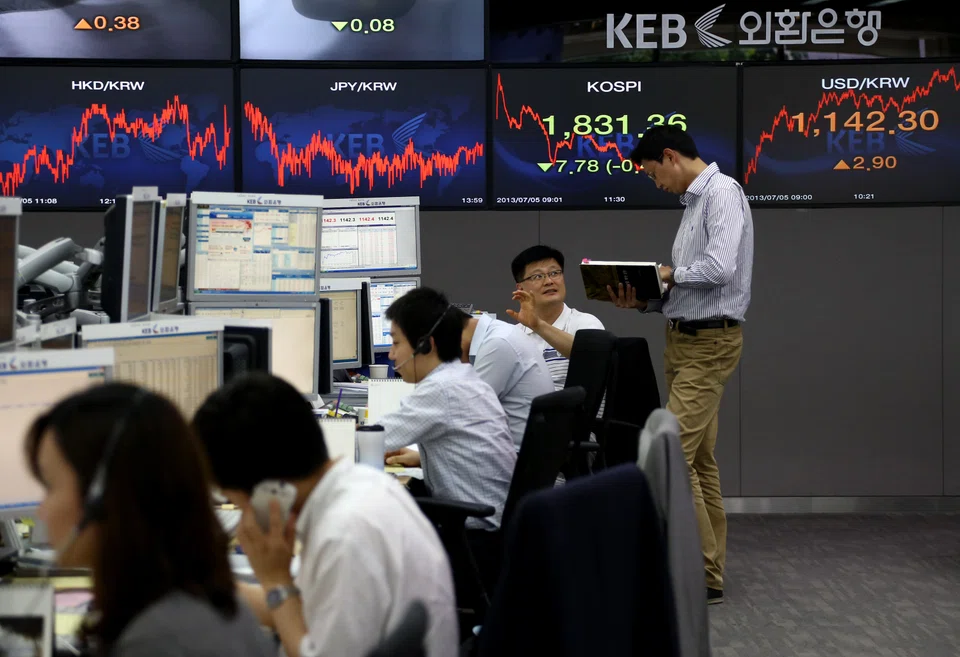
DeeperDive is a beta AI feature. Refer to full articles for the facts.
SOUTH Korean shares on Friday (Sep 30) closed at their lowest in more than 2 years, as automakers and electric-vehicle battery manufacturers slid, with the benchmark index marking its first monthly decline in 3.
The won strengthened, while the benchmark bond yield dropped.
The benchmark Kospi ended down 15.44 points or 0.71 per cent at 2,155.49 – the lowest close since Jul 10, 2020.
The index shed 5.9 per cent for the week, the biggest since mid-June. For the month, it dropped 12.8 per cent, the first decline in 3, and 7.6 per cent for the quarter, the fifth in a row.
South Korean President Yoon Suk-yeol on Friday called for more sense of urgency in dealing with heightened volatility in financial markets.
“Auto stocks, which had been comparatively solid amid macroeconomic uncertainties, slumped on heightened worries about weaker demand and dragged the index lower,” said Choi Yoo-june, an analyst at Shinhan Financial Investment.
Navigate Asia in
a new global order
Get the insights delivered to your inbox.
Losses were the sharpest for automakers and electric vehicle battery manufacturers that tracked US peers’ weakness overnight.
Hyundai Motor and Kia lost 2.75 per cent and 3.49 per cent respectively, while LG Energy Solution fell 3.07 per cent, Samsung SDI dropped 3.53 per cent, and SK Innovation declined 1.71 per cent.
Foreigners were net buyers of shares worth 162.6 billion won (S$162.6 million) on the main board.
The won was last quoted at 1,430.2 per dollar on the onshore settlement platform, up 0.61 per cent.
The currency weakened 1.46 per cent for the week, the eighth in a row, 6.47 per cent for the month, the biggest in 11 years, and 9.22 per cent for the quarter, also the fastest since the third quarter of 2011.
In money and debt markets, December futures on 3-year treasury bonds rose 0.36 point to 101.88.
FTSE Russell said it may add South Korea to its world bond index, paving the way for a potentially huge boost in capital inflows to the country.
The most liquid 3-year Korean treasury bond yield fell by 10.9 basis points to 4.214 per cent, while the benchmark 10-year yield fell by 11.8 basis points to 4.109 per cent. REUTERS
Decoding Asia newsletter: your guide to navigating Asia in a new global order. Sign up here to get Decoding Asia newsletter. Delivered to your inbox. Free.
Share with us your feedback on BT's products and services
TRENDING NOW
Shelving S$5 billion office redevelopment plan proved ‘wise’ as geopolitical risks mount: OCBC chairman
Why where you park your joint venture matters: Lessons from a US$689 million shareholder dispute

China pips the US if Asean is forced to choose, but analysts warn against reading it like a sports result
Singaporeans can now buy record amount of yen per Singdollar

