Seoul: Stocks end near 6-week low on inflation, growth concerns
 Add BT as a preferred source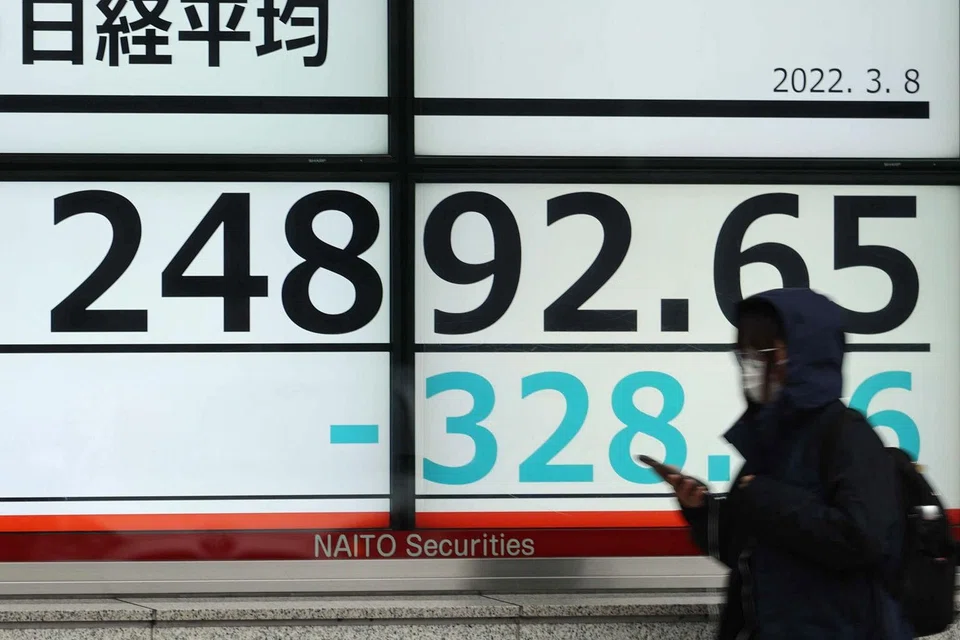
DeeperDive is a beta AI feature. Refer to full articles for the facts.
[SEOUL] South Korean shares closed at a near 6-week low on Tuesday (Mar 8), extending the sell-off to a third session, as surging commodity prices heightened worries about inflation and a slowdown in global economic growth.
The Korean won weakened to its lowest since May 2020, while the benchmark bond yield rose.
The benchmark Kospi closed down 28.91 points or 1.09 per cent at 2,622.40, the lowest since Jan 27. It will be closed for trading on Wednesday for presidential election.
Among heavyweights, chip giants Samsung Electronics and SK Hynix fell 0.86 per cent and 1.26 per cent, respectively, while LG Chem fell 2.14 per cent.
A Western ban on Russian oil imports may further push up oil prices, which have already hit 14-year highs, while Moscow warned that the price can more than double to US$300 a barrel and it might close the main gas pipeline to Germany as a retaliation.
"Concerns about Russia-Ukraine war and stagflation continued ... There is caution (because) of a 50 basis point rate hike (by the Federal Reserve) in May should oil price pressure persists," said Huh Jae-hwan, an analyst at Eugene Investment & Securities.
Navigate Asia in
a new global order
Get the insights delivered to your inbox.
Foreigners were net sellers of 472.8 billion won (S$521.4 million) worth of shares on the main board.
The won ended at 1,237 per dollar on the onshore settlement platform, the lowest since May 29, 2020 and 0.80 per cent lower than its previous close.
In offshore trading, the won was quoted at 1,238.2 per dollar, down 0.5 per cent from the previous day, while in non-deliverable forward trading, its 1-month contract was quoted at 1,238.6.
In money and debt markets, March futures on 3-year treasury bonds was unchanged at 107.92, while the 3-month Certificate of Deposit rate was quoted at 1.50 per cent in late afternoon trade.
The most liquid 3-year Korean treasury bond yield fell by 0.3 basis point to 2.286 per cent, while the benchmark 10-year yield rose by 1.1 basis points to 2.718 per cent. REUTERS
Decoding Asia newsletter: your guide to navigating Asia in a new global order. Sign up here to get Decoding Asia newsletter. Delivered to your inbox. Free.
Share with us your feedback on BT's products and services