

Seoul: Stocks fall more than 1%, post worst month since March 2020
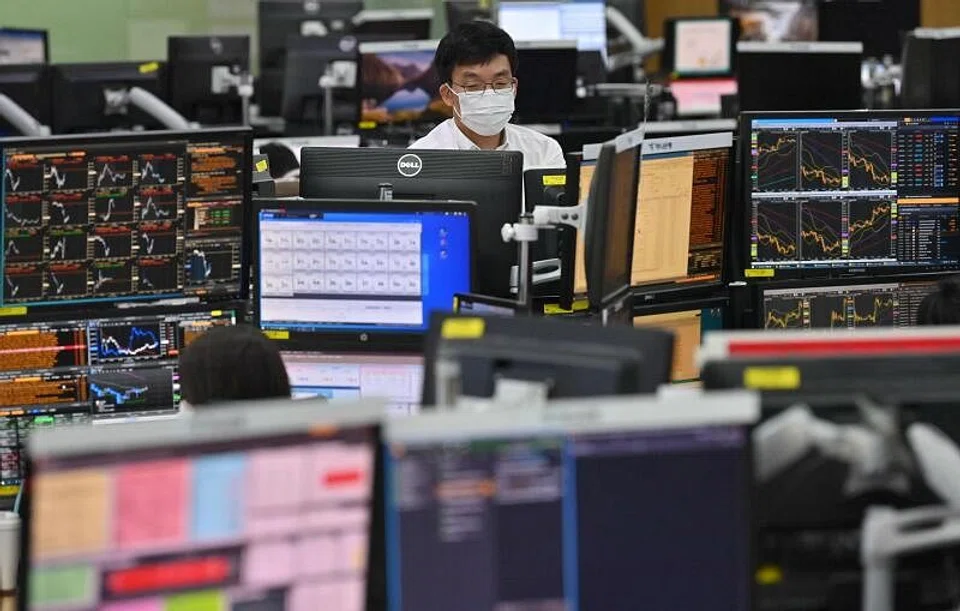
[SEOUL] South Korean shares tumbled more than 1 per cent on Friday, and posted its worst monthly decline in more than a year, weighed by continued worries about the Chinese government's regulatory crackdown and the Covid-19 pandemic.
Both the won and the benchmark bond yield also fell.
The Kospi ended down 40.33 points or 1.24 per cent at 3,202.32, its sharpest daily fall in more than two months. The index ended the month down 2.86 per cent, its sharpest monthly decline since March last year, and snapped an eight month winning streak.
Asian peers also slumped, with the benchmark Hang Seng index declining near 2 per cent. A resurgence in Covid-19 cases in mainland China also weighed on sentiment.
At home, South Korea reported 1,710 new cases for Thursday, still near the record infections marked this week, even after the country imposed the toughest distancing measures in the metropolitan Seoul area and some neighbouring cities.
Chip giants Samsung Electronics and SK Hynix fell 0.63 per cent and 1.32 per cent, respectively, leading benchmark declines, while internet giant Naver also dropped 1.37 per cent.
Foreigners were net sellers of 710.4 billion won (S$836.1 million) worth of shares on the main board.
Meanwhile, Friday's data showed South Korea's factory output in June rebounded from May on a boost in semiconductor and car production.
The won ended at 1,150.3 per dollar on the onshore settlement platform, 0.33 per cent lower than its previous close at 1,146.5.
It ended the month down 2.10 per cent at its sharpest pace since January.
In offshore trading, the won was quoted at 1,149.3 per dollar, down 0.5 per cent from the previous day, while in non-deliverable forward trading its one-month contract was quoted at 1,149.6.
In money and debt markets, September futures on three-year treasury bonds rose 0.08 point to 110.26.
REUTERS
Decoding Asia newsletter: your guide to navigating Asia in a new global order. Sign up here to get Decoding Asia newsletter. Delivered to your inbox. Free.
Share with us your feedback on BT's products and services
TRENDING NOW
Can a first-time homebuyer couple earning S$18,000 a month afford a new EC unit?

He built the Vingroup empire. Now South-east Asia’s richest man is handing some key roles to his sons

Asia needs new energy security architecture
Chagee, Mixue and Luckin won the market. Sustaining their edge is the harder part

