

Seoul: Stocks hit record high, financials and techs rally
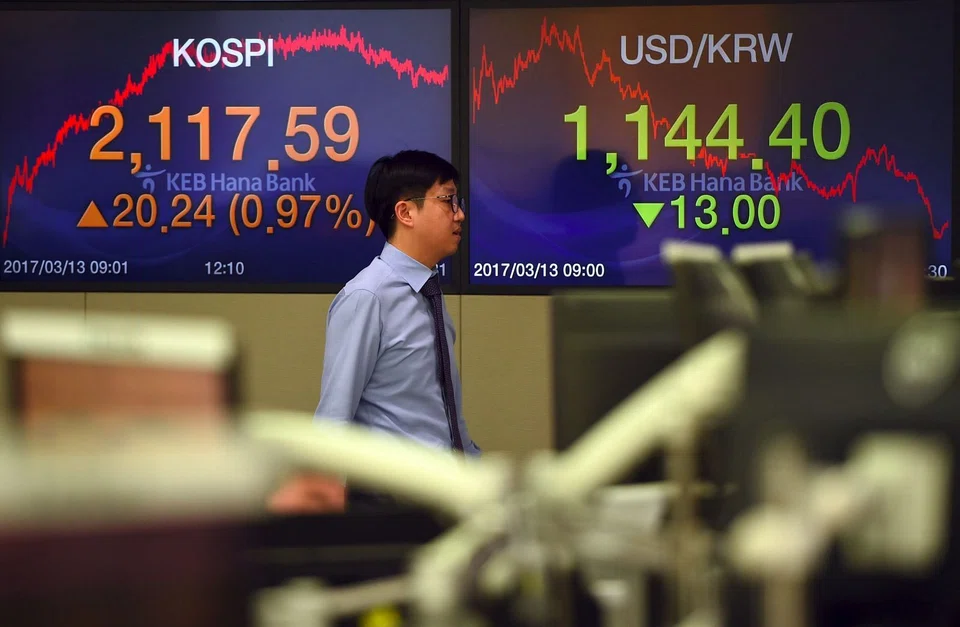
[SEOUL] South Korean shares bounced on Thursday morning and scaled record highs, as tech and financial shares were boosted by a solid performance in their US counterparts overnight.
The Korea Composite Stock Price Index (Kospi) was up 0.7 per cent at 2,398.10 points as of 0226 GMT after touching 2,402.80, a record intraday high.
"Huge gains among bank and tech shares in the United States are largely pulling up local counterparts as well," said Kim Ji-Hyung, a stock analyst at Hanyang Securities.
The sub-index for major finance shares climbed over 2 per cent with Hana Financial Group up 4.2 per cent, while electric and electronics shares rose nearly one per cent.
Mr Kim said signs of a switch toward more tighter monetary conditions in advanced countries could hurt market sentiment occasionally, but fairly solid domestic fundamentals should underpin stocks.
The Bank of England and the Bank of Canada turned more hawkish on policy on Wednesday, while European Central Bank President Mario Draghi opened the door to trimming the ECB's stimulus.
Advancing stocks outnumbered declining ones 435 to 345.
The South Korean won rose against the US dollar thanks to foreign stock purchases, edging up 0.4 per cent at 1,139.2 compared to Wednesday's close of 1,144.0.
Offshore investors were poised to be net buyers, purchasing 45.4 billion Korean won (S$55.06 million) worth of Kospi shares near mid-session.
September futures on three-year treasury bonds gained 0.01 point to 109.28.
REUTERS
Share with us your feedback on BT's products and services
TRENDING NOW

One-third of Singapore-listed firms at risk in severe AI downturn: MAS

‘We don’t want to stay as we are’: CEO Patrick Ng builds a more resilient Huationg

He built the Vingroup empire. Now South-east Asia’s richest man is handing some key roles to his sons

Radiant World table shows six lenders with US$870 million exposure

