

Seoul: Won gains as authorities seen stepping up; stocks fall
 Add BT as a preferred source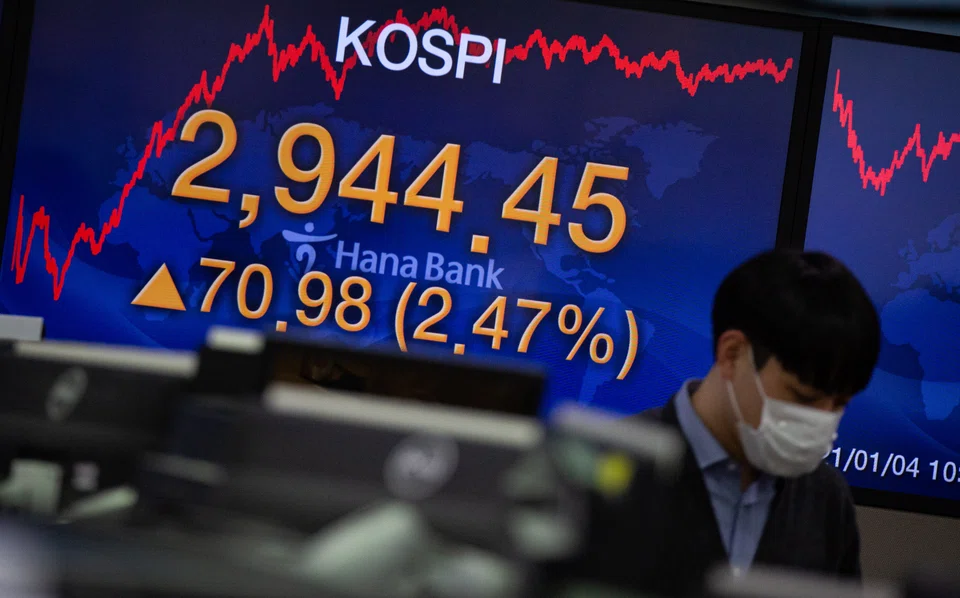
SOUTH Korean shares closed lower on Friday (Sep 16), on heightened prospects of aggressive US monetary tightening, but the won reversed early losses to end higher as authorities appeared to make an all-out effort to defend the psychological 1,400-mark.
The benchmark Kospi index closed down 19.05 points or 0.79 per cent at 2,382.78, extending losses to a third session and posting a fifth weekly loss of 0.06 per cent.
The won ended its onshore trade 0.41 per cent higher at 1,388 per dollar, after opening the session at 1,399 to touch the weakest level since Mar 31, 2009. The currency still ended the week down 0.52 per cent, a sixth weekly loss in a row.
US retail sales unexpectedly rebounded in August and weekly jobless claims fell, data showed overnight, providing support to views that the Federal Reserve would keep tightening its monetary policy aggressively. Amid the US dollar’s strength near its 2-decade peak, neighbouring China’s yuan breached below its own psychological threshold of 7 per dollar for the first time in 2 years.
Facing all the headwinds, the won opened the session lower, just an inch short of hitting the 1,400 level for the first time in 13 1/2 years. But, it sharply recovered losses near the end of the session to turn stronger, with the country’s foreign exchange authorities seen selling dollars heavily for a second day.
“The authorities were seen to intervene really aggressively today,” said a local foreign exchange (FX) dealer. The FX authorities had been suspected of selling dollars in the previous session as well, with the won recovering much losses to end only slightly weaker, after issuing an official verbal warning.
Separately, the finance ministry plans to meet with major exporters and importers early next week to prepare market stabilising measures.
So far this month, the won has weakened 3.6 per cent against the dollar, at a faster pace than the Japanese yen and the Chinese yuan that are down 3.2 per cent and 1.7 per cent, respectively. The US dollar index has added 1.1 per cent.
The won breached 1,300 mark in late June, after falling below 1,200 in mid-October last year, which had been levels seen only during economic crises and thus considered to be psychologically “big figures”.
In the bond market, South Korea’s treasury bond yields fell in late afternoon trade, with the yield of most liquid 3-year bonds down 2.1 basis points to 3.754 per cent and the benchmark 10-year yield down 3.4 basis points to 3.757 per cent. REUTERS
Decoding Asia newsletter: your guide to navigating Asia in a new global order. Sign up here to get Decoding Asia newsletter. Delivered to your inbox. Free.
Share with us your feedback on BT's products and services
TRENDING NOW

ComfortDelGro’s Zig to buy S$10 million worth of BYD cars for private-hire fleet

From sales executive to DBS chairman: A look at banking veteran Peter Seah’s career

Japan Home licenses Singapore retail stores to Valu$ owner Radha Exports

Japan Home closing outlets; staff say Valu$ taking over operations

