

SGX H1 profit up at S$342.7 million as revenue hits record; steps up push to lure Chinese listings
Adjusted net profit for the half-year period stands at S$357.1 million, an 11.6% increase

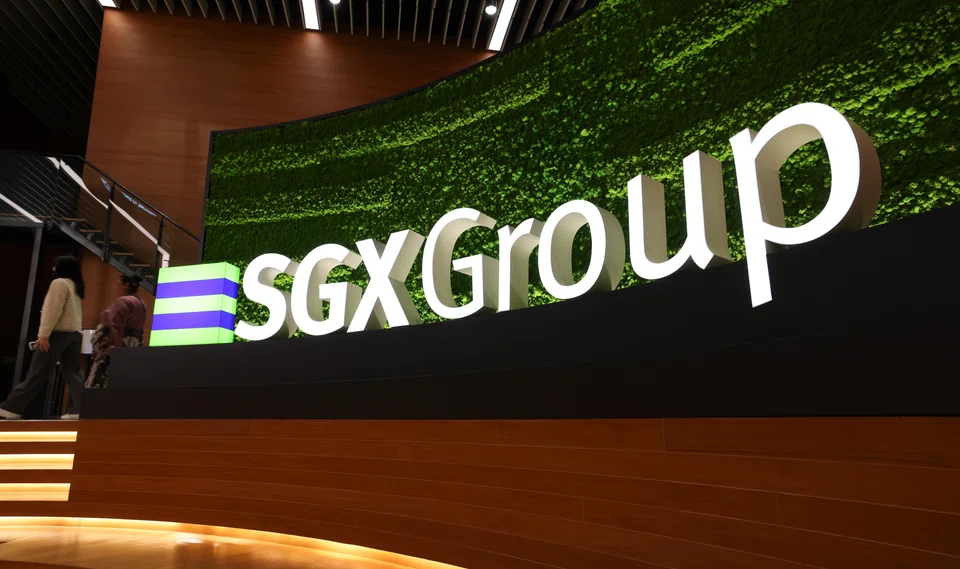
[SINGAPORE] The Singapore Exchange (SGX) posted a 0.8 per cent rise in net profit for its first half ended Dec 31, 2025, to S$342.7 million, from S$340 million for the corresponding period a year earlier.
“Trading activity has broadened across sectors, driving higher turnover beyond the Straits Times Index (STI) and contributing to a more balanced liquidity profile across the market,” said Loh Boon Chye, chief executive officer of the bourse operator, at its financial results briefing on Thursday (Feb 5). “Notably, interest in mid-cap and growth-oriented companies rose significantly, with institutional investors recording net purchases of S$415 million in small and mid-cap stocks over the year,” he added.
This was partly boosted by last September’s launch of the iEdge Singapore Next 50 Index, which tracks the next 50 largest companies beyond the STI constituents.
SGX’s earnings before interest, taxes, depreciation and amortisation for H1 grew 9.6 per cent on the year to S$466.1 million from S$425.3 million.
Earnings per share (EPS) for the half-year period stood at S$0.32, up from S$0.318 for the first half of financial year 2025.
After adjusting for certain non-cash and non-recurring items that have less bearing on SGX’s operating performance, its net profit would have risen 11.6 per cent to S$357.1 million, and its EPS would have been S$0.334.
SGX’s board of directors has declared an interim quarterly dividend of S$0.11 a share, up from the S$0.09 a share payout in the previous corresponding period. This brings total dividends in H1 FY2026 to S$0.2175 a share.
The interim quarterly dividend will be paid on Feb 24.
Revenue for H1 increased 7.9 per cent to S$736.2 million, from S$682.2 million in the previous corresponding period. This was the group’s highest revenue for a half-year, but it missed analysts’ forecasts.
SEE ALSO


Excluding transaction-based expenses such as processing and royalty fees, net revenue would have risen 7.6 per cent to S$695.4 million, from S$646.4 million in the year-ago period.
Healthier IPO outlook
Market liquidity also benefited from stronger initial public offering (IPO) activity, noted Loh. SGX led South-east Asia in terms of IPO funds, with nearly S$3 billion raised.
“Looking ahead, our IPO pipeline continues to strengthen, with a healthier outlook compared with six months ago,” said Loh.
He noted that more than 30 companies were identified as being part of SGX’s IPO pipeline last August. Of that number, 18 have since listed.
This pipeline has grown further since then, Loh added, with more companies now engaging advisers and working towards potential listings on SGX. The exchange now expects the pipeline to remain active, and aims to outperform the previous year.
Pol de Win, head of global sales and origination at SGX Group, noted that the newly announced Global Listing Board (GLB) has broadened SGX’s reach by attracting companies that may not previously have considered Singapore as a listing destination.
He added that the bourse operator has attracted interest from various sectors, ranging from technology, healthcare and consumer businesses to digital infrastructure and real estate, with this mix already reflected in transactions in the last six to eight months.
Speaking to The Business Times, de Win noted that the improvement in the IPO pipeline comes despite the seasonality typically seen in IPO activity, with the first quarter of the calendar year often quieter as companies prepare their full-year financial statements.
“Overall, as we continue to look at that sort of medium-term window, we are very confident,” he added.
De Win, who had previously described 2025 as a transitional year, said that there was a clear shift in market conditions between July and December last year.
He added that regional supply dynamics remain supportive, with many companies in Asia seeking liquidity for shareholders and capital for growth.
Initiatives rolled out following the Equities Market Review, including regulatory changes, the deployment of Equity Market Development Programme funds, and the introduction of the GLB, are expected to meaningfully improve the listing environment, he noted.
Separately, Loh said that SGX expects to announce the formation of the Equity Market Implementation Committee and its plans in the coming weeks. The committee will oversee the implementation of the recommendations of the Equities Market Review Group.
As SGX prepares to launch the GLB later this year, the exchange is noting earlier engagement from high-growth, new-economy companies, he noted. This is broadening the pipeline and reshaping the profile of prospective listings.
In response to a query, Loh said that SGX hopes “to get the GLB up and running by the middle of this year”.
Alongside efforts to attract companies with an “Asian nexus” and access to Asian and global investor bases, he noted that under the GLB, the bourse is also seeking to draw companies from China.
In this regard, the Monetary Authority of Singapore and the China Securities Regulatory Commission have expressed support for Chinese corporates, or “A-share” companies, to pursue secondary listings in Singapore.
“There is now a clear fundraising pathway for eligible Shanghai and Shenzhen-listed companies to raise capital on SGX while maintaining their ‘A-share’ obligations,” said Loh.
Thilan Wickramasinghe, head of research at Maybank Securities, asked for an update on another recently announced initiative, the Value Unlock Programme, including the number of companies that have signed up and when results might be announced.
In response, Ng Yao Loong, SGX’s head of equities, said that since the programme’s official launch in mid-January, it has attracted around 100 companies, or roughly one-sixth of listed companies on SGX.
“The response has been quite encouraging,” he added.
Upbeat about the future
Commenting on the results for H1, Loh noted that the group’s performance was driven by sustained growth across its multi-asset business.
“We remain confident in delivering medium-term revenue growth of 6 to 8 per cent alongside sustainable shareholder returns,” he said.
He added that securities daily average traded value rose 20 per cent year on year to S$1.51 billion – the highest in five years.
The bourse operator noted that expense and capital expenditure guidance for FY2026 remain unchanged at a 4 to 6 per cent increase and S$90 million to S$95 million, respectively. It also reiterated its confidence in delivering a S$0.0025 a share quarterly dividend increase until the end of FY2028.
SGX shares fell 0.6 per cent or S$0.11 to close at S$17.64, after the news.
Decoding Asia newsletter: your guide to navigating Asia in a new global order. Sign up here to get Decoding Asia newsletter. Delivered to your inbox. Free.
Copyright SPH Media. All rights reserved.
TRENDING NOW

Grab CEO’s wife Chloe Tong on life with Anthony Tan and finding her purpose
Brokers maintain ‘buy’ on CDL despite investor reservations over strategic review

Deal between tycoon friends sparks scrutiny of Philippine power sector

Hwa Seng Builder, two China companies win S$1.2 billion Tuas Road Viaduct phase two contracts

