Singapore shares edge higher despite losses in local banks; STI up 0.1%
CapitaLand Investment leads gainers on Singapore’s blue-chip index
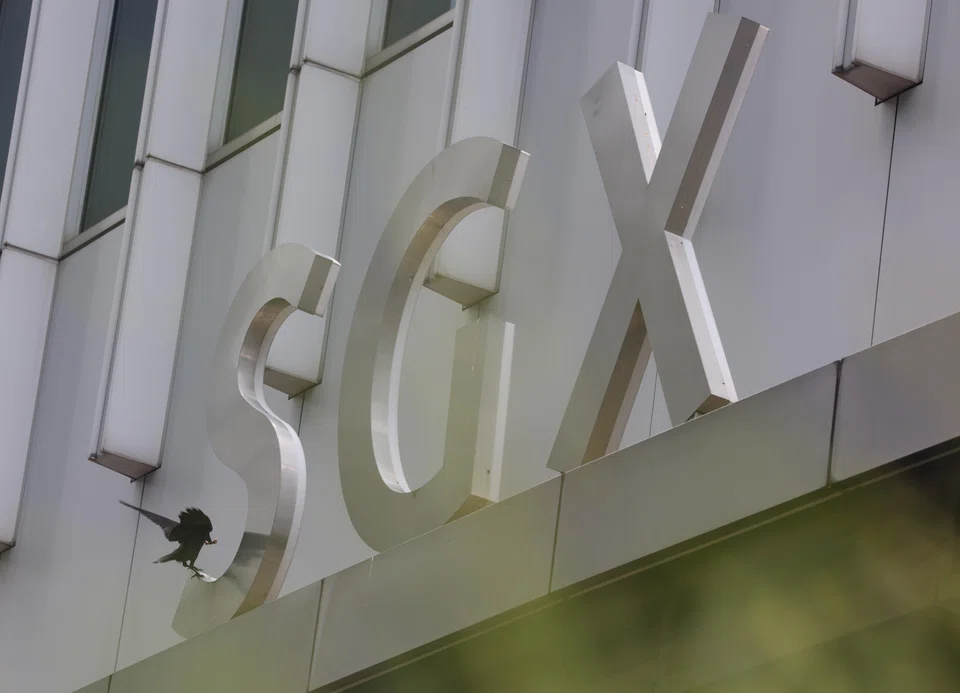
[SINGAPORE] Singapore stocks ended higher on Friday (Oct 23). The benchmark Straits Times Index (STI) gained 0.1 per cent or 7.02 points to finish at 5,422.16.
CapitaLand Investment led the gainers on Singapore’s blue-chip index, rising 3.9 per cent or S$0.09 to S$2.40.
The worst performer among STI constituents was Yangzijiang Shipbuilding , which fell 1.6 per cent or S$0.08 to S$4.88.
The local banks all ended lower. DBS lost S$0.13 or 0.2 per cent to S$74.44, OCBC fell S$0.05 or 0.2 per cent to S$29, and UOB was down S$0.29 or 0.7 per cent to S$41.59.
Within the iEdge Singapore Next 50 Index, Top Glove was the top gainer, rising 5.5 per cent or S$0.015 to S$0.29, while UMS Integration was the biggest decliner, falling 3.6 per cent or S$0.08 to S$2.14.
Across the broader market, gainers outnumbered losers 331 to 258, after 1.3 billion securities worth S$1.8 billion changed hands.
Addvalue Tech was the most actively traded stock with 71.8 million shares changing hands. DBS was the most actively traded stock in terms of value, with a volume of 2.7 million shares and a value of S$197.6 million.
Key regional indices were mixed. Hong Kong’s Hang Seng Index gained 0.7 per cent, Japan’s Nikkei 225 fell 0.3 per cent, South Korea’s Kospi was up 0.3 per cent and the FTSE Bursa Malaysia KLCI advanced 0.2 per cent.
Investors will be watching the US Federal Reserve’s monetary policy decision on Oct 29 amid heightened volatility in technology stocks.

Barnabas Gan, group chief economist and head of market research at RHB Bank, warned of risks from excessive valuations in the technology sector, pointing to recent sell-offs in artificial intelligence-related stocks.
He also noted signs of investors pivoting towards safe-haven assets, with the yield on the benchmark 10-year US Treasury falling below 5 per cent.
This article was written with the assistance of AI and reviewed by a reporter
Decoding Asia newsletter: your guide to navigating Asia in a new global order. Sign up here to get Decoding Asia newsletter. Delivered to your inbox. Free.
Share with us your feedback on BT's products and services